Whittington Hannah J, McAndrew Debra J, Cross Rebecca L, Neubauer Stefan, Lygate Craig A
Division of Cardiovascular Medicine, Radcliffe Department of Medicine. Wellcome Trust Centre for Human Genetics, University of Oxford, Oxford, United Kingdom.
PLoS One. 2016 Jan 14;11(1):e0146429. doi: 10.1371/journal.pone.0146429. eCollection 2016.
Ischaemic heart disease is most prevalent in the ageing population and often exists with other comorbidities; however the majority of laboratory research uses young, healthy animal models. Several recent workshops and focus meetings have highlighted the importance of using clinically relevant models to help aid translation to realistic patient populations. We have previously shown that mice over-expressing the creatine transporter (CrT-OE) have elevated intracellular creatine levels and are protected against ischaemia-reperfusion injury. Here we test whether elevating intracellular creatine levels retains a cardioprotective effect in the presence of common comorbidities and whether it is additive to protection afforded by hypothermic cardioplegia.
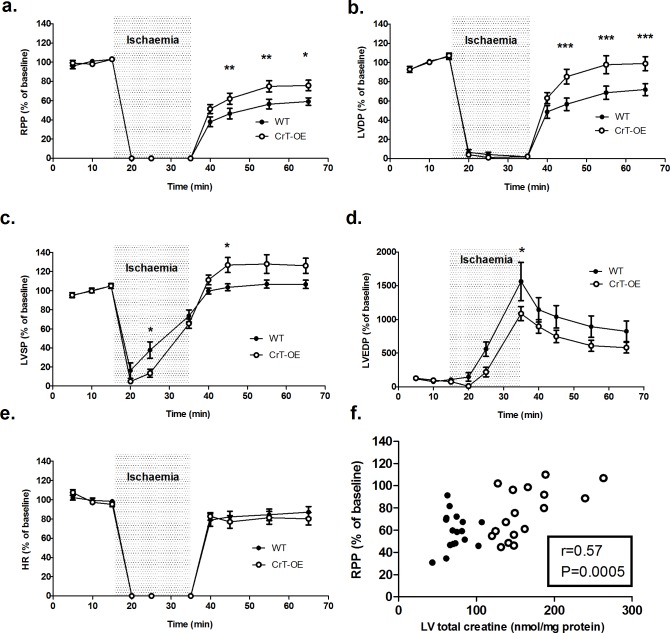
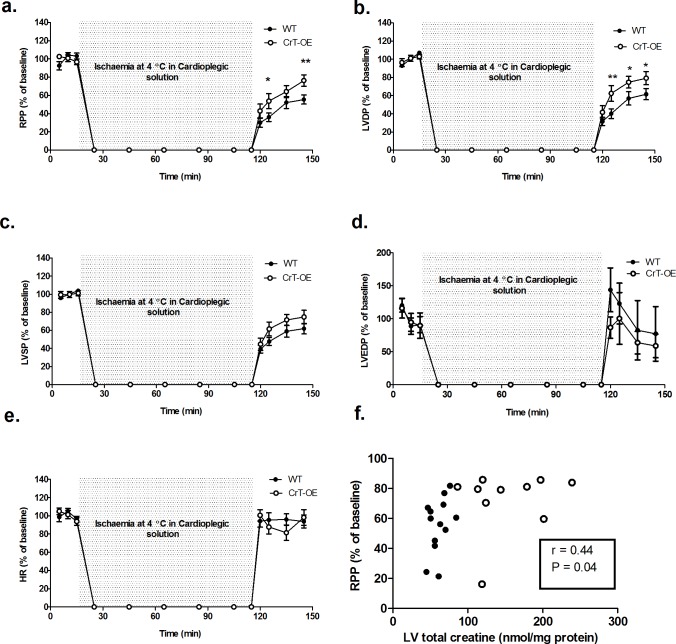
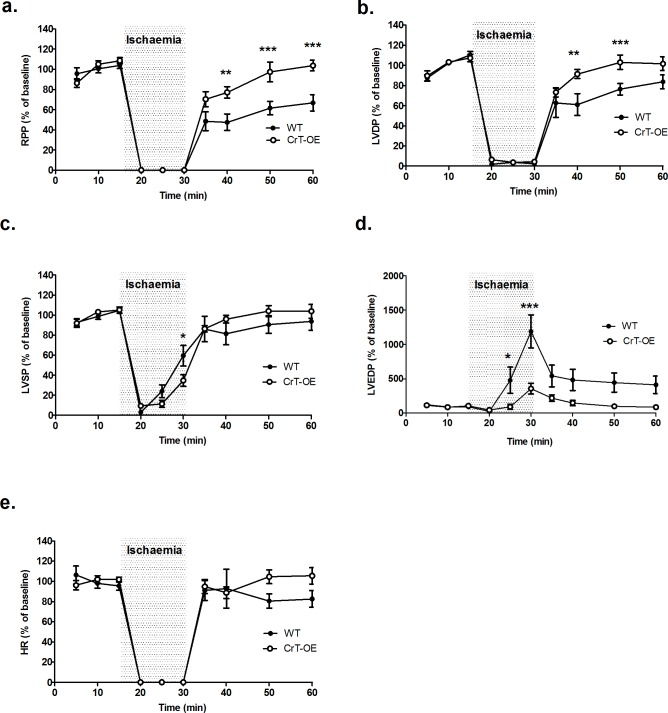
CrT-OE mice and wild-type controls were subjected to transverse aortic constriction for two weeks to induce compensated left ventricular hypertrophy (LVH). Hearts were retrogradely perfused in Langendorff mode for 15 minutes, followed by 20 minutes ischaemia and 30 minutes reperfusion. CrT-OE hearts exhibited significantly improved functional recovery (Rate pressure product) during reperfusion compared to WT littermates (76% of baseline vs. 59%, respectively, P = 0.02). Aged CrT-OE mouse hearts (78±5 weeks) also had enhanced recovery following 15 minutes ischaemia (104% of baseline vs. 67%, P = 0.0007). The cardioprotective effect of hypothermic high K+ cardioplegic arrest, as used during cardiac surgery and donor heart transplant, was further enhanced in prolonged ischaemia (90 minutes) in CrT-OE Langendorff perfused mouse hearts (76% of baseline vs. 55% of baseline as seen in WT hearts, P = 0.02).
These observations in clinically relevant models further support the development of modulators of intracellular creatine content as a translatable strategy for cardiac protection against ischaemia-reperfusion injury.
缺血性心脏病在老年人群中最为普遍,且常与其他合并症并存;然而,大多数实验室研究使用的是年轻、健康的动物模型。最近的几次研讨会和焦点会议强调了使用临床相关模型以帮助向实际患者群体转化的重要性。我们之前已经表明,过表达肌酸转运体的小鼠(CrT - OE)细胞内肌酸水平升高,并能免受缺血再灌注损伤。在此,我们测试在存在常见合并症的情况下提高细胞内肌酸水平是否仍具有心脏保护作用,以及它是否与低温心脏停搏所提供的保护作用相加。
对CrT - OE小鼠和野生型对照进行为期两周的主动脉缩窄,以诱导代偿性左心室肥厚(LVH)。心脏在Langendorff模式下逆行灌注15分钟,随后缺血20分钟,再灌注30分钟。与野生型同窝小鼠相比,CrT - OE心脏在再灌注期间表现出显著改善的功能恢复(速率压力乘积)(分别为基线的76%和59%,P = 0.02)。老年CrT - OE小鼠心脏(78±5周)在缺血15分钟后也有增强的恢复(基线的104%对67%,P = 0.0007)。在心脏手术和供体心脏移植中使用的低温高钾心脏停搏的心脏保护作用,在CrT - OE Langendorff灌注小鼠心脏的长时间缺血(90分钟)中进一步增强(基线的76%,而野生型心脏为基线的55%,P = 0.02)。
在临床相关模型中的这些观察结果进一步支持了将细胞内肌酸含量调节剂开发为一种可转化的策略,用于心脏保护以对抗缺血再灌注损伤。