White William B, Cuadra René H, Lloyd Eric, Bakris George L, Kupfer Stuart
aDivision of Hypertension and Clinical Pharmacology, Calhoun Cardiology Center, University of Connecticut School of Medicine, Farmington, Connecticut bClinical Science, Takeda Development Center, Deerfield cASH Comprehensive Hypertension Center, University of Chicago Medicine, Chicago, Illinois, USA.
J Hypertens. 2016 Apr;34(4):788-97. doi: 10.1097/HJH.0000000000000839.
Angiotensin receptor blockers (ARBs) are preferred antihypertensive therapies in patients with type 2 diabetes mellitus (T2DM). Azilsartan medoxomil (AZL-M) is a potent ARB for the treatment of stages 1-2 hypertension. We compared the efficacy, safety, and metabolic effects of AZL-M to both valsartan (VAL) and olmesartan (OLM), separately in patients with impaired fasting glucose (prediabetes mellitus) and T2DM.
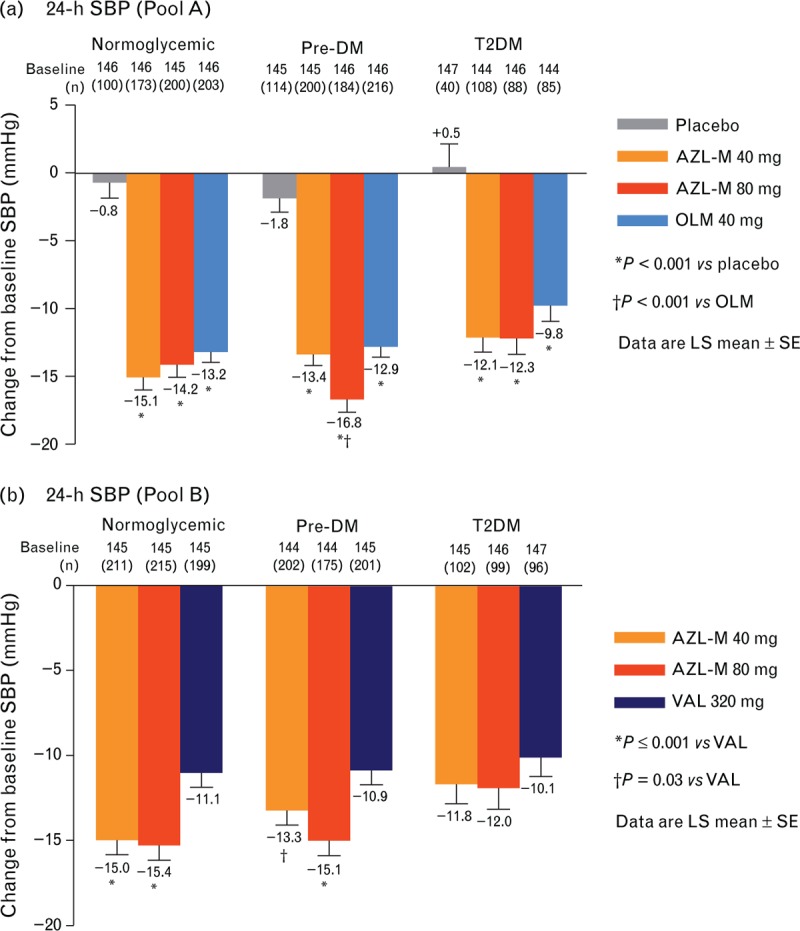
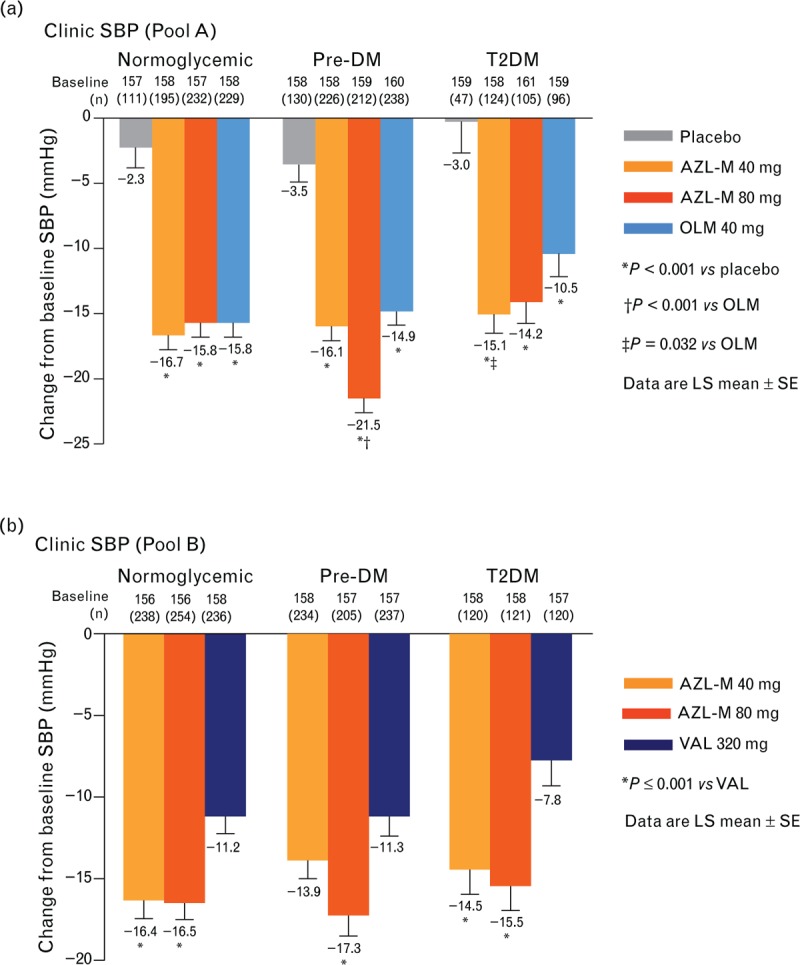
A pooled analysis of 3821 patients from three separate randomized placebo-controlled trials comparing the effects of AZL-M (40 and 80 mg), OLM (40 mg), VAL (320 mg), and placebo on changes in ambulatory and clinic blood pressure (BP) among patients with hypertension and prediabetes mellitus or T2DM was performed. Two analysis pools were created to facilitate comparisons: Pool A included patients who received placebo, AZL-M or OLM and Pool B included those who received AZL-M or VAL. Within each pool, patients were stratified by glycemic subgroups (normoglycemic, prediabetes mellitus, or T2DM) based on hemoglobin A1c values. Changes from baseline in both 24-h and clinic SBP were the primary efficacy assessments.
Baseline 24-h mean SBPs were approximately 145 and 146 mmHg in the prediabetes mellitus and T2DM subgroups, respectively; corresponding clinic SBPs were approximately 158 and 159 mmHg. Baseline hemoglobin A1c values for each subgroup (both pools) were normoglycemic, 5.3%; prediabetes mellitus, 6.0%; and T2DM, 6.9%. Changes from baseline in 24-h or clinic SBP were significantly greater with AZL-M, 80 mg compared with either OLM 40 mg or VAL 320 mg in all subgroups in each pool. Safety and tolerability were similar among the active treatment and placebo subgroups.
These analyses indicate that AZL-M, 80 mg/day lowers SBP by a greater magnitude than OLM or VAL at maximally approved doses in patients with prediabetes mellitus and T2DM. These findings have important clinical implications for this high-risk patient group.
血管紧张素受体阻滞剂(ARBs)是2型糖尿病(T2DM)患者首选的抗高血压治疗药物。阿齐沙坦美索米酯(AZL-M)是一种有效的ARB,用于治疗1-2期高血压。我们分别比较了AZL-M与缬沙坦(VAL)和奥美沙坦(OLM)在空腹血糖受损(糖尿病前期)患者和T2DM患者中的疗效、安全性及代谢影响。
对三项独立的随机安慰剂对照试验中的3821例患者进行汇总分析,比较AZL-M(40和80mg)、OLM(40mg)、VAL(320mg)和安慰剂对高血压合并糖尿病前期或T2DM患者动态血压和诊室血压(BP)变化的影响。创建了两个分析组以方便比较:A组包括接受安慰剂、AZL-M或OLM的患者,B组包括接受AZL-M或VAL的患者。在每个组内,根据糖化血红蛋白值将患者按血糖亚组(血糖正常、糖尿病前期或T2DM)分层。24小时和诊室收缩压(SBP)相对于基线的变化是主要疗效评估指标。
糖尿病前期和T2DM亚组的基线24小时平均SBP分别约为145和146mmHg;相应的诊室SBP分别约为158和159mmHg。每个亚组(两组)的基线糖化血红蛋白值为血糖正常者5.3%;糖尿病前期者6.0%;T2DM者6.9%。在每个组的所有亚组中,与40mg的OLM或320mg的VAL相比,80mg的AZL-M使24小时或诊室SBP相对于基线的变化显著更大。活性治疗组和安慰剂组的安全性和耐受性相似。
这些分析表明,在糖尿病前期和T2DM患者中,每天80mg的AZL-M比最大批准剂量的OLM或VAL能更大程度地降低SBP。这些发现对这一高危患者群体具有重要的临床意义。