Chen Yingying, Sheng Jiayuan, Jiang Tao, Stevens Joseph, Feng Xueyang, Wei Na
Department of Civil and Environmental Engineering and Earth Sciences, University of Notre Dame, 106E Cushing Hall of Engineering, Notre Dame, South Bend, IN 46556 USA.
Department of Biological Systems Engineering, Virginia Polytechnic Institute and State University, Blacksburg, VA USA.
Biotechnol Biofuels. 2016 Jan 13;9:9. doi: 10.1186/s13068-015-0418-5. eCollection 2016.
Lignocellulosic biomass is a promising source of renewable biofuels. However, pretreatment of lignocellulosic biomass generates fermentation inhibitors that adversely affect the growth of industrial microorganisms such as Saccharomyces cerevisiae and prevent economic production of lignocellulosic biofuels. A critical challenge on developing S. cerevisiae with improved inhibitor resistance lies in incomplete understanding of molecular basis for inhibitor stress response and limited information on effective genetic targets for increasing yeast resistance to mixed fermentation inhibitors. In this study, we applied comparative transcriptomic analysis to determine the molecular basis for acetic acid and/or furfural resistance in S. cerevisiae.
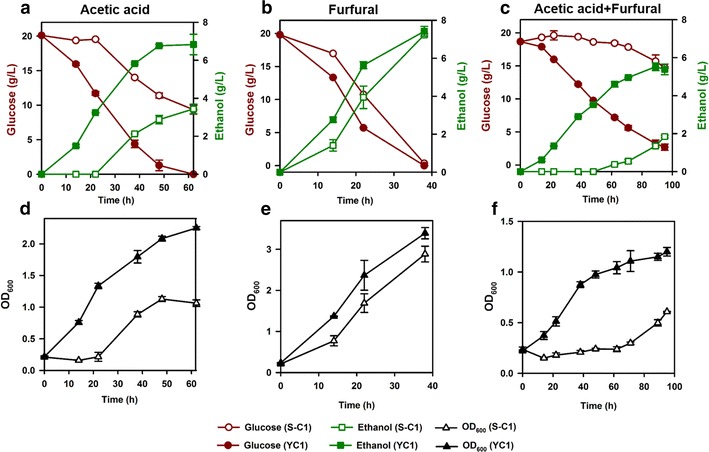
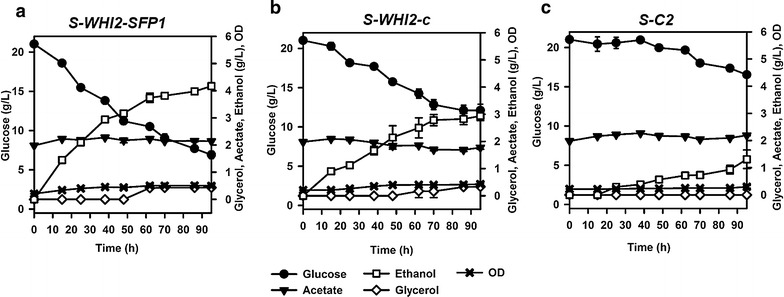
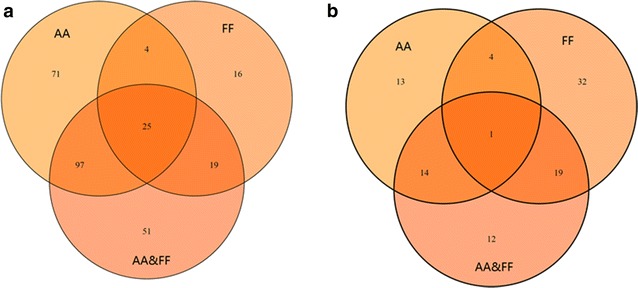
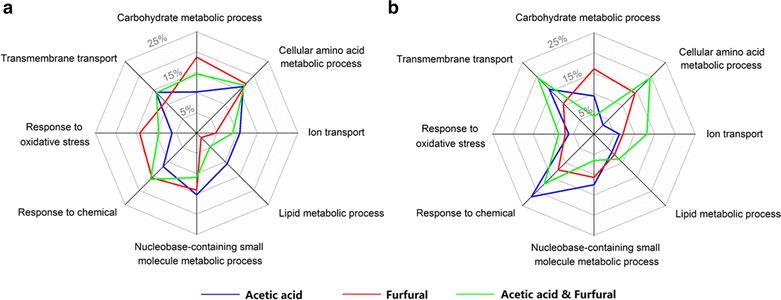
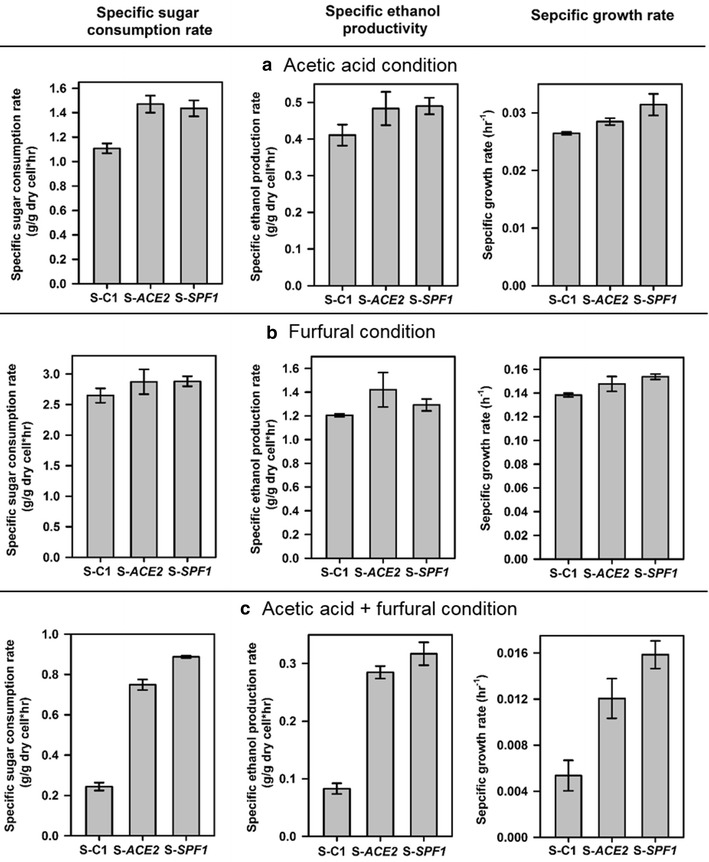
We recently developed a yeast strain YC1 with superior resistance to acetic acid, furfural, and their mixture through inverse metabolic engineering. In this study, we first determined transcriptional changes through RNA sequencing in YC1 versus the wild-type strain S-C1 under three different inhibitor conditions, including acetic acid alone, furfural alone, and mixture of acetic acid and furfural. The genes associated with stress responses of S. cerevisiae to single and mixed inhibitors were revealed. Specifically, we identified 184 consensus genes that were differentially regulated in response to the distinct inhibitor resistance between YC1 and S-C1. Bioinformatic analysis next revealed key transcription factors (TFs) that regulate these consensus genes. The top TFs identified, Sfp1p and Ace2p, were experimentally tested as overexpression targets for strain optimization. Overexpression of the SFP1 gene improved specific ethanol productivity by nearly four times, while overexpression of the ACE2 gene enhanced the rate by three times in the presence of acetic acid and furfural. Overexpression of SFP1 gene in the resistant strain YC1 further resulted in 42 % increase in ethanol productivity in the presence of acetic acid and furfural, suggesting the effect of Sfp1p in optimizing the yeast strain for improved tolerance to mixed fermentation inhibitor.
Transcriptional regulation underlying yeast resistance to acetic acid and furfural was determined. Two transcription factors, Sfp1p and Ace2p, were uncovered for the first time for their functions in improving yeast resistance to mixed fermentation inhibitors. The study demonstrated an omics-guided metabolic engineering framework, which could be developed as a promising strategy to improve complex microbial phenotypes.
木质纤维素生物质是一种很有前景的可再生生物燃料来源。然而,木质纤维素生物质的预处理会产生发酵抑制剂,这些抑制剂会对酿酒酵母等工业微生物的生长产生不利影响,并阻碍木质纤维素生物燃料的经济生产。开发具有更高抑制剂抗性的酿酒酵母面临的一个关键挑战在于对抑制剂应激反应的分子基础理解不完整,以及关于提高酵母对混合发酵抑制剂抗性的有效遗传靶点的信息有限。在本研究中,我们应用比较转录组分析来确定酿酒酵母对乙酸和/或糠醛抗性的分子基础。
我们最近通过逆向代谢工程开发了一种对乙酸、糠醛及其混合物具有卓越抗性的酵母菌株YC1。在本研究中,我们首先通过RNA测序确定了在三种不同抑制剂条件下,即单独的乙酸、单独的糠醛以及乙酸和糠醛混合物条件下,YC1与野生型菌株S-C1之间的转录变化。揭示了酿酒酵母对单一和混合抑制剂应激反应相关的基因。具体而言,我们鉴定出184个共有基因,它们因YC1和S-C1之间不同的抑制剂抗性而受到差异调节。接下来的生物信息学分析揭示了调控这些共有基因的关键转录因子(TFs)。鉴定出的顶级TFs,即Sfp1p和Ace2p,作为菌株优化的过表达靶点进行了实验测试。SFP1基因的过表达使特定乙醇生产率提高了近四倍,而ACE2基因的过表达在存在乙酸和糠醛的情况下使速率提高了三倍。抗性菌株YC1中SFP1基因的过表达在存在乙酸和糠醛的情况下进一步使乙醇生产率提高了42%,这表明Sfp1p在优化酵母菌株以提高对混合发酵抑制剂的耐受性方面的作用。
确定了酵母对乙酸和糠醛抗性的转录调控。首次发现了两个转录因子Sfp1p和Ace2p在提高酵母对混合发酵抑制剂抗性方面的功能。该研究展示了一个组学指导的代谢工程框架,可将其开发为改善复杂微生物表型的一种有前景的策略。