Pereira Susana R, Sànchez I Nogué Violeta, Frazão Cláudio J R, Serafim Luísa S, Gorwa-Grauslund Marie F, Xavier Ana M R B
CICECO - Aveiro Institute of Materials and Departamento de Química, Universidade de Aveiro, Campus Universitário de Santiago, Aveiro, 3810-193 Portugal.
Division of Applied Microbiology, Department of Chemistry, Lund University, PO Box 124, Lund, Sweden.
Biotechnol Biofuels. 2015 Mar 26;8:50. doi: 10.1186/s13068-015-0234-y. eCollection 2015.
Hardwood spent sulfite liquor (HSSL) is a by-product of acid sulfite pulping process that is rich in xylose, a monosaccharide that can be fermented to ethanol by Scheffersomyces stipitis. However, HSSL also contains acetic acid and lignosulfonates that are inhibitory compounds of yeast growth. The main objective of this study was the use of an evolutionary engineering strategy to obtain variants of S. stipitis with increased tolerance to HSSL inhibitors while maintaining the ability to ferment xylose to ethanol.
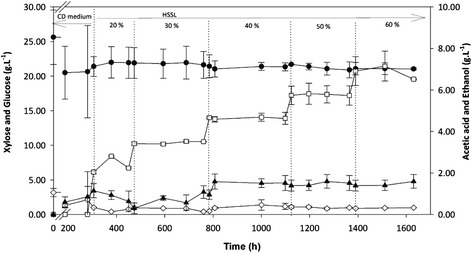
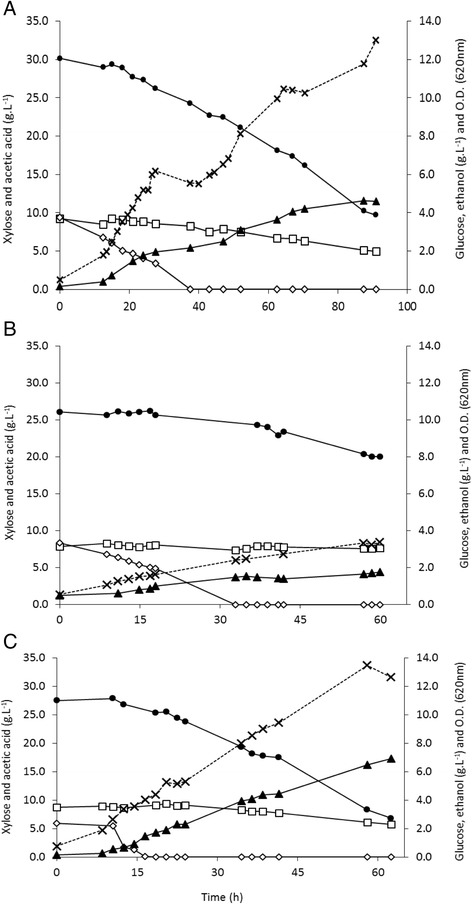
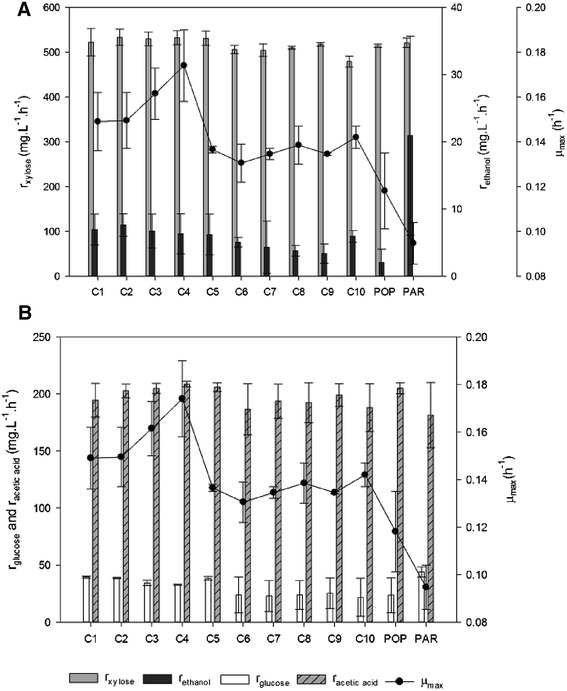
A continuous reactor with gradually increasing HSSL concentrations, from 20% to 60% (v/v), was operated for 382 generations. From the final obtained population (POP), a stable clone (C4) was isolated and characterized in 60% undetoxified HSSL. C4 isolate was then compared with both the parental strain (PAR) and POP. Both POP and C4 were able to grow in 60% undetoxified HSSL, with a higher capability to withstand HSSL inhibitors than PAR. Higher substrate uptake rates, 7% higher ethanol efficiency and improved ethanol yield were obtained using C4.
S. stipitis was successfully adapted to 60% (v/v) undetoxified eucalyptus HSSL. A stable isolate, C4, with an improved performance in undetoxified HSSL compared to PAR was successfully obtained from POP. Owing to its improved tolerance to inhibitors, C4 may represent a major advantage for the production of bioethanol using HSSL as substrate.
阔叶木亚硫酸盐废液(HSSL)是酸性亚硫酸盐制浆过程的一种副产物,富含木糖,木糖是一种单糖,可被树干毕赤酵母发酵生成乙醇。然而,HSSL还含有乙酸和木质素磺酸盐,它们是酵母生长的抑制性化合物。本研究的主要目的是利用进化工程策略获得对HSSL抑制剂耐受性增强的树干毕赤酵母变体,同时保持将木糖发酵为乙醇的能力。
在一个连续反应器中,HSSL浓度从20%逐步提高到60%(v/v),运行382代。从最终获得的群体(POP)中,分离出一个稳定的克隆株(C4),并在60%未解毒的HSSL中对其进行表征。然后将C4分离株与亲本菌株(PAR)和POP进行比较。POP和C4都能够在60%未解毒的HSSL中生长,且比PAR具有更强的耐受HSSL抑制剂的能力。使用C4可获得更高的底物摄取率、高7%的乙醇效率和更高的乙醇产量。
树干毕赤酵母成功适应了60%(v/v)未解毒的桉木HSSL。从POP中成功获得了一个稳定的分离株C4,与PAR相比,它在未解毒的HSSL中表现更佳。由于其对抑制剂的耐受性提高,C4可能是利用HSSL作为底物生产生物乙醇的一个主要优势。