He Lingjuan, Liu Qiaozhen, Hu Tianyuan, Huang Xiuzhen, Zhang Hui, Tian Xueying, Yan Yan, Wang Li, Huang Yu, Miquerol Lucile, Wythe Joshua D, Zhou Bin
Key Laboratory of Nutrition and Metabolism, Institute for Nutritional Sciences, Shanghai Institutes for Biological Sciences, Graduate School of the Chinese Academy of Sciences, Chinese Academy of Sciences, Shanghai 200031, China.
Key Laboratory of Nutrition and Metabolism, Institute for Nutritional Sciences, Shanghai Institutes for Biological Sciences, Graduate School of the Chinese Academy of Sciences, Chinese Academy of Sciences, Shanghai 200031, China Institute of Neuroscience, State Key Laboratory of Neuroscience, CAS Center for Excellence in Brain Science and Intelligence Technology, Shanghai Institutes for Biological Sciences, Chinese Academy of Sciences, Shanghai 200031, China.
Cardiovasc Res. 2016 Mar 1;109(3):419-30. doi: 10.1093/cvr/cvw005. Epub 2016 Jan 13.
Capillary and arterial endothelial cells share many common molecular markers in both the neonatal and adult hearts. Herein, we aim to establish a genetic tool that distinguishes these two types of vessels in order to determine the cellular mechanism underlying collateral artery formation.
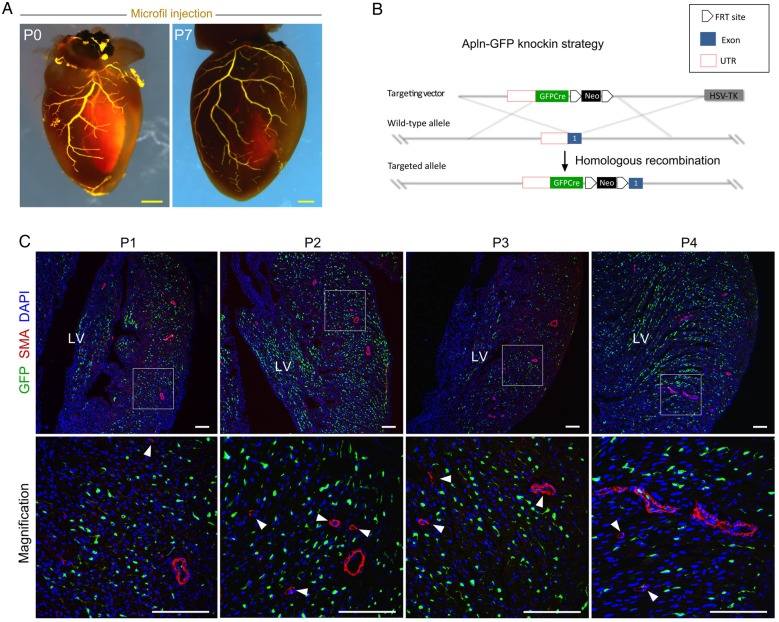
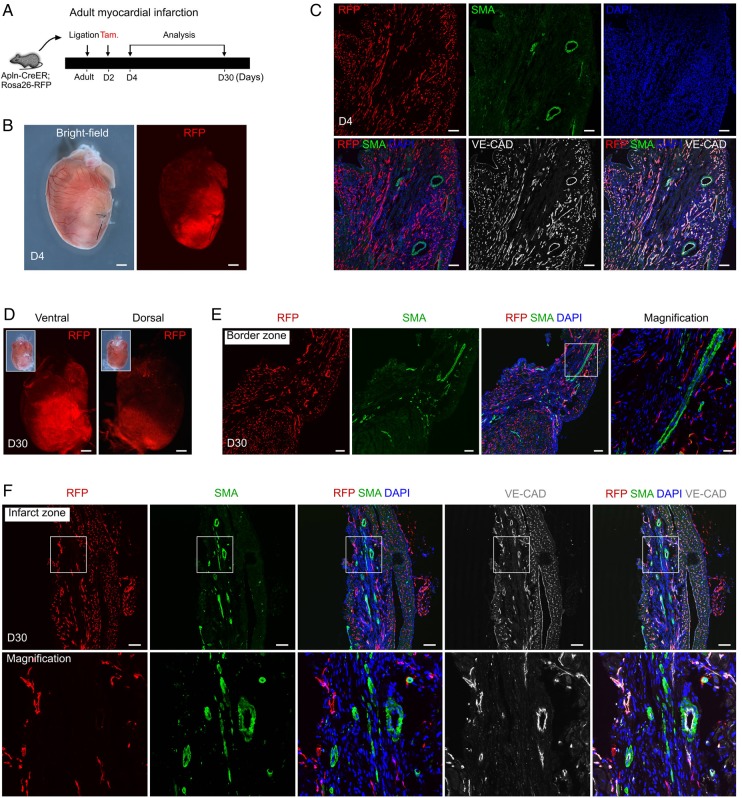
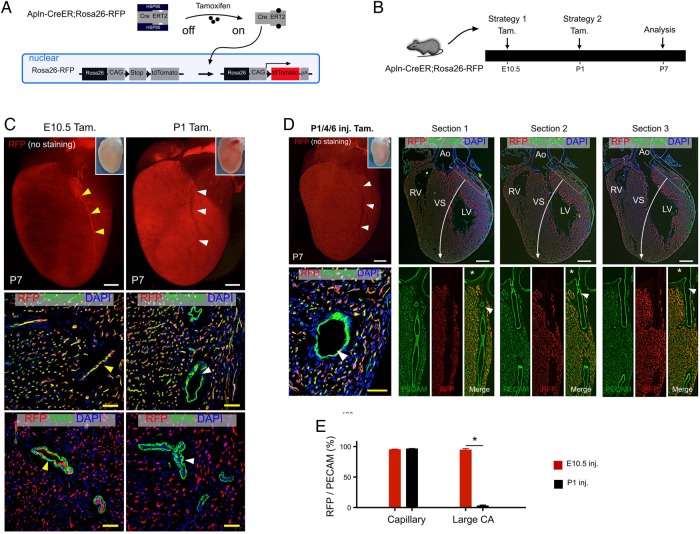
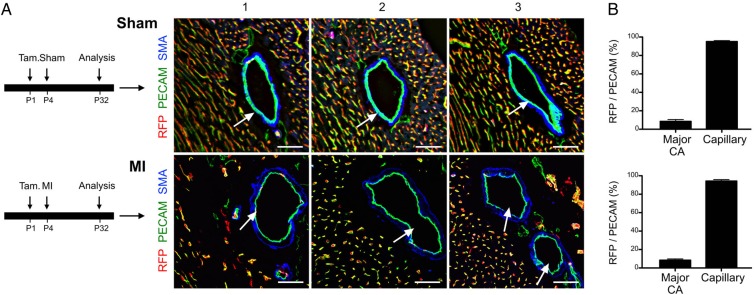
Using Apln-GFP and Apln-LacZ reporter mice, we demonstrate that APLN expression is enriched in coronary vascular endothelial cells. However, APLN expression is reduced in coronary arterial endothelial cells. Genetic lineage tracing, using an Apln-CreER mouse line, robustly labelled capillary endothelial cells, but not arterial endothelial cells. We leveraged this differential activity of Apln-CreER to study collateral artery formation following myocardial infarction (MI). In a neonatal heart MI model, we found that Apln-CreER-labelled capillary endothelial cells do not contribute to the large collateral arteries. Instead, these large collateral arteries mainly arise from pre-existing, infrequently labelled coronary arteries, indicative of arteriogenesis. Furthermore, in an adult heart MI model, Apln-CreER activity also distinguishes large and small diameter arteries from capillaries. Lineage tracing in this setting demonstrated that most large and small coronary arteries in the infarcted myocardium and border region are derived not from capillaries, but from pre-existing arteries.
Apln-CreER-mediated lineage tracing distinguishes capillaries from large arteries, in both the neonatal and adult hearts. Through genetic fate mapping, we demonstrate that pre-existing arteries, but not capillaries, extensively contribute to collateral artery formation following myocardial injury. These results suggest that arteriogenesis is the major mechanism underlying collateral vessel formation.
在新生儿和成年心脏中,毛细血管内皮细胞和动脉内皮细胞共享许多共同的分子标记。在此,我们旨在建立一种区分这两种血管类型的遗传工具,以确定侧支动脉形成的细胞机制。
使用Apln-GFP和Apln-LacZ报告基因小鼠,我们证明APLN表达在冠状血管内皮细胞中富集。然而,APLN表达在冠状动脉内皮细胞中减少。使用Apln-CreER小鼠品系进行遗传谱系追踪,能强有力地标记毛细血管内皮细胞,但不能标记动脉内皮细胞。我们利用Apln-CreER的这种差异活性来研究心肌梗死(MI)后的侧支动脉形成。在新生儿心脏MI模型中,我们发现Apln-CreER标记的毛细血管内皮细胞对大的侧支动脉没有贡献。相反,这些大的侧支动脉主要源自预先存在的、很少被标记的冠状动脉,这表明是动脉生成。此外,在成年心脏MI模型中,Apln-CreER活性也能区分大小不同直径的动脉和毛细血管。在这种情况下的谱系追踪表明,梗死心肌和边界区域的大多数大、小冠状动脉并非源自毛细血管,而是源自预先存在的动脉。
Apln-CreER介导的谱系追踪在新生儿和成年心脏中都能区分毛细血管和大动脉。通过遗传命运图谱,我们证明在心肌损伤后,预先存在的动脉而非毛细血管对侧支动脉形成有广泛贡献。这些结果表明动脉生成是侧支血管形成的主要机制。