Research and Innovation Centre, Fondazione Edmund Mach, Via Mach 1, 38010 San Michele all'Adige (TN), Italy; The New Zealand Institute for Plant & Food Research Limited, Palmerston North Research Centre, Palmerston North, New Zealand; Institut de Recherche en Horticulture et Semences - UMR1345, Institut National de la Recherche Agronomique (INRA), SFR 4207 Quasav, 42 rue Georges Morel, F-49071 Beaucouzé, France.
The New Zealand Institute for Plant & Food Research Limited, Motueka Research Centre , Motueka, New Zealand.
Hortic Res. 2016 Jan 6;3:15064. doi: 10.1038/hortres.2015.64. eCollection 2016.
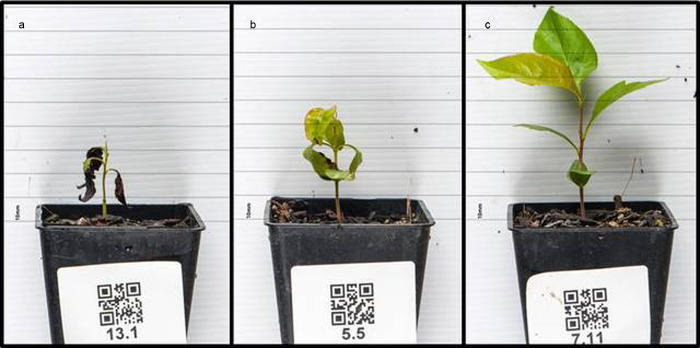
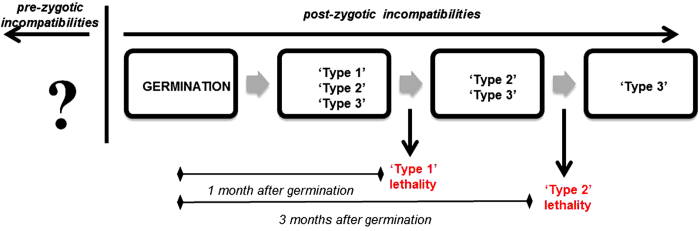
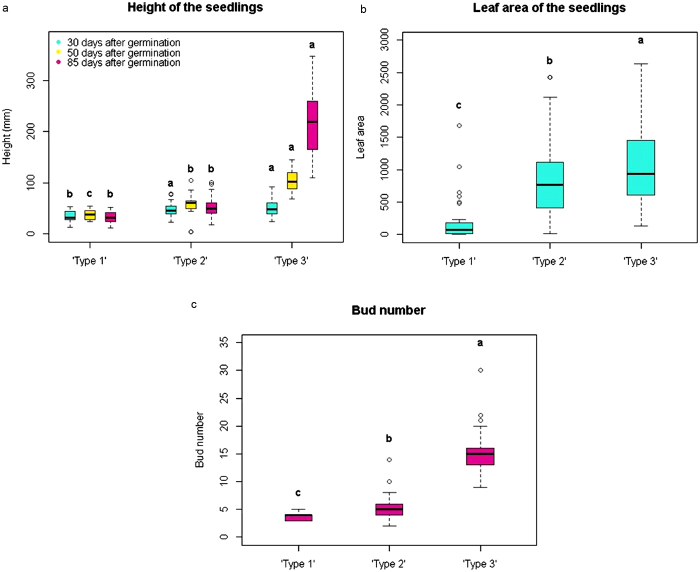
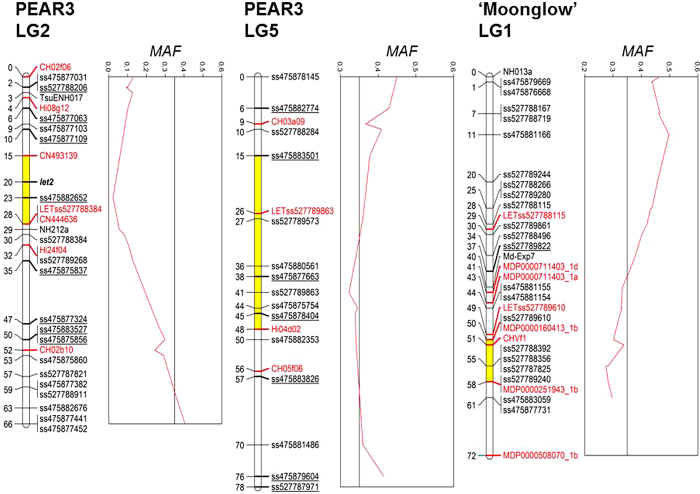
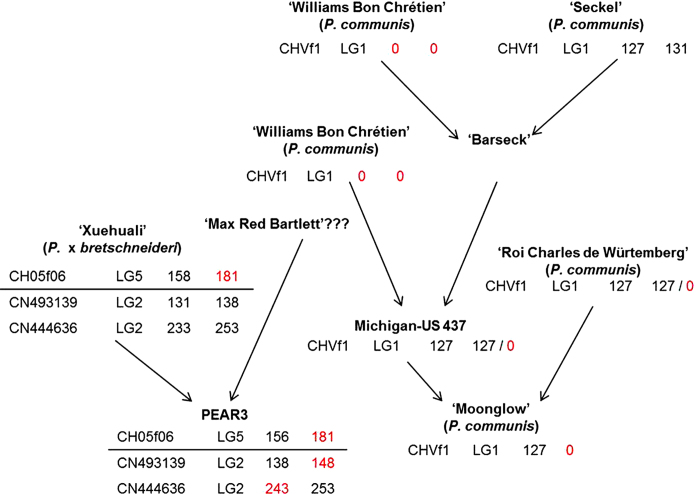
Deleterious epistatic interactions in plant inter- and intraspecific hybrids can cause a phenomenon known as hybrid necrosis, characterized by a typical seedling phenotype whose main distinguishing features are dwarfism, tissue necrosis and in some cases lethality. Identification of the chromosome regions associated with this type of incompatibility is important not only to increase our understanding of the evolutionary diversification that led to speciation but also for breeding purposes. Development of molecular markers linked to the lethal genes will allow breeders to avoid incompatible inbred combinations that could affect the expression of important agronomic tratis co-segregating with these genes. Although hybrid necrosis has been reported in several plant taxa, including Rosaceae species, this phenomenon has not been described previously in pear. In the interspecific pear population resulting from a cross between PEAR3 (Pyrus bretschneideri × Pyrus communis) and 'Moonglow' (P. communis), we observed two types of hybrid necrosis, expressed at different stages of plant development. Using a combination of previously mapped and newly developed genetic markers, we identified three chromosome regions associated with these two types of lethality, which were genetically independent. One type resulted from a negative epistatic interaction between a locus on linkage group 5 (LG5) of PEAR3 and a locus on LG1 of 'Moonglow', while the second type was due to a gene that maps to LG2 of PEAR3 and which either acts alone or more probably interacts with another gene of unknown location inherited from 'Moonglow'.
植物种间和种内杂种中的有害上位性相互作用会导致杂种坏死现象,其特征是典型的幼苗表型,主要特征是矮化、组织坏死,在某些情况下是致死性。鉴定与这种类型的不亲和性相关的染色体区域不仅对于增加我们对导致物种形成的进化多样化的理解很重要,而且对于育种目的也很重要。开发与致死基因连锁的分子标记将使育种者能够避免可能影响与这些基因共分离的重要农艺性状表达的不相容自交组合。尽管杂种坏死已在包括蔷薇科物种在内的几种植物类群中被报道,但在梨中以前没有描述过这种现象。在由 PEAR3(梨×西洋梨)和 'Moonglow'(西洋梨)杂交产生的种间梨群体中,我们观察到两种类型的杂种坏死,在植物发育的不同阶段表现出来。利用先前映射和新开发的遗传标记的组合,我们鉴定了与这两种致死性相关的三个染色体区域,它们在遗传上是独立的。一种类型是由 PEAR3 的连锁群 5(LG5)上的一个位点和 'Moonglow' 的 LG1 上的一个位点之间的负上位性相互作用引起的,而第二种类型是由于一个基因引起的,该基因位于 PEAR3 的 LG2 上,它可以单独作用,也更可能与从 'Moonglow' 遗传的未知位置的另一个基因相互作用。