Cerin Ester, Cain Kelli L, Oyeyemi Adewale L, Owen Neville, Conway Terry L, Cochrane Tom, VAN Dyck Delfien, Schipperijn Jasper, Mitáš Josef, Toftager Mette, Aguinaga-Ontoso Ines, Sallis James F
1Institute for Health and Ageing, Australian Catholic University, Melbourne, AUSTRALIA; 2School of Public Health, The University of Hong Kong, Hong Kong, CHINA; 3Department of Family Medicine and Public Health, University of California, San Diego, CA; 4Department of Physiotherapy, College of Medical Sciences, University of Maiduguri, Maiduguri, NIGERIA; 5Physical Activity, Sport and Recreation Research Focus Area, Faculty of Health Sciences, North-West University, Potchefstroom, SOUTH AFRICA; 6Baker IDI Heart and Diabetes Institute, Melbourne, AUSTRALIA; 7Centre for Research and Action in Public Health, University of Canberra, Canberra, AUSTRALIA; 8Department of Movement and Sport Sciences, Ghent University, Ghent, BELGIUM; 9Research Unit for Active Living, Department of Sport Science and Clinical Biomechanics, University of Southern Denmark, Odense, DENMARK; 10Faculty of Physical Culture, Institute of Active Lifestyle, Palacký University, Olomouc, CZECH REPUBLIC; 11National Institute of Public Health, University of Southern Denmark, Copenhagen, DENMARK; and 12Department of Health Sciences, Public University of Navarra, Pamplona, SPAIN.
Med Sci Sports Exerc. 2016 Jun;48(6):1075-84. doi: 10.1249/MSS.0000000000000870.
Understanding factors that influence accurate assessment of physical activity (PA) and sedentary behavior (SB) is important to measurement development, epidemiologic studies, and interventions. This study examined agreement between self-reported (International Physical Activity Questionnaire-Long Form [IPAQ-LF]) and accelerometry-based estimates of PA and SB across six countries and identified correlates of between-method agreement.
Self-report and objective (accelerometry-based) PA and SB data were collected in 2002-2011 from 3865 adult participants in eight cities from six countries (Belgium, Czech Republic, Denmark, Spain, United Kingdom, and United States). Between-method relative agreement (correlation) and absolute disagreement (mean difference between conceptually and intensity-matched IPAQ-LF and accelerometry-based PA and SB variables) were estimated. Also, sociodemographic characteristics and PA patterns were examined as correlates of between-method agreement.
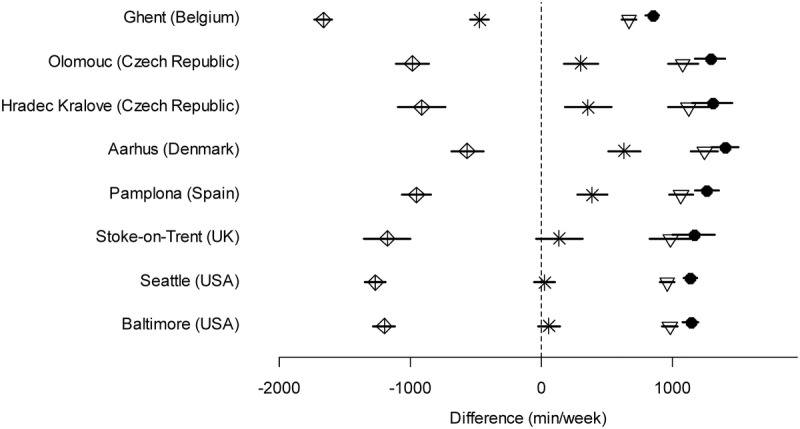
Observed relative agreement (relationships of IPAQ-LF with accelerometry-based PA and SB variables) was small to moderate (r = 0.05-0.37) and was moderated by sociodemographic (age, sex, weight status, and education) and behavioral (PA-type) factors. The absolute disagreement was large, with participants self-reporting higher PA intensity and total time in moderate-to-vigorous-intensity PA than accelerometry. Also, self-reported sitting time was lower than accelerometry-based sedentary behavior. After adjusting for sociodemographic and behavioral factors, the absolute disagreement between pairs of IPAQ-LF and accelerometry-based PA variables remained significantly different across cities/countries.
Present findings suggest systematic cultural and/or linguistic and sociodemographic differences in absolute agreement between the IPAQ-LF and the accelerometry-based PA and SB variables. These results have implications for the interpretation of international PA and SB data and correlate/determinant studies. They call for further efforts to improve such measures.
了解影响身体活动(PA)和久坐行为(SB)准确评估的因素对于测量方法的发展、流行病学研究及干预措施而言至关重要。本研究考察了六个国家中自我报告(国际身体活动问卷长表[IPAQ-LF])与基于加速度计的PA和SB评估之间的一致性,并确定了方法间一致性的相关因素。
2002年至2011年期间,收集了来自六个国家(比利时、捷克共和国、丹麦、西班牙、英国和美国)八个城市的3865名成年参与者的自我报告和客观(基于加速度计)的PA和SB数据。估计了方法间的相对一致性(相关性)和绝对不一致性(概念上和强度匹配的IPAQ-LF与基于加速度计的PA和SB变量之间的平均差异)。此外,还考察了社会人口学特征和PA模式作为方法间一致性的相关因素。
观察到的相对一致性(IPAQ-LF与基于加速度计的PA和SB变量之间的关系)较小至中等(r = 0.05 - 0.37),并受到社会人口学(年龄、性别、体重状况和教育程度)和行为(PA类型)因素的调节。绝对不一致性较大,参与者自我报告的PA强度和中等至剧烈强度PA的总时间高于加速度计测量结果。此外,自我报告的久坐时间低于基于加速度计的久坐行为。在调整社会人口学和行为因素后,不同城市/国家的IPAQ-LF与基于加速度计的PA变量对之间的绝对不一致性仍然存在显著差异。
目前的研究结果表明,IPAQ-LF与基于加速度计的PA和SB变量之间在绝对一致性方面存在系统性的文化和/或语言以及社会人口学差异。这些结果对国际PA和SB数据的解释以及相关/决定因素研究具有启示意义。它们呼吁进一步努力改进此类测量方法。