Rodrigues-da-Silva Rodrigo Nunes, Martins da Silva João Hermínio, Singh Balwan, Jiang Jianlin, Meyer Esmeralda V S, Santos Fátima, Banic Dalma Maria, Moreno Alberto, Galinski Mary R, Oliveira-Ferreira Joseli, Lima-Junior Josué da Costa
Laboratório de Imunoparasitologia, Instituto Oswaldo Cruz, Fundação Oswaldo Cruz (FIOCRUZ), Rio de Janeiro, RJ, Brazil.
Computational Modeling Group-FIOCRUZ-CE, Fortaleza, Brazil.
PLoS One. 2016 Jan 20;11(1):e0146951. doi: 10.1371/journal.pone.0146951. eCollection 2016.
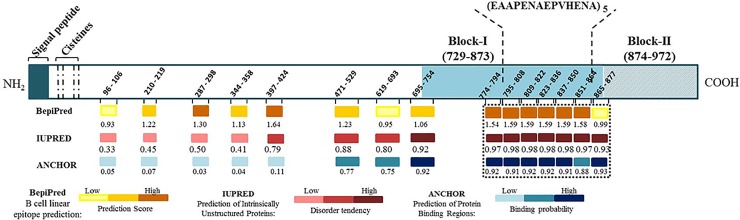
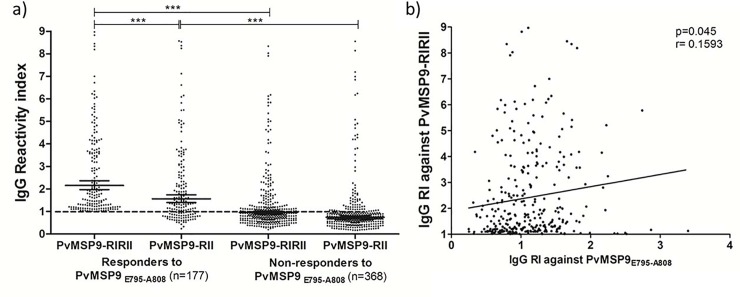
Synthetic peptide vaccines provide the advantages of safety, stability and low cost. The success of this approach is highly dependent on efficient epitope identification and synthetic strategies for efficacious delivery. In malaria, the Merozoite Surface Protein-9 of Plasmodium vivax (PvMSP9) has been considered a vaccine candidate based on the evidence that specific antibodies were able to inhibit merozoite invasion and recombinant proteins were highly immunogenic in mice and humans. However the identities of linear B-cell epitopes within PvMSP9 as targets of functional antibodies remain undefined. We used several publicly-available algorithms for in silico analyses and prediction of relevant B cell epitopes within PMSP9. We show that the tandem repeat sequence EAAPENAEPVHENA (PvMSP9E795-A808) present at the C-terminal region is a promising target for antibodies, given its high combined score to be a linear epitope and located in a putative intrinsically unstructured region of the native protein. To confirm the predictive value of the computational approach, plasma samples from 545 naturally exposed individuals were screened for IgG reactivity against the recombinant PvMSP9-RIRII729-972 and a synthetic peptide representing the predicted B cell epitope PvMSP9E795-A808. 316 individuals (58%) were responders to the full repetitive region PvMSP9-RIRII, of which 177 (56%) also presented total IgG reactivity against the synthetic peptide, confirming it validity as a B cell epitope. The reactivity indexes of anti-PvMSP9-RIRII and anti-PvMSP9E795-A808 antibodies were correlated. Interestingly, a potential role in the acquisition of protective immunity was associated with the linear epitope, since the IgG1 subclass against PvMSP9E795-A808 was the prevalent subclass and this directly correlated with time elapsed since the last malaria episode; however this was not observed in the antibody responses against the full PvMSP9-RIRII. In conclusion, our findings identified and experimentally confirmed the potential of PvMSP9E795-A808 as an immunogenic linear B cell epitope within the P. vivax malaria vaccine candidate PvMSP9 and support its inclusion in future subunit vaccines.
合成肽疫苗具有安全、稳定和低成本的优点。这种方法的成功高度依赖于有效的表位鉴定和有效的递送合成策略。在疟疾方面,基于特定抗体能够抑制裂殖子入侵以及重组蛋白在小鼠和人类中具有高度免疫原性的证据,间日疟原虫的裂殖子表面蛋白9(PvMSP9)被认为是一种疫苗候选物。然而,PvMSP9内作为功能性抗体靶标的线性B细胞表位的身份仍不明确。我们使用了几种公开可用的算法对PMSP9内相关B细胞表位进行计算机分析和预测。我们表明,存在于C末端区域的串联重复序列EAAPENAEPVHENA(PvMSP9E795 - A808)是抗体的一个有前景的靶标,因为它作为线性表位的综合得分很高,并且位于天然蛋白的一个假定的内在无序区域。为了证实计算方法的预测价值,对545名自然暴露个体的血浆样本进行了筛查,以检测其针对重组PvMSP9 - RIRII729 - 972和代表预测B细胞表位PvMSP9E795 - A808的合成肽的IgG反应性。316名个体(58%)对完整的重复区域PvMSP9 - RIRII有反应,其中177名(56%)也对合成肽呈现出总的IgG反应性,证实了其作为B细胞表位的有效性。抗PvMSP9 - RIRII和抗PvMSP9E795 - A808抗体的反应性指数相关。有趣的是,线性表位与获得保护性免疫的潜在作用相关,因为针对PvMSP9E795 - A808的IgG1亚类是主要亚类,并且这与自上次疟疾发作以来经过的时间直接相关;然而在针对完整的PvMSP9 - RIRII的抗体反应中未观察到这一点。总之,我们的研究结果鉴定并通过实验证实了PvMSP9E795 - A808作为间日疟原虫疟疾疫苗候选物PvMSP9内具有免疫原性的线性B细胞表位的潜力,并支持将其纳入未来的亚单位疫苗中。