Stensgaard Anna-Sofie, Vounatsou Penelope, Onapa Ambrose W, Utzinger Jürg, Pedersen Erling M, Kristensen Thomas K, Simonsen Paul E
Center for Macroecology, Evolution and Climate, The Natural History Museum of Denmark, University of Copenhagen, Copenhagen, Denmark.
Department of Epidemiology and Public Health, Swiss Tropical and Public Health Institute, Basel, Switzerland.
PLoS Negl Trop Dis. 2016 Jan 21;10(1):e0004319. doi: 10.1371/journal.pntd.0004319. eCollection 2016 Jan.
Mansonella perstans is a widespread, but relatively unknown human filarial parasite transmitted by Culicoides biting midges. Although it is found in many parts of sub-Saharan Africa, only few studies have been carried out to deepen the understanding of its ecology, epidemiology, and health consequences. Hence, knowledge about ecological drivers of the vector and parasite distribution, integral to develop spatially explicit models for disease prevention, control, and elimination strategies, is limited.
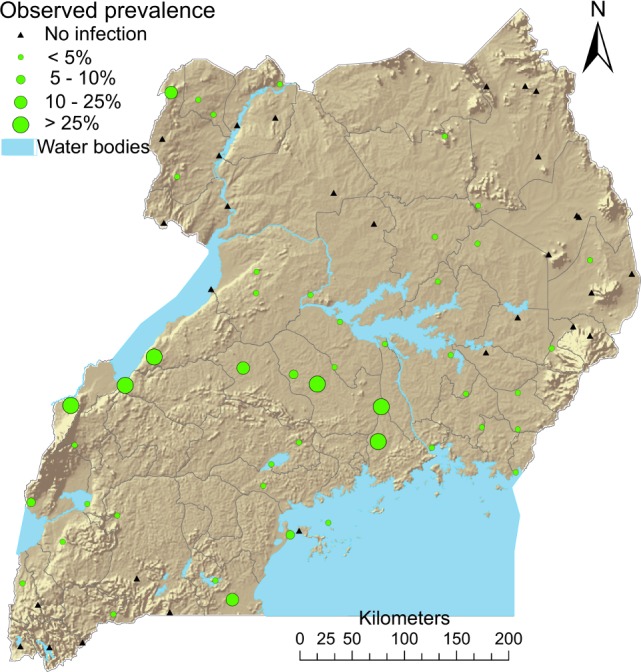
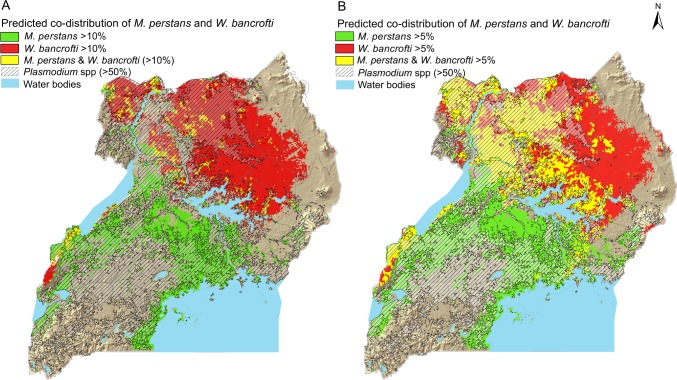
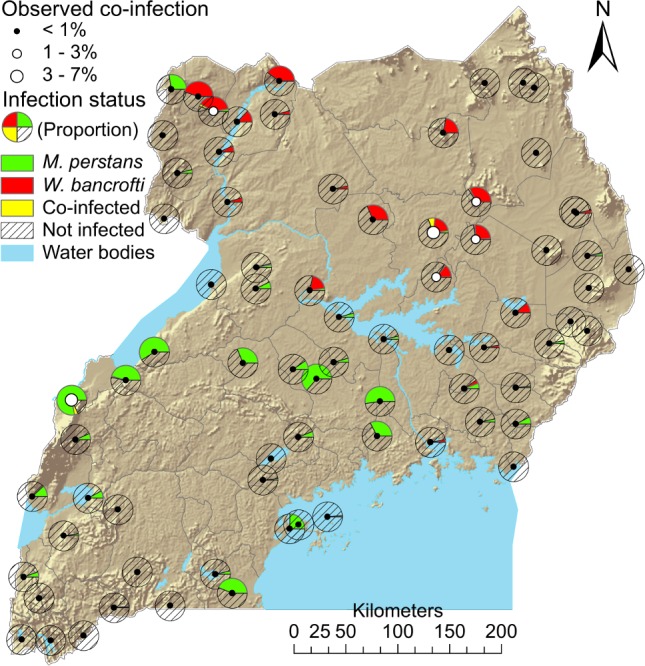
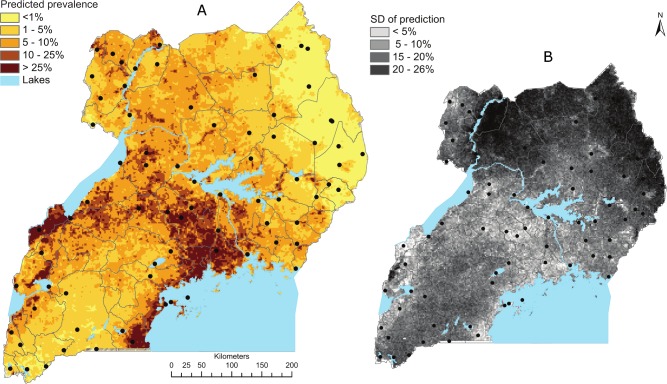
We analyzed data from a comprehensive nationwide survey of M. perstans infection conducted in 76 schools across Uganda in 2000-2003, to identify environmental drivers. A suite of Bayesian geostatistical regression models was fitted, and the best fitting model based on the deviance information criterion was utilized to predict M. perstans infection risk for all of Uganda. Additionally, we investigated co-infection rates and co-distribution with Wuchereria bancrofti and Plasmodium spp. infections observed at the same survey by mapping geographically overlapping areas.
Several bioclimatic factors were significantly associated with M. perstans infection levels. A spatial Bayesian regression model showed the best fit, with diurnal temperature range, normalized difference vegetation index, and cattle densities identified as significant covariates. This model was employed to predict M. perstans infection risk at non-sampled locations. The level of co-infection with W. bancrofti was low (0.3%), due to limited geographic overlap. However, where the two infections did overlap geographically, a positive association was found.
CONCLUSIONS/SIGNIFICANCE: This study presents the first geostatistical risk map for M. perstans in Uganda. We confirmed a widespread distribution of M. perstans, and identified important potential drivers of risk. The results provide new insight about the ecologic preferences of this otherwise poorly known filarial parasite and its Culicoides vector species in Uganda, which might be relevant for other settings in sub-Saharan Africa.
常现曼森线虫是一种广泛存在但相对鲜为人知的人体丝虫寄生虫,由库蠓叮咬传播。尽管在撒哈拉以南非洲的许多地区都有发现,但为加深对其生态学、流行病学及健康影响的理解而开展的研究却很少。因此,对于疾病预防、控制和消除策略所需的空间明确模型至关重要的病媒和寄生虫分布的生态驱动因素的了解十分有限。
我们分析了2000 - 2003年在乌干达全国76所学校进行的常现曼森线虫感染综合调查数据,以确定环境驱动因素。拟合了一组贝叶斯地理统计回归模型,并使用基于偏差信息准则的最佳拟合模型预测乌干达全境的常现曼森线虫感染风险。此外,我们通过绘制地理重叠区域图,调查了同一调查中观察到的与班氏吴策线虫和疟原虫感染的共感染率及共分布情况。
几个生物气候因素与常现曼森线虫感染水平显著相关。空间贝叶斯回归模型拟合效果最佳,日温度范围、归一化植被指数和牛的密度被确定为显著协变量。该模型用于预测未采样地点的常现曼森线虫感染风险。由于地理重叠有限,与班氏吴策线虫的共感染水平较低(0.3%)。然而,在这两种感染在地理上确实重叠的地方,发现了正相关关系。
结论/意义:本研究展示了乌干达常现曼森线虫的首张地理统计风险图。我们证实了常现曼森线虫的广泛分布,并确定了重要的潜在风险驱动因素。研究结果为这种鲜为人知的丝虫寄生虫及其在乌干达的库蠓病媒物种的生态偏好提供了新见解,这可能与撒哈拉以南非洲的其他地区相关。