Miyazaki Ikuko, Asanuma Masato
Department of Medical Neurobiology, Okayama University Graduate School of Medicine, Dentistry and Pharmaceutical Sciences, 2-5-1 Shikata-cho, Kita-ku, Okayama 700-8558, Japan.
Curr Med Chem. 2016;23(7):686-700. doi: 10.2174/0929867323666160122115057.
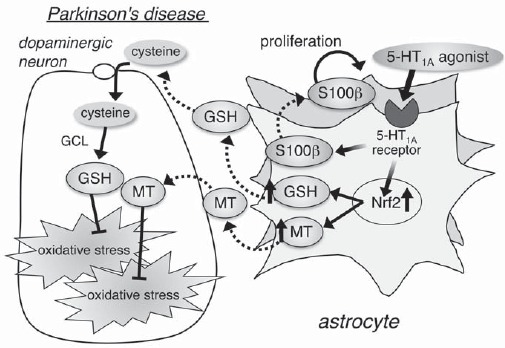
Astrocytes are the most abundant neuron-supporting glial cells in the central nervous system. The neuroprotective role of astrocytes has been demonstrated in various neurological disorders such as amyotrophic lateral sclerosis, spinal cord injury, stroke and Parkinson's disease (PD). Astrocyte dysfunction or loss-of-astrocytes increases the susceptibility of neurons to cell death, while astrocyte transplantation in animal studies has therapeutic advantage. We reported recently that stimulation of serotonin 1A (5-HT1A) receptors on astrocytes promoted astrocyte proliferation and upregulated antioxidative molecules to act as a neuroprotectant in parkinsonian mice. PD is a progressive neurodegenerative disease with motor symptoms such as tremor, bradykinesia, rigidity and postural instability, that are based on selective loss of nigrostriatal dopaminergic neurons, and with non-motor symptoms such as orthostatic hypotension and constipation based on peripheral neurodegeneration. Although dopaminergic therapy for managing the motor disability associated with PD is being assessed at present, the main challenge remains the development of neuroprotective or disease- modifying treatments. Therefore, it is desirable to find treatments that can reduce the progression of dopaminergic cell death. In this article, we summarize first the neuroprotective properties of astrocytes targeting certain molecules related to PD. Next, we review neuroprotective effects induced by stimulation of 5-HT1A receptors on astrocytes. The review discusses new promising therapeutic strategies based on neuroprotection against oxidative stress and prevention of dopaminergic neurodegeneration.
星形胶质细胞是中枢神经系统中数量最多的支持神经元的神经胶质细胞。星形胶质细胞的神经保护作用已在各种神经系统疾病中得到证实,如肌萎缩侧索硬化症、脊髓损伤、中风和帕金森病(PD)。星形胶质细胞功能障碍或星形胶质细胞缺失会增加神经元对细胞死亡的易感性,而在动物研究中,星形胶质细胞移植具有治疗优势。我们最近报道,刺激星形胶质细胞上的5-羟色胺1A(5-HT1A)受体可促进星形胶质细胞增殖并上调抗氧化分子,从而在帕金森病小鼠中起到神经保护作用。帕金森病是一种进行性神经退行性疾病,具有震颤、运动迟缓、僵硬和姿势不稳等运动症状,这些症状基于黑质纹状体多巴胺能神经元的选择性丧失,还具有基于外周神经退行性变的直立性低血压和便秘等非运动症状。尽管目前正在评估用于治疗与帕金森病相关的运动障碍的多巴胺能疗法,但主要挑战仍然是开发神经保护或疾病修饰疗法。因此,需要找到能够减缓多巴胺能细胞死亡进程的治疗方法。在本文中,我们首先总结了星形胶质细胞针对某些与帕金森病相关分子的神经保护特性。接下来,我们回顾了刺激星形胶质细胞上的5-HT1A受体所诱导的神经保护作用。这篇综述讨论了基于对抗氧化应激的神经保护和预防多巴胺能神经退行性变的新的有前景的治疗策略。