Bassler Dirk, Mueller Katharina F, Briel Matthias, Kleijnen Jos, Marusic Ana, Wager Elizabeth, Antes Gerd, von Elm Erik, Altman Douglas G, Meerpohl Joerg J
Department of Neonatology, University Hospital Zurich, University of Zurich, Zurich, Switzerland.
Center for Pediatric Clinical Studies, University Children's Hospital Tuebingen, Tuebingen, Germany.
BMJ Open. 2016 Jan 21;6(1):e010024. doi: 10.1136/bmjopen-2015-010024.
The aim of this study is to review highly cited articles that focus on non-publication of studies, and to develop a consistent and comprehensive approach to defining (non-) dissemination of research findings.
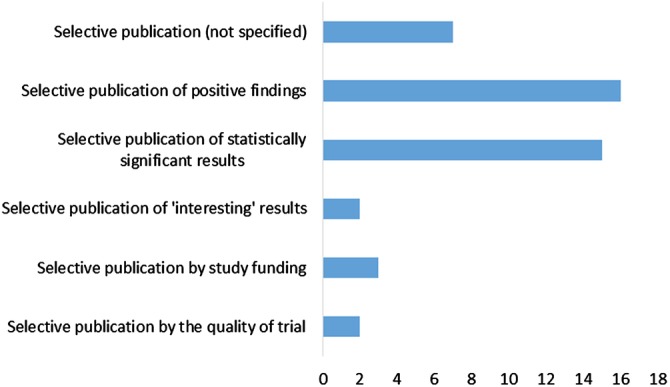
We performed a scoping review of definitions of the term 'publication bias' in highly cited publications.
Ideas and experiences of a core group of authors were collected in a draft document, which was complemented by the findings from our literature search.
The draft document including findings from the literature search was circulated to an international group of experts and revised until no additional ideas emerged and consensus was reached.
We propose a new approach to the comprehensive conceptualisation of (non-) dissemination of research.
Our 'What, Who and Why?' approach includes issues that need to be considered when disseminating research findings (What?), the different players who should assume responsibility during the various stages of conducting a clinical trial and disseminating clinical trial documents (Who?), and motivations that might lead the various players to disseminate findings selectively, thereby introducing bias in the dissemination process (Why?).
Our comprehensive framework of (non-) dissemination of research findings, based on the results of a scoping literature search and expert consensus will facilitate the development of future policies and guidelines regarding the multifaceted issue of selective publication, historically referred to as 'publication bias'.
本研究旨在回顾聚焦于研究未发表情况的高被引文章,并制定一种一致且全面的方法来定义研究结果的(未)传播。
我们对高被引出版物中“发表偏倚”一词的定义进行了范围综述。
在一份文件草稿中收集了核心作者群体的观点和经验,并辅以文献检索结果。
将包含文献检索结果的文件草稿分发给一组国际专家,并进行修订,直到没有新的观点出现且达成共识。
我们提出了一种对研究(未)传播进行全面概念化的新方法。
我们的“是什么、谁、为什么?”方法包括在传播研究结果时需要考虑的问题(是什么?)、在开展临床试验和传播临床试验文件的各个阶段应承担责任的不同参与者(谁?),以及可能导致不同参与者有选择地传播结果从而在传播过程中引入偏倚的动机(为什么?)。
我们基于范围文献检索结果和专家共识得出的关于研究结果(未)传播的综合框架,将有助于制定未来关于选择性发表这一多方面问题(历史上称为“发表偏倚”)的政策和指南。