Vilhelmsson Andreas, Davis Courtney, Mulinari Shai
Department of Clinical Sciences, Division of Social Medicine and Global Health, Faculty of Medicine, Malmö University, Lund, Sweden.
Department of Gender Studies, Faculty of Social Sciences, Lund University, Lund, Sweden.
PLoS Med. 2016 Jan 26;13(1):e1001945. doi: 10.1371/journal.pmed.1001945. eCollection 2016 Jan.
European Union law prohibits companies from marketing drugs off-label. In the United Kingdom--as in some other European countries, but unlike the United States--industry self-regulatory bodies are tasked with supervising compliance with marketing rules. The objectives of this study were to (1) characterize off-label promotion rulings in the UK compared to the whistleblower-initiated cases in the US and (2) shed light on the UK self-regulatory mechanism for detecting, deterring, and sanctioning off-label promotion.
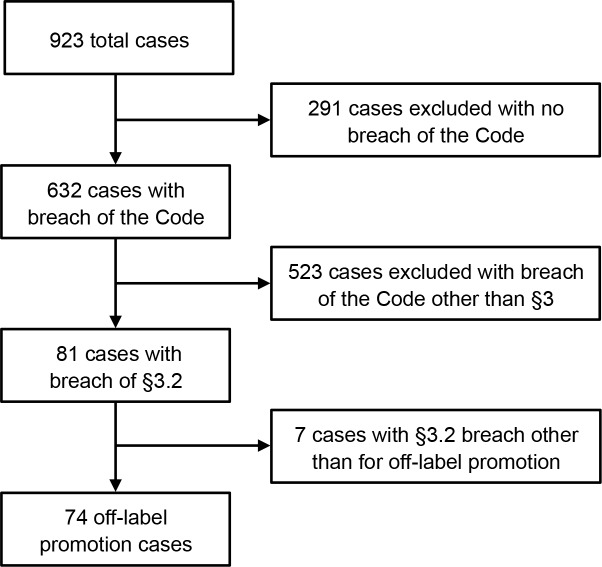
We conducted structured reviews of rulings by the UK self-regulatory authority, the Prescription Medicines Code of Practice Authority (PMCPA), between 2003 and 2012. There were 74 off-label promotion rulings involving 43 companies and 65 drugs. Nineteen companies were ruled in breach more than once, and ten companies were ruled in breach three or more times over the 10-y period. Drawing on a typology previously developed to analyse US whistleblower complaints, we coded and analysed the apparent strategic goals of each off-label marketing scheme and the practices consistent with those alleged goals. 50% of rulings cited efforts to expand drug use to unapproved indications, and 39% and 38% cited efforts to expand beyond approved disease entities and dosing strategies, respectively. The most frequently described promotional tactic was attempts to influence prescribers (n = 72, 97%), using print material (70/72, 97%), for example, advertisements (21/70, 30%). Although rulings cited prescribers as the prime target of off-label promotion, competing companies lodged the majority of complaints (prescriber: n = 16, 22%, versus companies: n = 42, 57%). Unlike US whistleblower complaints, few UK rulings described practices targeting consumers (n = 3, 4%), payers (n = 2, 3%), or company staff (n = 2, 3%). Eight UK rulings (11%) pertaining to six drugs described promotion of the same drug for the same off-label use as was alleged by whistleblowers in the US. However, while the UK cases typically related to only one or a few claims made in printed material, several complaints in the US alleged multifaceted and covert marketing activities. Because this study is limited to PMCPA rulings and whistleblower-initiated federal cases, it may offer a partial view of exposed off-label marketing.
The UK self-regulatory system for exposing marketing violations relies largely on complaints from company outsiders, which may explain why most off-label promotion rulings relate to plainly visible promotional activities such as advertising. This contrasts with the US, where Department of Justice investigations and whistleblower testimony have alleged complex off-label marketing campaigns that remain concealed to company outsiders. UK authorities should consider introducing increased incentives and protections for whistleblowers combined with US-style governmental investigations and meaningful sanctions. UK prescribers should be attentive to, and increasingly report, off-label promotion.
欧盟法律禁止公司进行药品的非标签营销。在英国,与其他一些欧洲国家一样,但与美国不同,行业自律机构负责监督营销规则的遵守情况。本研究的目的是:(1)与美国举报人发起的案件相比,描述英国的非标签推广裁决情况;(2)阐明英国用于发现、威慑和制裁非标签推广的自我监管机制。
我们对英国自律机构药品推广行为规范管理局(PMCPA)在2003年至2012年间作出的裁决进行了结构化审查。共有74项非标签推广裁决,涉及43家公司和65种药品。在这10年期间,有19家公司被裁定不止一次违规,10家公司被裁定违规三次或更多次。借鉴先前用于分析美国举报人投诉的类型,我们对每个非标签营销计划的明显战略目标以及与这些所谓目标一致的做法进行了编码和分析。50%的裁决提到了将药物使用扩大到未批准适应症的行为,分别有39%和38%的裁决提到了超出批准疾病实体和给药策略的行为。最常描述的促销策略是试图影响开处方者(n = 72,97%),例如使用印刷材料(70/72,97%),如广告(21/70,30%)。尽管裁决指出开处方者是非标签推广的主要目标,但大多数投诉是由竞争公司提出的(开处方者:n = 16,22%,而公司:n = 42,57%)。与美国举报人投诉不同,英国的裁决很少描述针对消费者(n = 3,4%)、付款人(n = 2,3%)或公司员工(n = 2,3%)的行为。八项与六种药品相关的英国裁决(11%)描述了与美国举报人所指控的相同药品的相同非标签用途的推广。然而,虽然英国的案件通常只涉及印刷材料中提出的一项或几项主张,但美国的一些投诉指控存在多方面的隐蔽营销活动。由于本研究仅限于PMCPA的裁决和举报人发起的联邦案件,它可能只能部分反映被曝光的非标签营销情况。
英国用于揭露营销违规行为的自我监管系统在很大程度上依赖于公司外部人员的投诉,这或许可以解释为什么大多数非标签推广裁决都与广告等明显可见的促销活动有关。这与美国形成对比,在美国,美国司法部调查和举报人证词指控存在复杂的非标签营销活动,这些活动对公司外部人员来说仍然是隐蔽的。英国当局应考虑为举报人提供更多激励和保护措施,同时结合美国式的政府调查和有意义的制裁。英国的开处方者应注意并更多地举报非标签推广行为。

