Chen Liye, Zeng Xin, Kleibeuker Esther, Buffa Francesca, Barberis Alessandro, Leek Russell D, Roxanis Ioannis, Zhang Wei, Worth Andrew, Beech John S, Harris Adrian L, Cai Shijie
Molecular Oncology Laboratories, Department of Oncology, Weatherall Institute of Molecular Medicine, University of Oxford, John Radcliffe Hospital, Oxford OX3 9DS, UK.
Current address: Xiamen Institute for Diabetes Research, The First Affiliated Hospital of Xiamen University, Xiamen, China.
Oncotarget. 2016 Feb 23;7(8):9353-67. doi: 10.18632/oncotarget.6981.
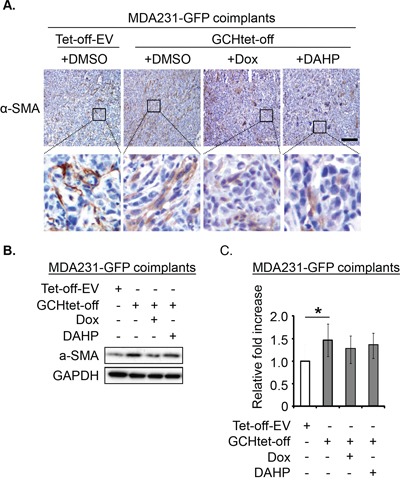
Cancer-associated fibroblasts (CAFs) play a key role in promoting tumor growth, acting through complex paracrine regulation. GTP cyclohydrolase (GTPCH) expression for tetrahydrobiopterin synthesis in tumor stroma is implicated in angiogenesis and tumor development. However, the clinical significance of GTPCH expression in breast cancer is still elusive and how GTPCH regulates stromal fibroblast and tumor cell communication remains unknown. We found that GTPCH was upregulated in breast CAFs and epithelia, and high GTPCH RNA was significantly correlated with larger high grade tumors and worse prognosis. In cocultures, GTPCH expressing fibroblasts stimulated breast cancer cell proliferation and motility, cancer cell Tie2 phosphorylation and consequent downstream pathway activation. GTPCH interacted with Ang-1 in stromal fibroblasts and enhanced Ang-1 expression and function, which in turn phosphorylated tumor Tie2 and induced cell proliferation. In coimplantation xenografts, GTPCH in fibroblasts enhanced tumor growth, upregulating Ang-1 and alpha-smooth muscle actin mainly in fibroblast-like cells. GTPCH inhibition resulted in the attenuation of tumor growth and angiogenesis. GTPCH/Ang-1 interaction in stromal fibroblasts and activation of Tie2 on breast tumor cells could play an important role in supporting breast cancer growth. GTPCH may be an important mechanism of paracrine tumor growth and hence a target for therapy in breast cancer.
癌症相关成纤维细胞(CAFs)通过复杂的旁分泌调节,在促进肿瘤生长中发挥关键作用。肿瘤基质中用于合成四氢生物蝶呤的鸟苷三磷酸环化水解酶(GTPCH)表达与血管生成和肿瘤发展有关。然而,GTPCH表达在乳腺癌中的临床意义仍不明确,且GTPCH如何调节基质成纤维细胞与肿瘤细胞的通讯尚不清楚。我们发现GTPCH在乳腺CAFs和上皮细胞中上调,高GTPCH RNA与更大的高级别肿瘤及更差的预后显著相关。在共培养中,表达GTPCH的成纤维细胞刺激乳腺癌细胞增殖和迁移、癌细胞Tie2磷酸化及随后的下游通路激活。GTPCH在基质成纤维细胞中与血管生成素-1(Ang-1)相互作用,增强Ang-1表达和功能,进而使肿瘤Tie2磷酸化并诱导细胞增殖。在共植入异种移植中,成纤维细胞中的GTPCH增强肿瘤生长,主要在成纤维细胞样细胞中上调Ang-1和α-平滑肌肌动蛋白。GTPCH抑制导致肿瘤生长和血管生成减弱。基质成纤维细胞中的GTPCH/Ang-1相互作用及乳腺肿瘤细胞上Tie2的激活可能在支持乳腺癌生长中起重要作用。GTPCH可能是旁分泌肿瘤生长的重要机制,因此是乳腺癌治疗的一个靶点。