
慢性中心性浆液性脉络膜视网膜病变患者的选择性视网膜治疗:一项初步研究。
Selective Retina Therapy in Patients With Chronic Central Serous Chorioretinopathy: A Pilot Study.
作者信息
Kang Seungbum, Park Young Gun, Kim Jae Ryun, Seifert Eric, Theisen-Kunde Dirk, Brinkmann Ralf, Roh Young Jung
机构信息
From the Department of Ophthalmology and Visual Science, College of Medicine, The Catholic University of Korea, Seoul, Republic of Korea (SK, YGP, JRK, YJR); Clinical Research Institute, Daejeon St. Mary's Hospital, College of Medicine, The Catholic University of Korea, Daejeon, Republic of Korea (SK); and Medical Laser Center Lübeck GmbH, Lübeck, Germany (ES, DT-K, RB).
出版信息
Medicine (Baltimore). 2016 Jan;95(3):e2524. doi: 10.1097/MD.0000000000002524.
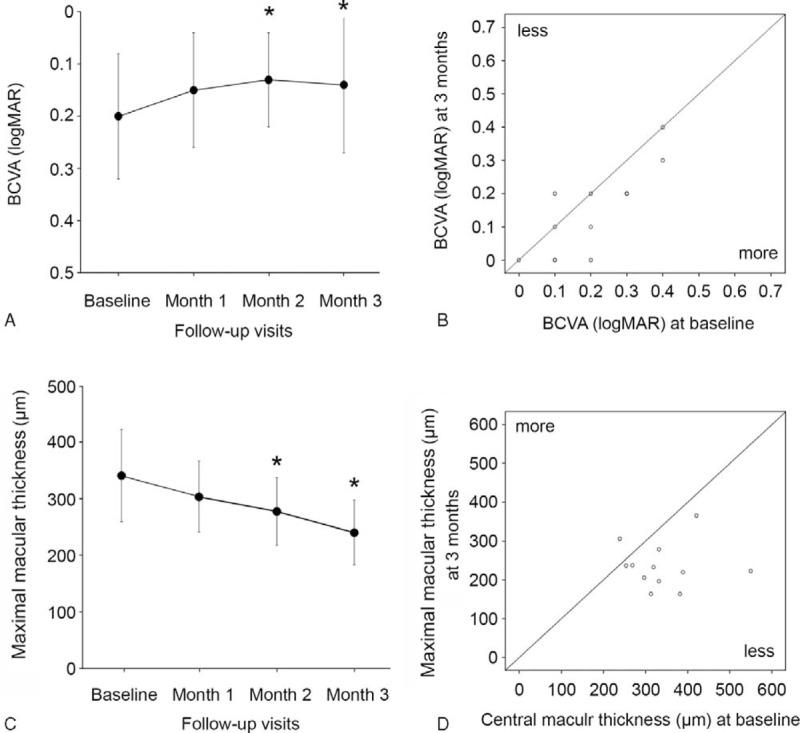
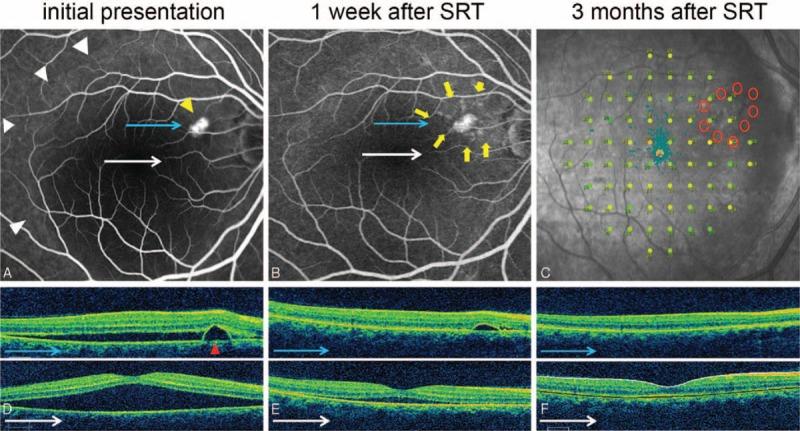
We evaluated visual outcomes, changes of maximum macular thickness (MMT) and subretinal fluid (SRF), and safety in patients with chronic central serous chorioretinopathy (CSC) after treatment with selective retina therapy (SRT). Retrospective cohort study of patients with chronic CSC presenting to a university-based hospital from January 2014 through January 2015 was conducted. A total of 12 eyes of 12 patients with chronic CSC lasting for at least 3 months was recruited. The follow-up period ranged from 3 to 12 months. Following evaluation of test spots at temporal arcades, SRT (Q-switched neodymium-doped yttrium lithium fluoride [Nd:YLF] laser; wavelength, 527 nm, pulse duration, 1.7 microsececond) was applied to the surrounding areas of leakage observed on fluorescein angiogram and/or pigment epithelial detachment (PED). Changes in best-correct visual acuity (BCVA), MMT, and SRF and macular sensitivity (MS) by microperimetry (MP) were evaluated. Eyes received treatment in a mean of 3.83 spots at the pulse energy of 65 to 90 μJ. Mean BCVA (logMAR) improved from 0.23 ± 0.12 at baseline to 0.14 ± 0.13 at 3 months. MMT decreased from 341.4 ± 85.5 μm at baseline to 236.0 ± 57.9 μm at 3 months. SRF completely resolved in 75% (9 eyes) at 3 months. Large PEDs (2 eyes) were flattened at 3 months. Retreatment was performed in 4 eyes. MP showed no evidence of scotoma around SRT-treated lesions. SRT treatment targeting the surrounding area of leakage point showed favorable visual and structural outcomes in chronic CSC patients without the risk of scotoma.
我们评估了慢性中心性浆液性脉络膜视网膜病变(CSC)患者接受选择性视网膜治疗(SRT)后的视力结果、黄斑最大厚度(MMT)和视网膜下液(SRF)的变化以及安全性。对2014年1月至2015年1月在一家大学附属医院就诊的慢性CSC患者进行了回顾性队列研究。共招募了12例慢性CSC患者的12只眼,病程至少3个月。随访期为3至12个月。在评估颞侧视网膜的测试点后,将SRT(调Q掺钕钇锂氟化物[Nd:YLF]激光;波长527nm,脉冲持续时间1.7微秒)应用于荧光素血管造影观察到的渗漏周围区域和/或色素上皮脱离(PED)。评估了最佳矫正视力(BCVA)、MMT、SRF以及微视野检查(MP)的黄斑敏感度(MS)的变化。在脉冲能量为65至90μJ时,平均每只眼接受治疗的光斑数为3.83个。平均BCVA(logMAR)从基线时的0.23±0.12提高到3个月时的0.14±0.13。MMT从基线时的341.4±85.5μm降至3个月时的236.0±57.9μm。3个月时,75%(9只眼)的SRF完全消退。大的PED(2只眼)在3个月时变平。4只眼进行了再次治疗。MP显示在SRT治疗的病变周围没有暗点迹象。针对渗漏点周围区域的SRT治疗在慢性CSC患者中显示出良好的视力和结构结果,且无暗点风险。





 Zotero 插件