Augustin Livia S A, Chiavaroli Laura, Campbell Janice, Ezatagha Adish, Jenkins Alexandra L, Esfahani Amin, Kendall Cyril W C
Clinical Nutrition and Risk Factor Modification Center, St. Michael's Hospital, Toronto, ON, Canada.
Glycemic Index Laboratories Inc., Toronto, ON, Canada.
Nutr J. 2016 Jan 27;15:13. doi: 10.1186/s12937-016-0129-1.
Pulses are low glycemic index (GI) foods and have been associated with reduced risk of heart disease, diabetes and some cancers. However the blood glucose and insulin responses of hummus, a food containing chickpea, have not been thoroughly tested.
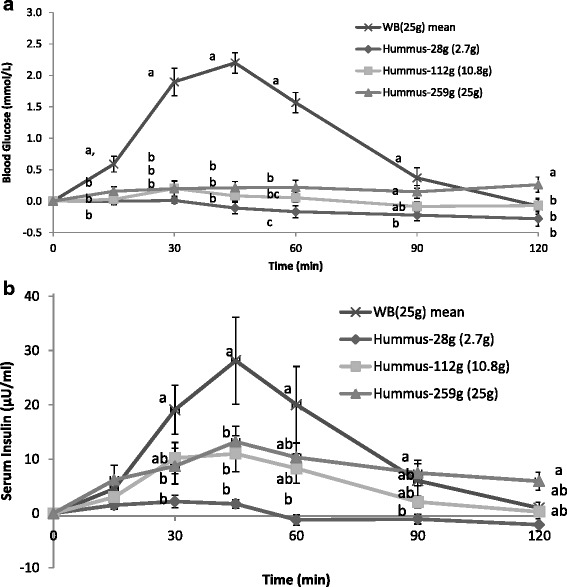
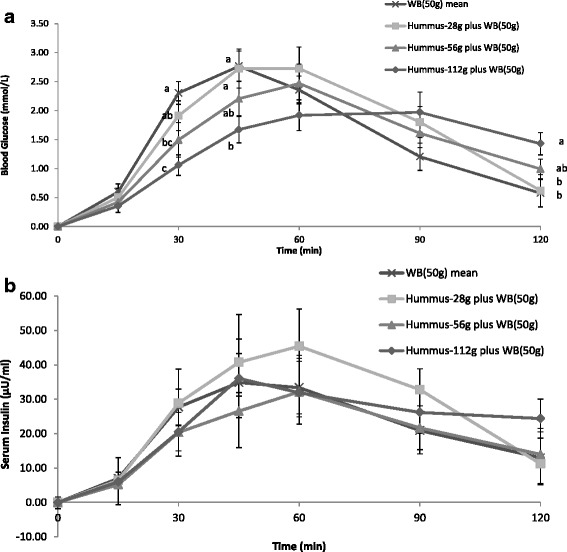
Ten healthy subjects each consumed 11 breakfast study meals in randomized order over a period of 15 weeks. Hummus was consumed alone at three doses (2.7 g, 10.8 g and 25 g available carbohydrate [avCHO] portions) and with 50 g avCHO from white bread at three doses (2.7 g, 5.4 g and 10.8 g avCHO portions). The responses elicited by hummus alone were compared with 25 g avCHO portions of white bread, while those after hummus plus white bread were compared with 50 g avCHO from white bread. Plasma glucose and serum insulin responses were monitored over two hours and the GI and insulin index (II) calculated using standard methodology.
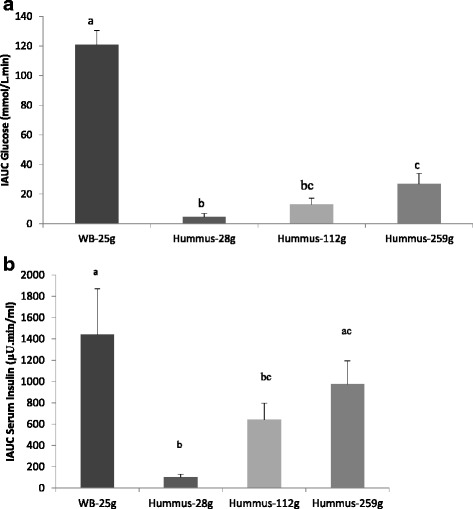
The GI and II of hummus were 15 ± 3 and 52 ± 13, respectively, and were significantly lower than white bread (P < 0.05). The glucose and insulin incremental area under the curve (IAUC) for hummus alone were significantly lower than white bread except for insulin IAUC of hummus 25 g avCHO. The peak rise of blood glucose and insulin after hummus were significantly lower than after white bread. Glucose and insulin IAUC after adding hummus to bread did not differ significantly from white bread alone. However the blood glucose 45 min after adding 25 g avCHO from hummus to white bread was significantly lower while at 120 min it was significantly higher than after white bread alone.
This study demonstrated that, similar to chickpeas, hummus has a very low GI and II. Postprandial glucose responses were 4 times less than that of white bread and did not compromise insulin levels.
豆类是低血糖指数(GI)食物,与降低心脏病、糖尿病和某些癌症的风险有关。然而,鹰嘴豆泥(一种含有鹰嘴豆的食物)对血糖和胰岛素的反应尚未得到充分测试。
10名健康受试者在15周内按随机顺序各食用11顿早餐研究餐。单独食用三种剂量(2.7克、10.8克和25克可利用碳水化合物[avCHO]份)的鹰嘴豆泥,以及与50克avCHO的白面包搭配食用三种剂量(2.7克、5.4克和10.8克avCHO份)的鹰嘴豆泥。将单独食用鹰嘴豆泥引起的反应与25克avCHO份的白面包进行比较,而将鹰嘴豆泥加白面包后的反应与50克avCHO的白面包进行比较。在两小时内监测血浆葡萄糖和血清胰岛素反应,并使用标准方法计算GI和胰岛素指数(II)。
鹰嘴豆泥的GI和II分别为15±3和52±13,显著低于白面包(P<0.05)。单独食用鹰嘴豆泥时,葡萄糖和胰岛素曲线下增量面积(IAUC)除鹰嘴豆泥25克avCHO的胰岛素IAUC外,均显著低于白面包。鹰嘴豆泥后血糖和胰岛素的峰值升高显著低于白面包后。在面包中添加鹰嘴豆泥后的葡萄糖和胰岛素IAUC与单独食用白面包无显著差异。然而,在白面包中添加25克avCHO的鹰嘴豆泥后45分钟的血糖显著低于单独食用白面包后,而在120分钟时则显著高于单独食用白面包后。
本研究表明,与鹰嘴豆类似,鹰嘴豆泥的GI和II非常低。餐后葡萄糖反应比白面包少4倍,且不影响胰岛素水平。