Zhang Ya-Nan, Vernooij Flora, Ibrahim Irwani, Ooi Shirley, Gijsberts Crystel M, Schoneveld Arjan H, Sen Kuan Win, den Ruijter Hester M, Timmers Leo, Richards Arthur Mark, Jong Chun Tzen, Mazlan Ibrahim, Wang Jiong-Wei, Lam Carolyn S P, de Kleijn Dominique P V
Department of Surgery, Yong Loo Lin School of Medicine, National University of Singapore, Singapore, Singapore.
Cardiovascular Research Institute, National University Heart Centre Singapore; National University Health System Singapore, Singapore, Singapore.
PLoS One. 2016 Jan 28;11(1):e0148073. doi: 10.1371/journal.pone.0148073. eCollection 2016.
SerpinF2, SerpinG1, CystatinC and CD14 are involved in inflammatory processes and plasma extracellular vesicle (EV) -levels of these proteins have been reported to be associated with systemic vascular events. Evidence is accumulating that inflammatory processes may play a pivotal role both in systemic vascular events and in heart failure. Therefore, we studied the association between plasma extracellular vesicle SerpinF2-, SerpinG1-, CystatinC and CD14-levels and the occurrence of acute heart failure in patients.
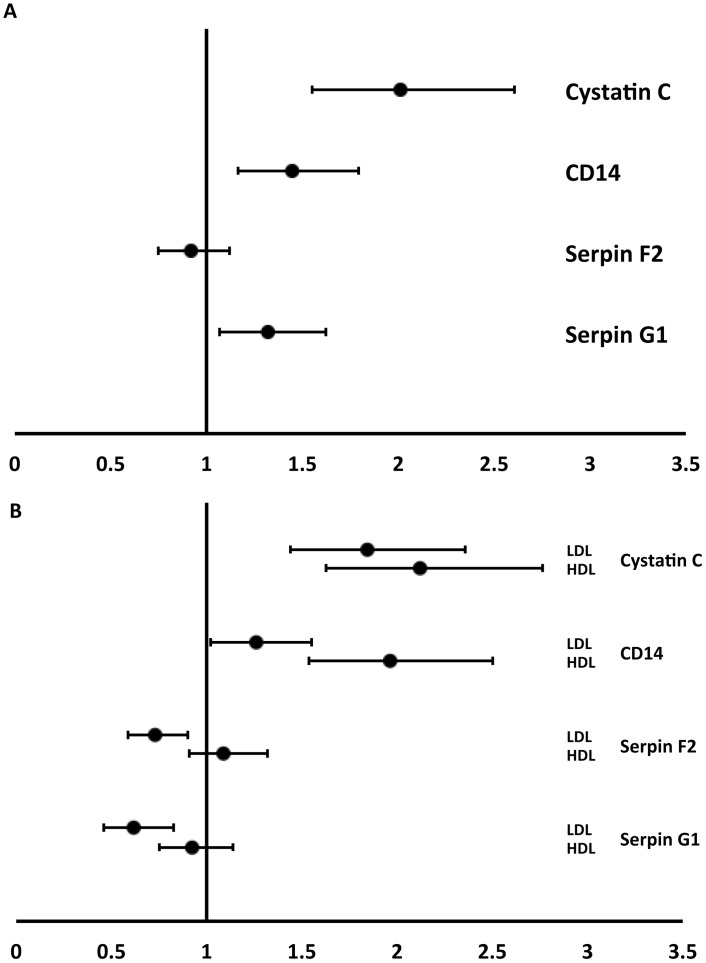
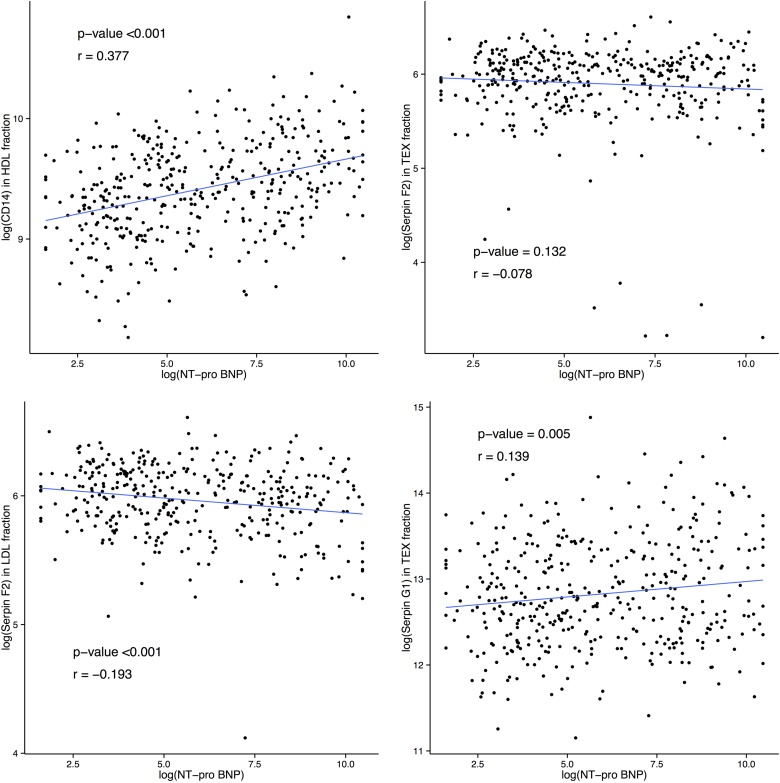
Extracellular vesicle protein levels of SerpinG1, SerpinF2, CystatinC and CD14 were measured in an observational study of 404 subjects presenting with dysponea at the emergency department (4B-cohort). Plasma extracellular vesicles were precipitated in a total extracellular vesicles (TEX)-fraction and in separate LDL- and HDL-subfractions. Extracellular vesicle protein levels were measured with a quantitative immune assay in all 3 precipitates. Out of 404 subjects, 141 (35%) were diagnosed with acutely decompensated heart failure. After correction for confounders (including comorbidities and medications), levels of CD14 in the HDL-fraction (OR 1.53, p = 0.01), SerpinF2 in the TEX-and LDL-fraction (ORs respectively 0.71 and 0.65, p<0.05) and SerpinG1 in the TEX-fraction (OR 1.55, p = 0.004) were statistically significantly related to heart failure. Furthermore, extracellular vesicle CD14- and SerpinF2-levels were significantly higher in heart failure patients with preserved ejection fraction than in those with reduced ejection fraction.
Extracellular vesicle levels of CD14, SerpinG1 and SerpinF2 are associated with the occurrence of heart failure in subjects suspected for acute heart failure, suggesting common underlying pathophysiological mechanisms for heart failure and vascular events.
丝氨酸蛋白酶抑制剂F2(SerpinF2)、丝氨酸蛋白酶抑制剂G1(SerpinG1)、胱抑素C(CystatinC)和CD14参与炎症过程,据报道这些蛋白质的血浆细胞外囊泡(EV)水平与全身血管事件有关。越来越多的证据表明,炎症过程可能在全身血管事件和心力衰竭中都起关键作用。因此,我们研究了血浆细胞外囊泡SerpinF2、SerpinG1、CystatinC和CD14水平与患者急性心力衰竭发生之间的关联。
在一项对404名因呼吸困难到急诊科就诊的受试者(4B队列)的观察性研究中,测量了SerpinG1、SerpinF2、CystatinC和CD14的细胞外囊泡蛋白水平。血浆细胞外囊泡沉淀在总细胞外囊泡(TEX)组分以及单独的低密度脂蛋白(LDL)和高密度脂蛋白(HDL)亚组分中。在所有3种沉淀物中用定量免疫测定法测量细胞外囊泡蛋白水平。在404名受试者中,141名(35%)被诊断为急性失代偿性心力衰竭。在校正混杂因素(包括合并症和药物治疗)后,HDL组分中的CD14水平(比值比[OR]1.53,p = 0.01)、TEX和LDL组分中的SerpinF2水平(OR分别为0.71和0.65,p<0.05)以及TEX组分中的SerpinG1水平(OR 1.55,p = 0.004)与心力衰竭在统计学上显著相关。此外,射血分数保留的心力衰竭患者的细胞外囊泡CD14和SerpinF2水平显著高于射血分数降低的患者。
CD14、SerpinG1和SerpinF2的细胞外囊泡水平与疑似急性心力衰竭患者的心力衰竭发生有关,提示心力衰竭和血管事件存在共同的潜在病理生理机制。