Koelsch Stefan, Busch Tobias, Jentschke Sebastian, Rohrmeier Martin
University of Bergen, Department for Biological and Medical Psychology, Bergen, 5009, Norway.
Freie Universität Berlin, Department for Educational Sciences and Psychology, Berlin, 14195, Germany.
Sci Rep. 2016 Feb 2;6:19741. doi: 10.1038/srep19741.
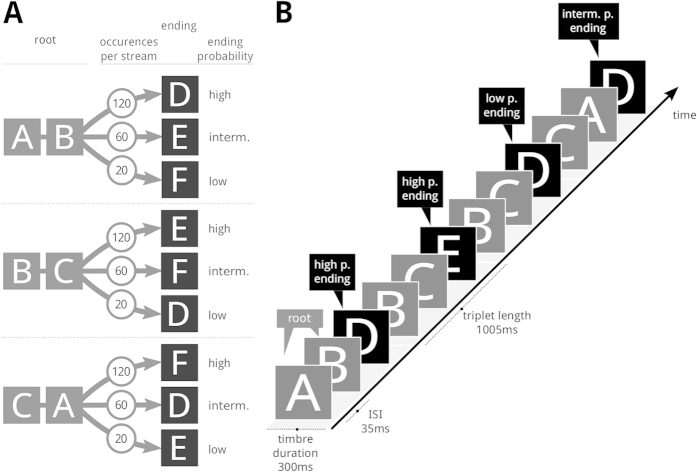
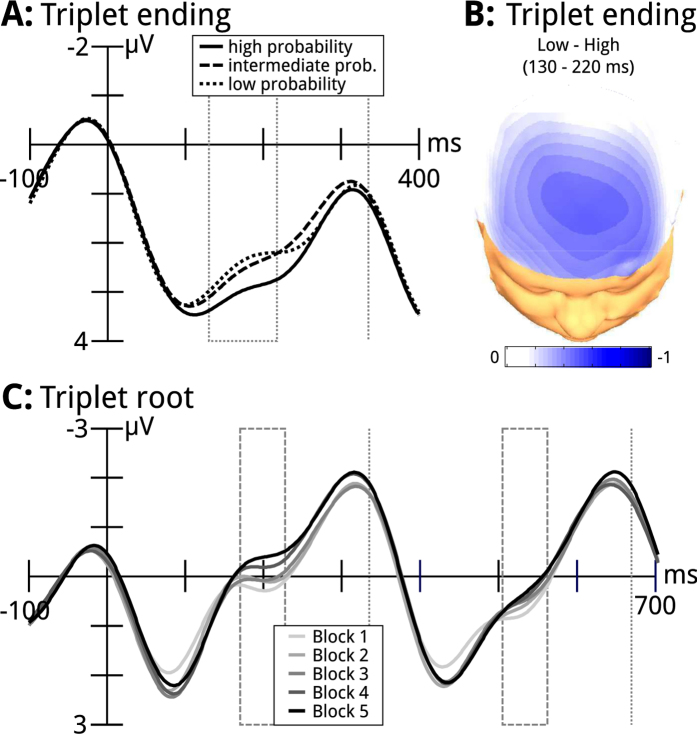
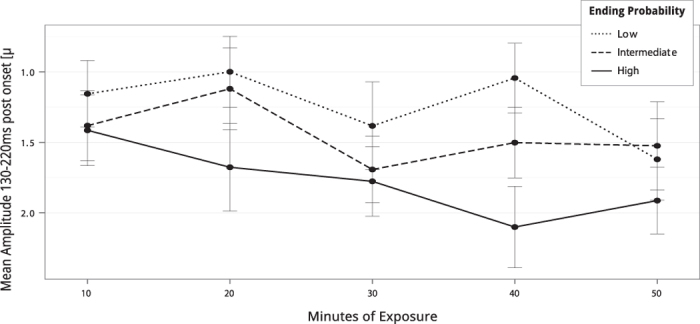
Within the framework of statistical learning, many behavioural studies investigated the processing of unpredicted events. However, surprisingly few neurophysiological studies are available on this topic, and no statistical learning experiment has investigated electroencephalographic (EEG) correlates of processing events with different transition probabilities. We carried out an EEG study with a novel variant of the established statistical learning paradigm. Timbres were presented in isochronous sequences of triplets. The first two sounds of all triplets were equiprobable, while the third sound occurred with either low (10%), intermediate (30%), or high (60%) probability. Thus, the occurrence probability of the third item of each triplet (given the first two items) was varied. Compared to high-probability triplet endings, endings with low and intermediate probability elicited an early anterior negativity that had an onset around 100 ms and was maximal at around 180 ms. This effect was larger for events with low than for events with intermediate probability. Our results reveal that, when predictions are based on statistical learning, events that do not match a prediction evoke an early anterior negativity, with the amplitude of this mismatch response being inversely related to the probability of such events. Thus, we report a statistical mismatch negativity (sMMN) that reflects statistical learning of transitional probability distributions that go beyond auditory sensory memory capabilities.
在统计学习的框架内,许多行为学研究探讨了对意外事件的处理。然而,令人惊讶的是,关于这一主题的神经生理学研究却很少,而且没有统计学习实验研究过处理具有不同转换概率的事件时的脑电图(EEG)相关性。我们采用已确立的统计学习范式的一种新变体进行了一项脑电图研究。音色以三连音的等时序列呈现。所有三连音的前两个声音出现的概率相等,而第三个声音出现的概率为低(10%)、中(30%)或高(60%)。因此,每个三连音中第三个音(在前两个音之后)的出现概率是变化的。与高概率三连音结尾相比,低概率和中概率结尾引发了一种早期的前部负波,其起始时间约为100毫秒,在180毫秒左右达到最大值。这种效应在低概率事件中比在中概率事件中更大。我们的结果表明,当基于统计学习进行预测时,与预测不匹配的事件会引发早期前部负波,这种失配反应的幅度与此类事件的概率呈负相关。因此,我们报告了一种统计失配负波(sMMN),它反映了超出听觉感觉记忆能力的转换概率分布的统计学习。