Henkenberens C, Janssen S, Lavae-Mokhtari M, Leni K, Meyer A, Christiansen H, Bremer M, Dickgreber N
Department of Radiation Oncology, Hannover Medical School, Carl-Neuberg-Str. 1, 30625, Hannover, Germany.
Department of Radiotherapy and Special Oncology, Hannover Medical School, Carl-Neuberg-Str. 1, 30625, Hannover, Germany.
Radiat Oncol. 2016 Feb 2;11:12. doi: 10.1186/s13014-016-0580-3.
To assess efficacy of our single-centre experience with inhalative steroids (IS) in lung cancer patients with symptomatic radiation pneumonitis (RP) grade II.
Between 05/09 and 07/10, 24 patients (female, n = 8; male, n = 16) with lung cancer (non-small cell lung carcinoma [NSCLC]: n = 19; small cell lung cancer [SCLC]: n = 3; unknown histology: n = 2) and good performance status (ECOG ≤1) received definitive radiotherapy to the primary tumour site and involved lymph nodes with concurrent chemotherapy (n = 18), sequential chemotherapy (n = 2) or radiation only (n = 4) and developed symptomatic RP grade II during follow-up. No patient presented with oxygen requiring RP grade III. The mean age at diagnosis was 66 years (range: 50-82 years). Nine patients suffered from chronic obstructive pulmonary disease (COPD) before treatment, and 18 patients had a smoking history (median pack years: 48). The mean lung dose was 15.5 Gy (range: 3.0-23.1 Gy). All patients were treated with IS. If a patient's clinical symptoms did not significantly improve within two weeks of IS therapy initiation, their treatment was switched to oral prednisolone.
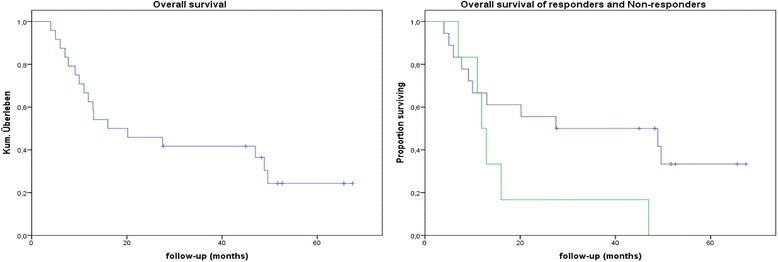
All 24 patients were initially treated with a high dose IS (budesonide 800 μg 1-0-1) for 14 days. Of the patients, 18 showed a significant improvement of clinical symptoms and 6 patients did not show significant improvement of clinical symptoms and were classified as non-responders to IS. Their treatment was switched to oral steroids after two weeks (starting with oral prednisolone, 0.5 mg/kg bodyweight; at least 50 mg per day). All of these patients responded to the prednisolone. None of non-responders presented with increased symptoms of RP and required oxygen and / or hospitalization (RP grade III). The median follow-up after IS treatment initiation was 18 months (range: 4-66 months). The median duration of IS treatment and prednisolone treatment was 8.2 months (range: 3.0-48.3 months) and 11.4 months (range: 5.0-44.0 months), respectively. Of the 18 IS treatment responders, 2 (11.1 %) patients with pre-existing grade 2 COPD still required IS (400 μg twice a day) 45.0 and 48.3 months after radiotherapy, respectively. For the remaining 16 responders (88.9 %), IS therapy was stopped after 7.7 months (range: 3.0-18.2 months). None of the patients treated with IS developed any specific IS-related side effects such as oral candidiasis.
This single-centre experience shows that high-dose IS is an individual treatment option for radiation-induced pneumonitis grade II in patients with a good performance status.
评估我们单中心使用吸入性类固醇(IS)治疗有症状的Ⅱ级放射性肺炎(RP)肺癌患者的疗效。
2009年5月至2010年7月期间,24例患者(女性8例;男性16例)患有肺癌(非小细胞肺癌[NSCLC]:19例;小细胞肺癌[SCLC]:3例;组织学类型未知:2例)且体能状态良好(东部肿瘤协作组[ECOG]≤1),接受了原发肿瘤部位及受累淋巴结的根治性放疗,同时接受化疗(18例)、序贯化疗(2例)或单纯放疗(4例),并在随访期间出现了有症状的Ⅱ级RP。无患者出现需要吸氧的Ⅲ级RP。诊断时的平均年龄为66岁(范围:50 - 82岁)。9例患者在治疗前患有慢性阻塞性肺疾病(COPD),18例患者有吸烟史(中位吸烟包年数:48)。平均肺剂量为15.5 Gy(范围:3.0 - 23.1 Gy)。所有患者均接受IS治疗。如果患者在开始IS治疗两周内临床症状未显著改善,则将其治疗改为口服泼尼松龙。
所有24例患者最初均接受高剂量IS(布地奈德800μg 1 - 0 - 1)治疗14天。其中,18例患者临床症状显著改善,6例患者临床症状未显著改善,被归类为对IS无反应者。两周后他们的治疗改为口服类固醇(开始为口服泼尼松龙,0.5mg/kg体重;每日至少50mg)。所有这些患者对泼尼松龙均有反应。无反应者均未出现RP症状加重且无需吸氧和/或住院(Ⅲ级RP)。开始IS治疗后的中位随访时间为18个月(范围:4 - 66个月)。IS治疗和泼尼松龙治疗的中位持续时间分别为8.2个月(范围:3.0 - 48.3个月)和11.4个月(范围:5.0 - 44.0个月)。在18例IS治疗有反应者中,2例(11.1%)既往有2级COPD的患者在放疗后45.0和48.3个月仍分别需要IS(每日400μg,分两次)。对于其余16例有反应者(88.9%),IS治疗在7.7个月(范围:3.0 - 18.2个月)后停止。接受IS治疗的患者均未出现任何特定的与IS相关的副作用,如口腔念珠菌病。
这一单中心经验表明,高剂量IS是体能状态良好的Ⅱ级放射性肺炎患者的一种个体化治疗选择。