Krupovic Mart, Koonin Eugene V
Unité Biologie Moléculaire du Gène chez les Extrêmophiles, Department of Microbiology, Institut Pasteur, Paris, France.
National Center for Biotechnology Information, National Library of Medicine, National Institutes of Health, Bethesda, MD 20894, USA.
Curr Opin Microbiol. 2016 Jun;31:25-33. doi: 10.1016/j.mib.2016.01.006. Epub 2016 Feb 1.
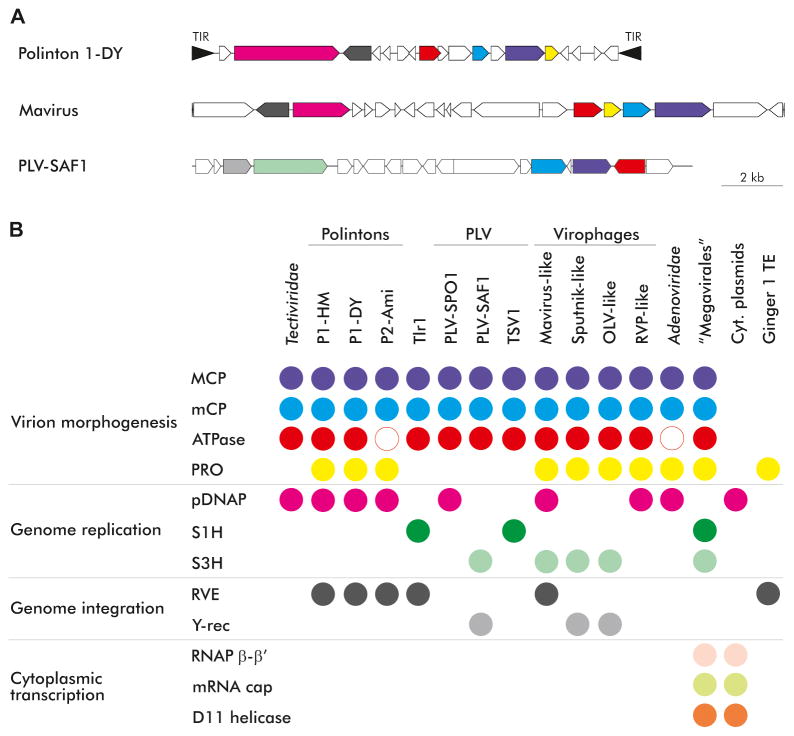
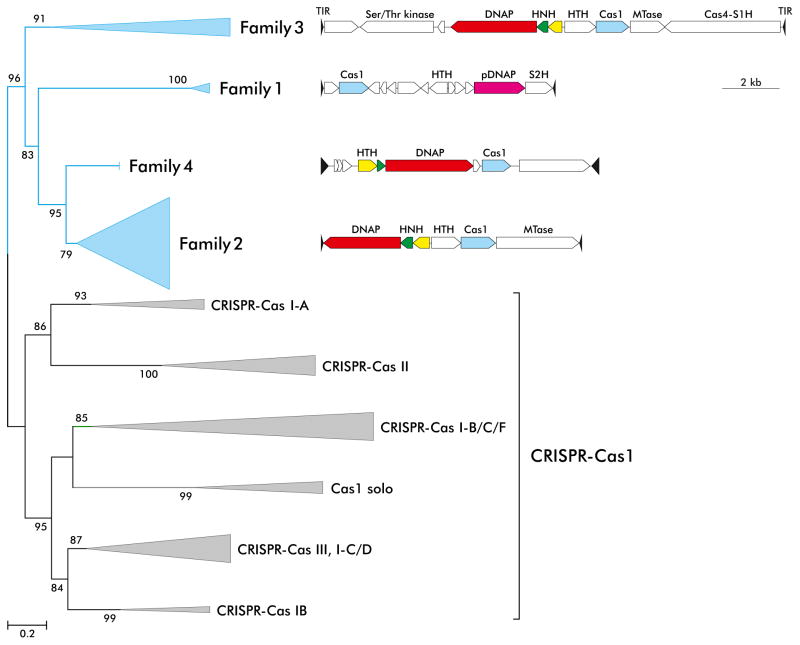
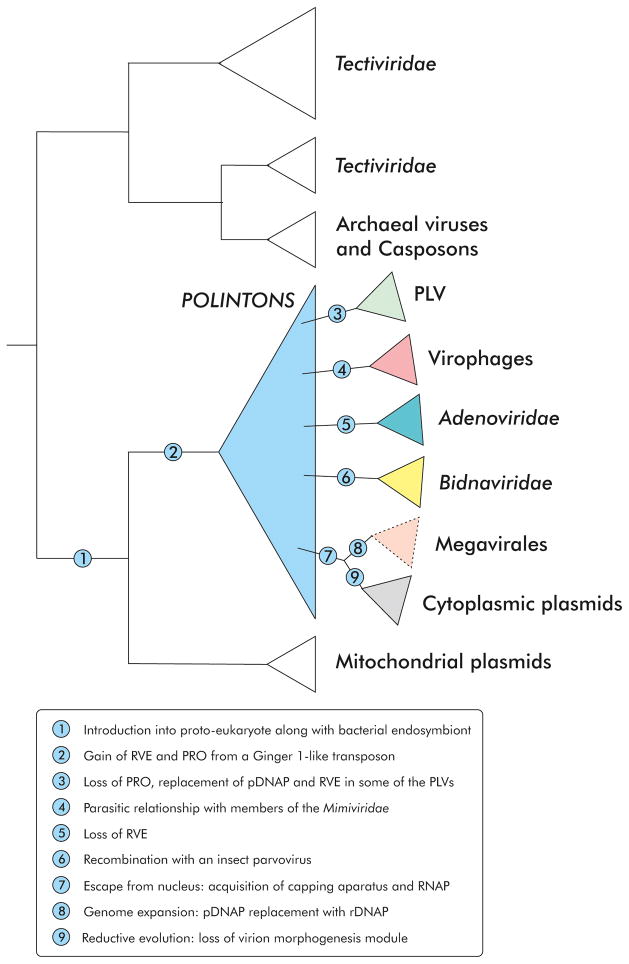
Self-synthesizing transposons are the largest known transposable elements that encode their own DNA polymerases (DNAP). The Polinton/Maverick family of self-synthesizing transposons is widespread in eukaryotes and abundant in the genomes of some protists. In addition to the DNAP and a retrovirus-like integrase, most of the polintons encode homologs of the major and minor jelly-roll capsid proteins, DNA-packaging ATPase and capsid maturation protease. Therefore, polintons are predicted to alternate between the transposon and viral lifestyles although virion formation remains to be demonstrated. Polintons are related to a group of eukaryotic viruses known as virophages that parasitize on giant viruses of the family Mimiviridae and another recently identified putative family of polinton-like viruses (PLV) predicted to lead a similar, dual life style. Comparative genomic analysis of polintons, virophages, PLV and the other viruses with double-stranded (ds)DNA genomes infecting eukaryotes and prokaryotes suggests that the polintons evolved from bacterial tectiviruses and could have been the ancestors of a broad range of eukaryotic viruses including adenoviruses and members of the proposed order 'Megavirales' as well as linear cytoplasmic plasmids. Recently, a group of predicted self-synthesizing transposons was discovered also in prokaryotes. These elements, denoted casposons, encode a DNAP and a homolog of the CRISPR-associated Cas1 endonuclease that has an integrase activity but no capsid proteins. Thus, unlike polintons, casposons appear to be limited to the transposon life style although they could have evolved from viruses. The casposons are thought to have played a pivotal role in the origin of the prokaryotic adaptive immunity, giving rise to the adaptation module of the CRISPR-Cas systems.
自我合成转座子是已知最大的可移动元件,它们编码自身的DNA聚合酶(DNAP)。自我合成转座子的Polinton/Maverick家族在真核生物中广泛存在,并且在一些原生生物的基因组中大量存在。除了DNAP和一种逆转录病毒样整合酶外,大多数Polinton还编码主要和次要果冻卷衣壳蛋白、DNA包装ATP酶和衣壳成熟蛋白酶的同源物。因此,尽管病毒体的形成仍有待证实,但预计Polinton会在转座子和病毒生活方式之间交替。Polinton与一组被称为噬病毒体的真核病毒有关,噬病毒体寄生于 Mimiviridae 科的巨型病毒以及另一个最近鉴定出的推测的类Polinton病毒(PLV)家族,预计它们也具有类似的双重生活方式。对Polinton、噬病毒体、PLV以及其他感染真核生物和原核生物的双链(ds)DNA基因组病毒的比较基因组分析表明,Polinton起源于细菌的覆盖病毒,并且可能是包括腺病毒和提议的“Megavirales”目成员以及线性细胞质质粒在内的多种真核病毒的祖先。最近,在原核生物中也发现了一组预测的自我合成转座子。这些元件被称为“casposons”,它们编码一种DNAP和CRISPR相关的Cas1核酸内切酶的同源物,该酶具有整合酶活性但没有衣壳蛋白。因此,与Polinton不同,casposons似乎仅限于转座子生活方式,尽管它们可能是从病毒进化而来的。人们认为casposons在原核生物适应性免疫的起源中发挥了关键作用,从而产生了CRISPR-Cas系统的适应模块。