Guo Hong, Cheng Tianhai, Gu Xingfa, Chen Hao, Wang Ying, Zheng Fengjie, Xiang Kunshen
State Key Laboratory of Remote Sensing Science, Institute of Remote Sensing and Digital Earth, Chinese Academy of Sciences, Beijing 100101, China.
Int J Environ Res Public Health. 2016 Jan 30;13(2):180. doi: 10.3390/ijerph13020180.
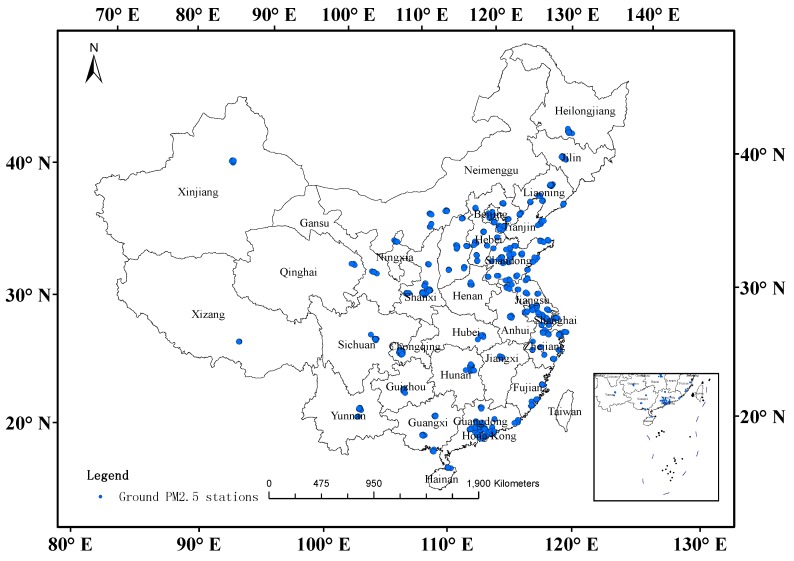
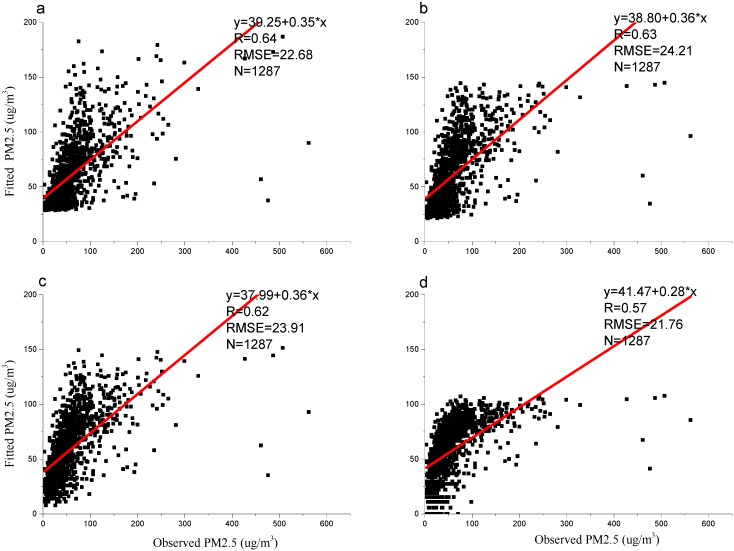
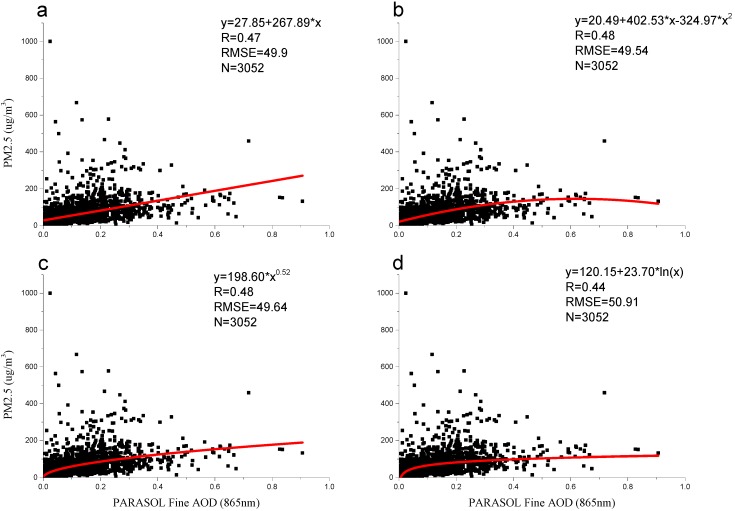
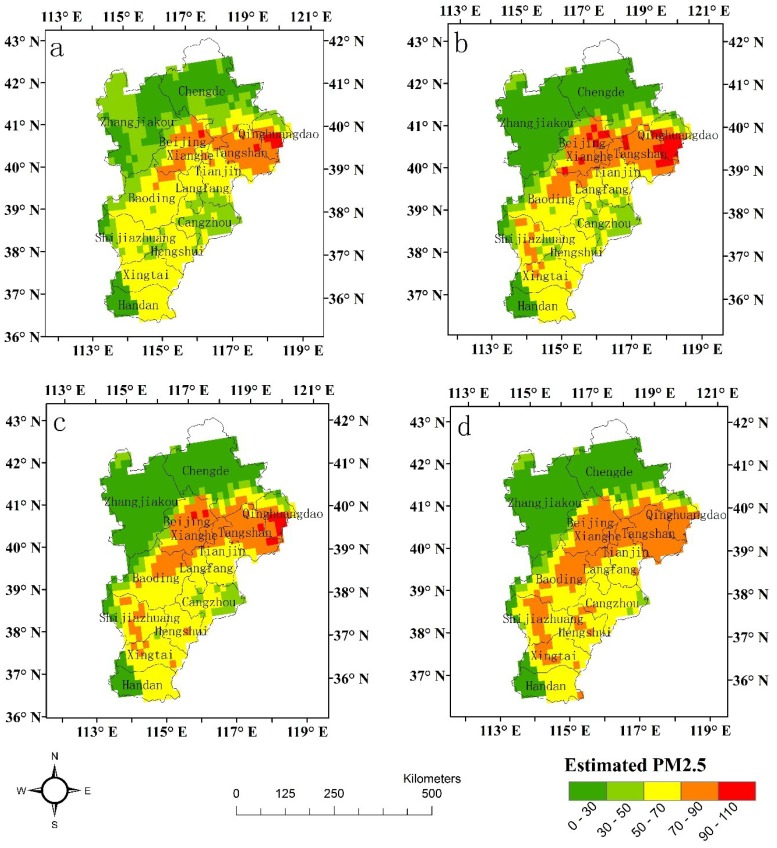
Satellite remote sensing is of considerable importance for estimating ground-level PM2.5 concentrations to support environmental agencies monitoring air quality. However, most current studies have focused mainly on the application of MODIS aerosol optical depth (AOD) to predict PM2.5 concentrations, while PARASOL AOD, which is sensitive to fine-mode aerosols over land surfaces, has received little attention. In this study, we compared a linear regression model, a quadratic regression model, a power regression model and a logarithmic regression model, which were developed using PARASOL level 2 AOD collected in China from 18 January 2013 to 10 October 2013. We obtained R (correlation coefficient) values of 0.64, 0.63, 0.62, and 0.57 for the four models when they were cross validated with the observed values. Furthermore, after all the data were classified into six levels according to the Air Quality Index (AQI), a low level of statistical significance between the four empirical models was found when the ground-level PM2.5 concentrations were greater than 75 μg/m³. The maximum R value was 0.44 (for the logarithmic regression model and the power model), and the minimum R value was 0.28 (for the logarithmic regression model and the power model) when the PM2.5 concentrations were less than 75 μg/m³. We also discussed uncertainty sources and possible improvements.
卫星遥感对于估算地面PM2.5浓度以支持环境机构监测空气质量具有相当重要的意义。然而,目前大多数研究主要集中在应用中分辨率成像光谱仪(MODIS)气溶胶光学厚度(AOD)来预测PM2.5浓度,而对陆地表面细模态气溶胶敏感的光探测和大气遥感卫星(PARASOL)AOD却很少受到关注。在本研究中,我们比较了利用2013年1月18日至2013年10月10日在中国收集的PARASOL二级AOD数据建立的线性回归模型、二次回归模型、幂回归模型和对数回归模型。当这四个模型与观测值进行交叉验证时,我们得到的相关系数(R)值分别为0.64、0.63、0.62和0.57。此外,根据空气质量指数(AQI)将所有数据分为六个等级后,当地面PM2.5浓度大于75μg/m³时,发现这四个经验模型之间的统计显著性水平较低。当PM2.5浓度小于75μg/m³时,最大R值为0.44(对数回归模型和幂模型),最小R值为0.28(对数回归模型和幂模型)。我们还讨论了不确定性来源和可能的改进措施。