Gelormino Elena, Melis Giulia, Marietta Cristina, Costa Giuseppe
Department of Public Health, Local Health Authority TO5, Piedmont Region, Italy.
Environmental Heritage and Urban Redevelopment - SiTI Higher Institute on Territorial Systems for Innovation, Turin, via Pier Carlo Boggio 61, 10138 Torino, Italy.
Prev Med Rep. 2015 Sep 4;2:737-45. doi: 10.1016/j.pmedr.2015.08.019. eCollection 2015.
The Health in All Policies strategy aims to engage every policy domain in health promotion. The more socially disadvantaged groups are usually more affected by potential negative impacts of policies if they are not health oriented. The built environment represents an important policy domain and, apart from its housing component, its impact on health inequalities is seldom assessed.
A scoping review of evidence on the built environment and its health equity impact was carried out, searching both urban and medical literature since 2000 analysing socio-economic inequalities in relation to different components of the built environment.
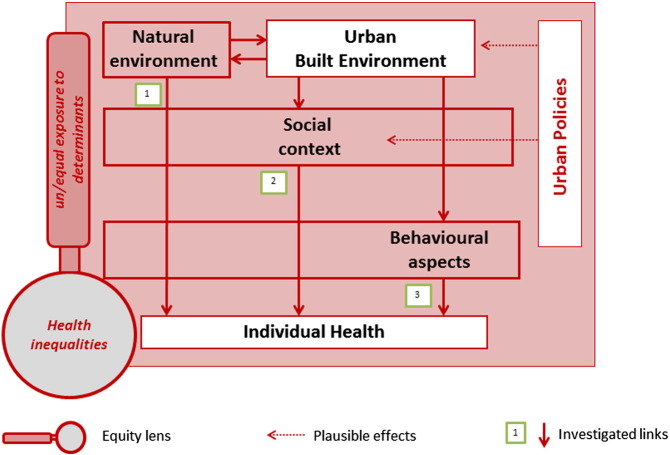
The proposed explanatory framework assumes that key features of built environment (identified as density, functional mix and public spaces and services), may influence individual health through their impact on both natural environment and social context, as well as behaviours, and that these effects may be unequally distributed according to the social position of individuals.
In general, the expected links proposed by the framework are well documented in the literature; however, evidence of their impact on health inequalities remains uncertain due to confounding factors, heterogeneity in study design, and difficulty to generalize evidence that is still very embedded to local contexts.
“健康融入所有政策”战略旨在让每个政策领域都参与到健康促进工作中。如果政策不以健康为导向,那么社会经济地位较低的群体通常更容易受到政策潜在负面影响的影响。建成环境是一个重要的政策领域,除了其住房组成部分外,其对健康不平等的影响很少得到评估。
对建成环境及其健康公平影响的证据进行了范围审查,检索了2000年以来的城市和医学文献,分析了与建成环境不同组成部分相关的社会经济不平等。
所提出的解释框架假定,建成环境的关键特征(确定为密度、功能混合以及公共空间和服务)可能通过对自然环境和社会环境以及行为的影响来影响个人健康,并且这些影响可能根据个人的社会地位而不平等地分布。
总体而言,该框架提出的预期联系在文献中有充分记载;然而,由于混杂因素、研究设计的异质性以及难以将仍然非常局限于当地背景的证据进行推广,其对健康不平等影响的证据仍不确定。