Doctoral Program in Sports Medicine, Graduate School of Comprehensive Human Sciences, University of Tsukuba, Tennodai 1-1-1, Tsukuba 305-8574, Ibaraki, Japan.
International Institute for Integrative Sleep Medicine, University of Tsukuba, Tennodai 1-1-1, Tsukuba 305-8574, Ibaraki, Japan.
EBioMedicine. 2015 Oct 30;2(12):2003-9. doi: 10.1016/j.ebiom.2015.10.029. eCollection 2015 Dec.
As part of the growing lifestyle diversity in modern society, there is wide variation in the time of day individuals choose to exercise. Recent surveys in the US and Japan have reported that on weekdays, more people exercise in the evening, with fewer individuals exercising in the morning or afternoon. Exercise performed in the post-prandial state has little effect on accumulated fat oxidation over 24 h (24-h fat oxidation) when energy intake is matched to energy expenditure (energy-balanced condition). The present study explored the possibility that exercise increases 24-h fat oxidation only when performed in a post-absorptive state, i.e. before breakfast.
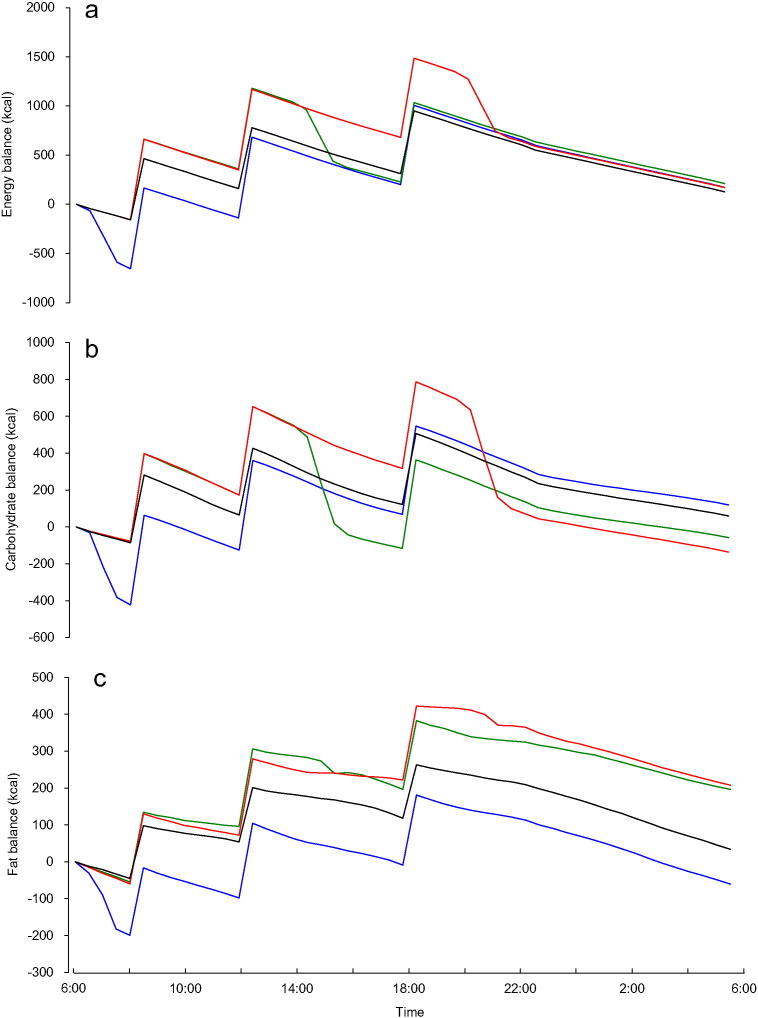
Indirect calorimetry using a metabolic chamber was performed in 10 young, non-obese men over 24 h. Subjects remained sedentary (control) or performed 60-min exercise before breakfast (morning), after lunch (afternoon), or after dinner (evening) at 50% of VO2max. All trials were designed to be energy balanced over 24 h. Time course of energy and substrate balance relative to the start of calorimetry were estimated from the differences between input (meal consumption) and output (oxidation).
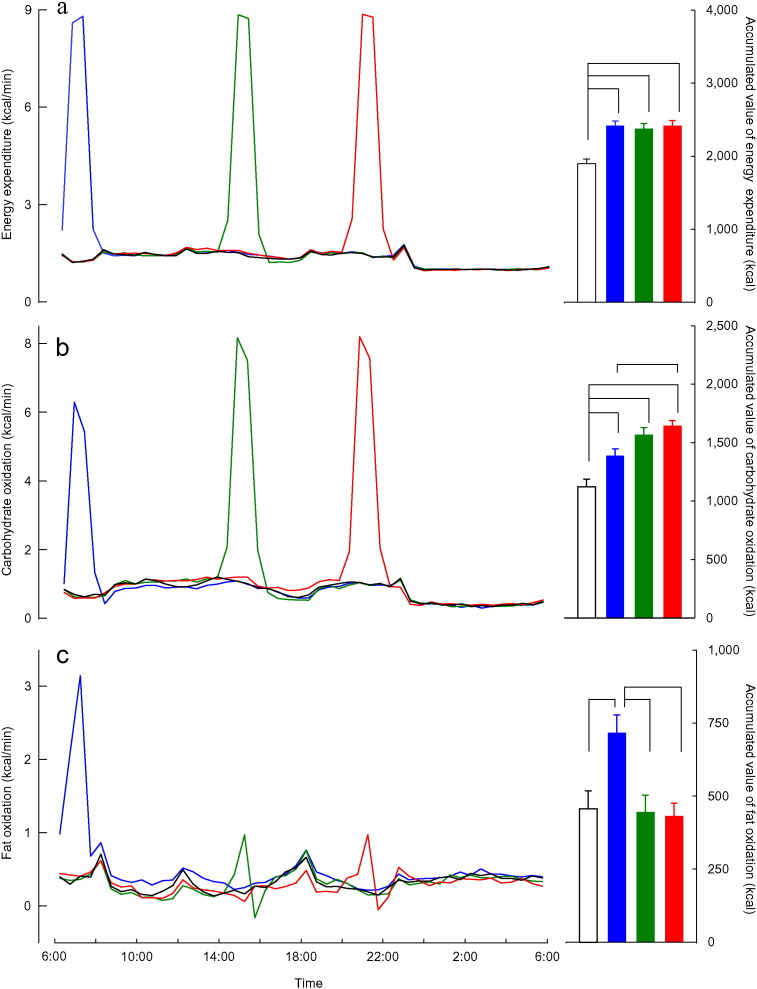
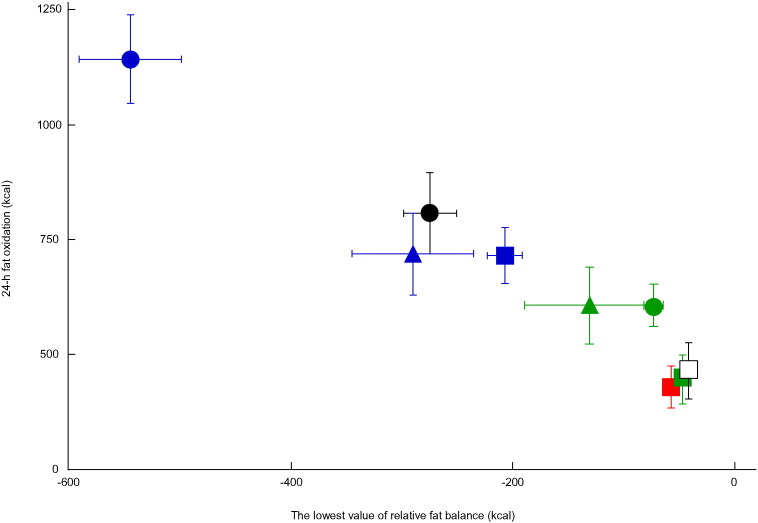
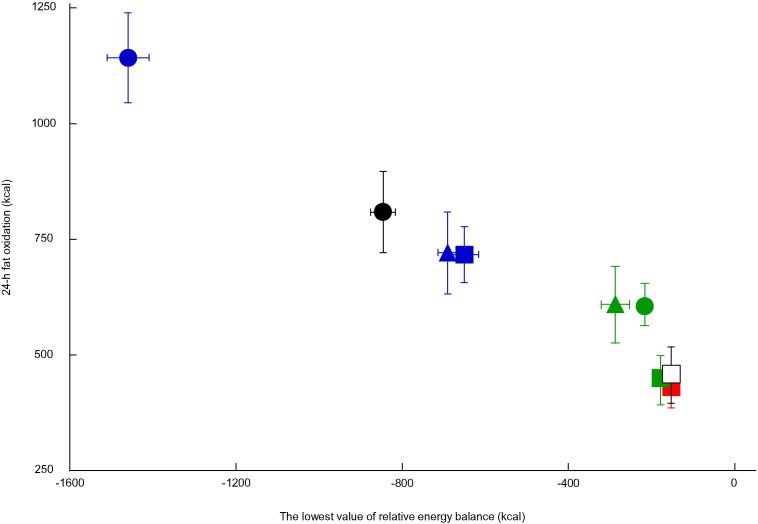
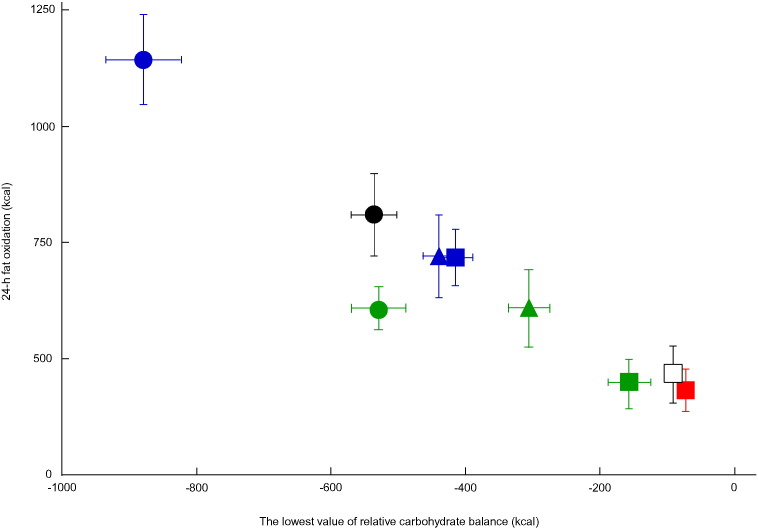
Fat oxidation over 24 h was increased only when exercise was performed before breakfast (control, 456 ± 61; morning, 717 ± 64; afternoon, 446 ± 57; and evening, 432 ± 44 kcal/day). Fat oxidation over 24 h was negatively correlated with the magnitude of the transient deficit in energy and carbohydrate.
Under energy-balanced conditions, 24-h fat oxidation was increased by exercise only when performed before breakfast. Transient carbohydrate deficits, i.e., glycogen depletion, observed after morning exercise may have contributed to increased 24-h fat oxidation.
随着现代社会生活方式多样化的发展,人们选择锻炼的时间也存在广泛差异。最近在美国和日本的调查显示,在工作日,更多的人选择在晚上锻炼,而选择在早上或下午锻炼的人较少。在能量摄入与能量消耗相匹配的能量平衡状态下,餐后进行的运动对 24 小时(24 小时脂肪氧化)内累积脂肪氧化的影响很小。本研究探讨了只有在吸收后状态下(即早餐前)进行运动才能增加 24 小时脂肪氧化的可能性。
通过代谢室进行间接热量测定,对 10 名年轻、非肥胖男性进行了 24 小时的测试。受试者保持静止(对照)或在早餐前(早上)、午餐后(下午)或晚餐后(晚上)以 50%的最大摄氧量进行 60 分钟的运动。所有试验均设计为在 24 小时内能量平衡。通过比较输入(膳食消耗)和输出(氧化)之间的差异,从热量测定开始的能量和底物平衡的时间过程进行估计。
只有在早餐前进行运动时,24 小时脂肪氧化才会增加(对照,456±61;早上,717±64;下午,446±57;晚上,432±44 千卡/天)。24 小时脂肪氧化与能量和碳水化合物的瞬态亏损幅度呈负相关。
在能量平衡的条件下,只有在早餐前进行运动才能增加 24 小时脂肪氧化。早上运动后观察到的瞬态碳水化合物不足(即糖原耗竭)可能导致 24 小时脂肪氧化增加。