Donovan Rory M, Tapia Jose-Juan, Sullivan Devin P, Faeder James R, Murphy Robert F, Dittrich Markus, Zuckerman Daniel M
Joint CMU-Pitt Ph.D. Program in Computational Biology, Pittsburgh, Pennsylvania, United States of America.
Department of Computational and Systems Biology, School of Medicine, University of Pittsburgh, Pittsburgh, Pennsylvania, United States of America.
PLoS Comput Biol. 2016 Feb 4;12(2):e1004611. doi: 10.1371/journal.pcbi.1004611. eCollection 2016 Feb.
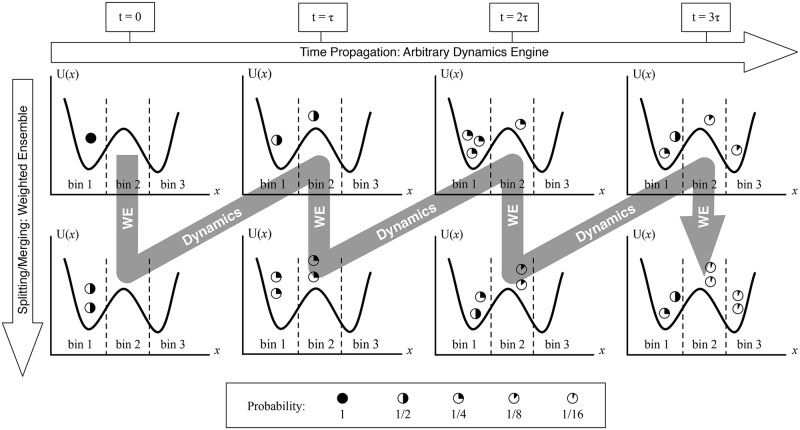
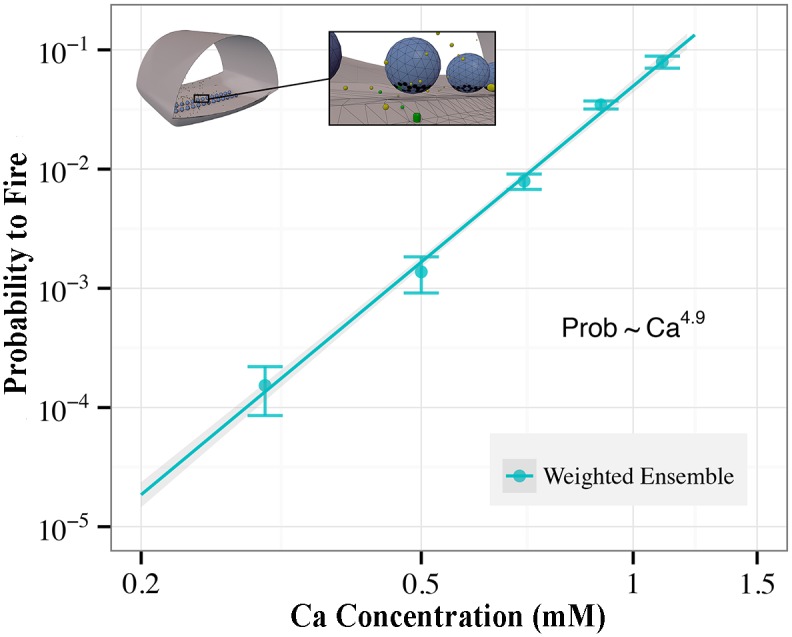
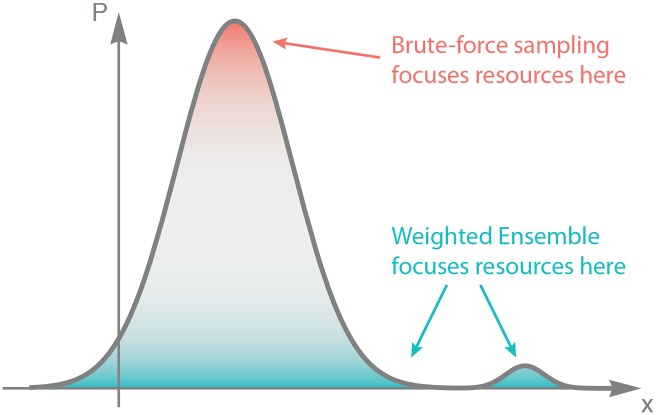
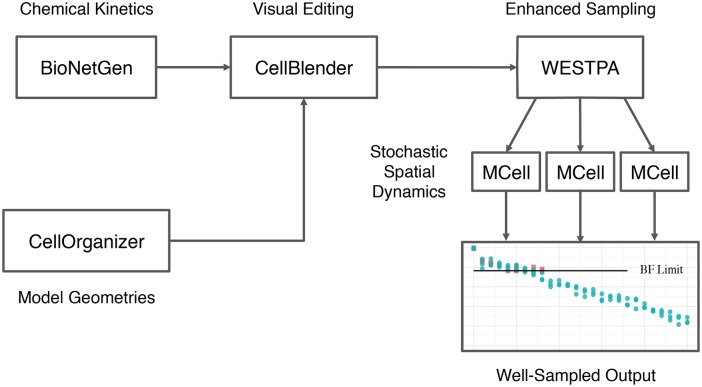
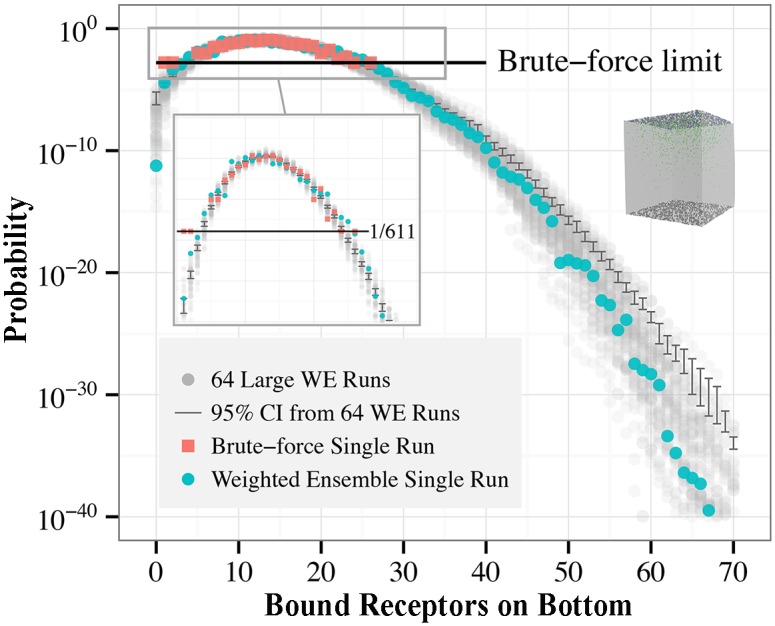
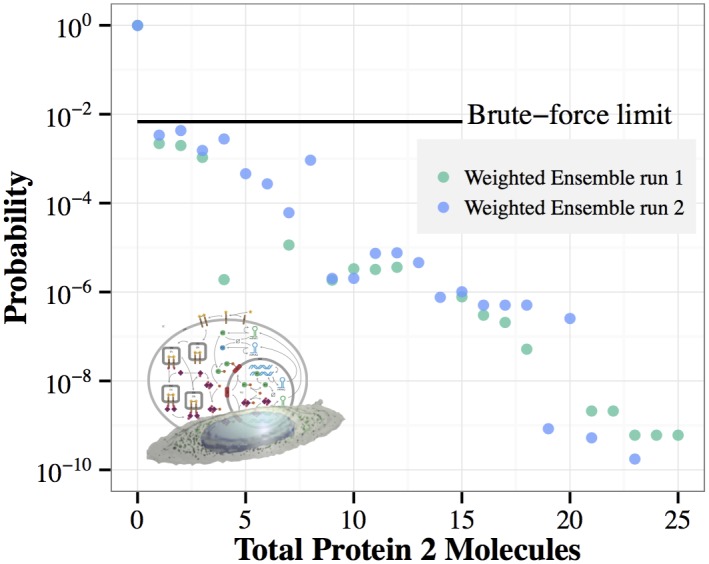
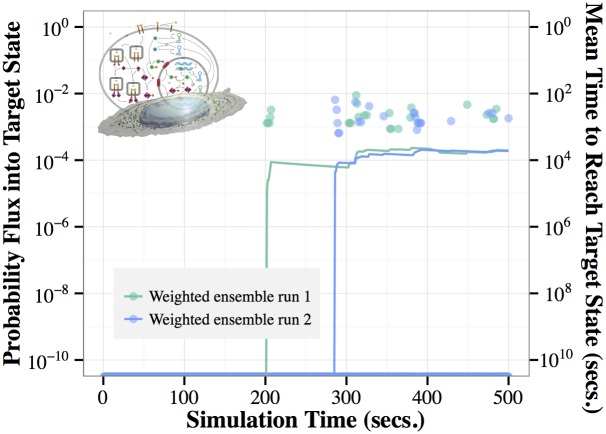
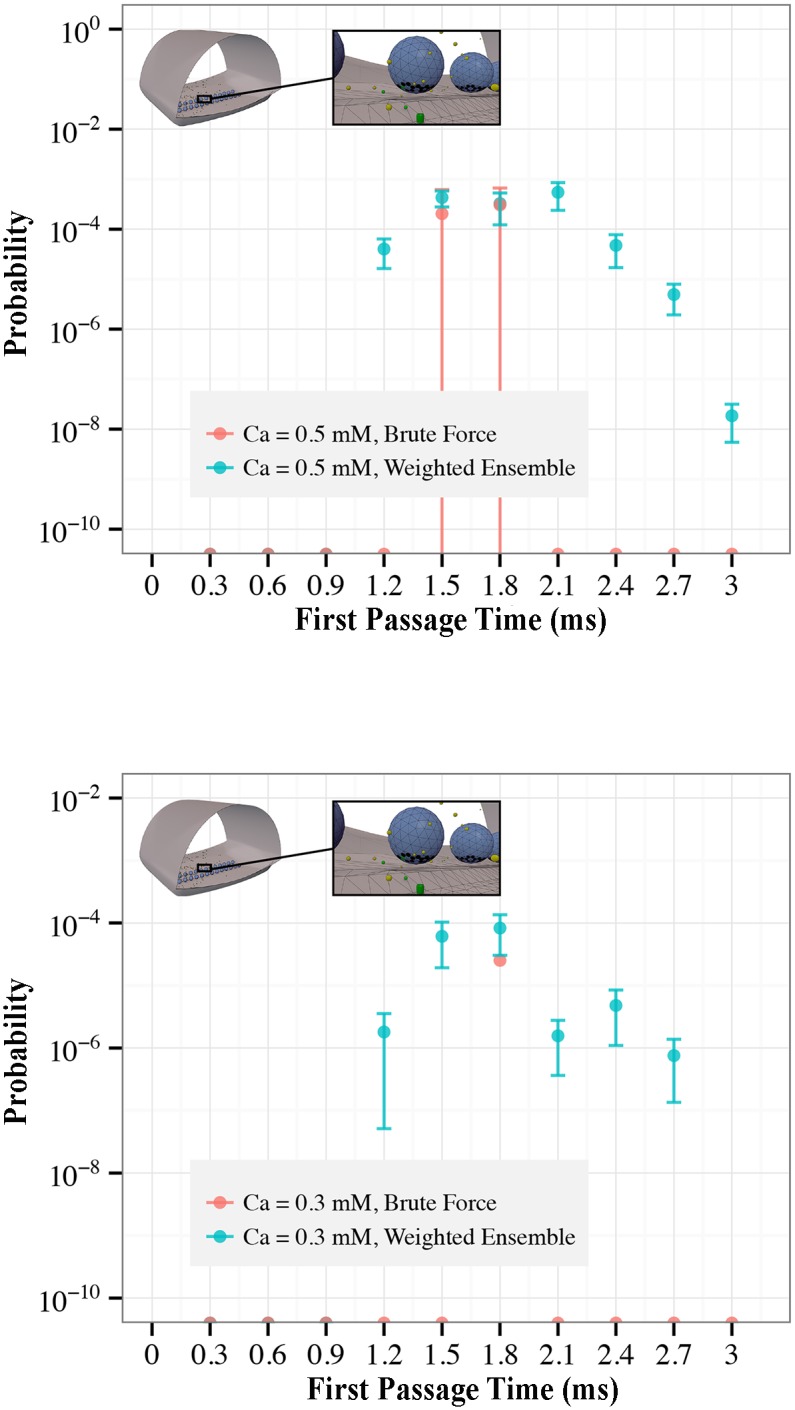
The long-term goal of connecting scales in biological simulation can be facilitated by scale-agnostic methods. We demonstrate that the weighted ensemble (WE) strategy, initially developed for molecular simulations, applies effectively to spatially resolved cell-scale simulations. The WE approach runs an ensemble of parallel trajectories with assigned weights and uses a statistical resampling strategy of replicating and pruning trajectories to focus computational effort on difficult-to-sample regions. The method can also generate unbiased estimates of non-equilibrium and equilibrium observables, sometimes with significantly less aggregate computing time than would be possible using standard parallelization. Here, we use WE to orchestrate particle-based kinetic Monte Carlo simulations, which include spatial geometry (e.g., of organelles, plasma membrane) and biochemical interactions among mobile molecular species. We study a series of models exhibiting spatial, temporal and biochemical complexity and show that although WE has important limitations, it can achieve performance significantly exceeding standard parallel simulation--by orders of magnitude for some observables.
尺度无关方法有助于实现生物模拟中连接不同尺度的长期目标。我们证明,最初为分子模拟开发的加权系综(WE)策略可有效地应用于空间分辨的细胞尺度模拟。WE方法运行一组带有指定权重的平行轨迹,并使用一种复制和修剪轨迹的统计重采样策略,将计算资源集中在难以采样的区域。该方法还可以生成非平衡和平衡可观测量的无偏估计,有时总计算时间比使用标准并行化方法要少得多。在这里,我们使用WE来编排基于粒子的动力学蒙特卡罗模拟,其中包括空间几何结构(如细胞器、质膜)以及可移动分子物种之间的生化相互作用。我们研究了一系列表现出空间、时间和生化复杂性的模型,结果表明,尽管WE有重要局限性,但它可以实现远超标准并行模拟的性能——对于某些可观测量,性能提升可达几个数量级。