Micalos Peter S, Arendt-Nielsen Lars
School of Biomedical Sciences, Charles Sturt University, Panorama Ave, Bathurst, NSW 2795 Australia.
Department for Health Sciences and Technology, Center for Sensory-Motor Interaction, School of Medicine, Aalborg University, Fredrik Bajers Vej 7-D3, Bld. D3, 9220 Ålborg, Denmark.
Springerplus. 2016 Jan 28;5:91. doi: 10.1186/s40064-016-1721-8. eCollection 2016.
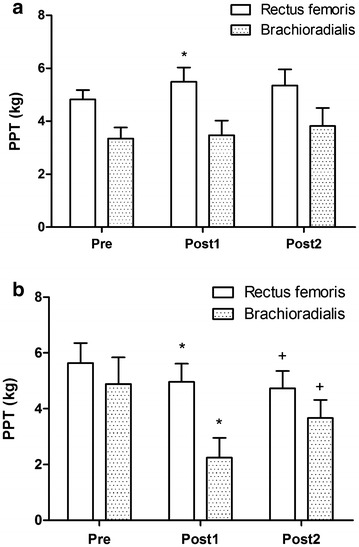
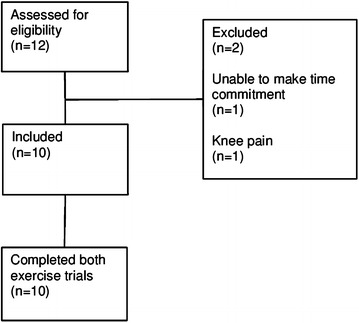
Physical exercise has been shown to inhibit experimental pain response in the post-exercise period. Modulation of the pain system may be differentiated between muscle sites engaging in contractile activity. The purpose of this study was to assess the pain response at remote and local muscle sites following aerobic exercise at different work intensities. Participants included 10 healthy and physically active males (mean age ± SD, 21.2 ± 3.4). Somatic pressure pain threshold (PPT) at the rectus femoris (local) and brachioradialis (remote) muscle site was measured at before (Pre), 5 min after (Post1), and 15 min after (Post2) aerobic cycling exercise at 70 and 30 % of peak oxygen uptake (VO2peak) performed on different occasions in a counterbalanced order, separated by minimum of 3 days interval. Repeated measures ANOVA for PPT reveals significant main effect for time (f = 3.581, p = 0.049, observed power = 0.588) and muscle site (f = 17.931, p = 0.002, observed power = 0.963). There was a significant interaction shown for exercise intensity by time (f = 11.390, p = 0.012, observed power = 0.790). PPT at rectus femoris following cycling exercise at 70 % of VO2peak reveals a significant increase between Pre-Post1 (p = 0.040). PPT for rectus femoris following cycling exercise at 30 % of VO2peak revealed a significant decrease between Pre-Post1 (p = 0.026) and Pre-Post2 (p = 0.008). The PPT for brachioradialis following cycling exercise at 30 % of VO2peak revealed a significant decrease between Pre-Post1 (p = 0.011) and Pre-Post2 (p = 0.005). These results show that aerobic exercise increases PPT locally at the exercise muscle site following exercise at 70 % of VO2peak but reduces PPT following exercise at 30 % of VO2peak.
体育锻炼已被证明在运动后的时间段内可抑制实验性疼痛反应。疼痛系统的调节可能因参与收缩活动的肌肉部位而异。本研究的目的是评估在不同工作强度下进行有氧运动后,远端和局部肌肉部位的疼痛反应。研究对象包括10名健康且有体育锻炼习惯的男性(平均年龄±标准差,21.2±3.4)。在以峰值摄氧量(VO2peak)的70%和30%进行有氧自行车运动的不同场合,以平衡的顺序进行,每次间隔至少3天,分别在运动前(Pre)、运动后5分钟(Post1)和运动后15分钟(Post2)测量股直肌(局部)和肱桡肌(远端)肌肉部位的躯体压力疼痛阈值(PPT)。对PPT进行重复测量方差分析显示,时间(f = 3.581,p = 0.049,观察功效 = 0.588)和肌肉部位(f = 17.931,p = 0.002,观察功效 = 0.963)有显著的主效应。运动强度与时间之间存在显著的交互作用(f = 11.390,p = 0.012,观察功效 = 0.790)。以VO2peak的70%进行自行车运动后,股直肌的PPT在Pre-Post1之间有显著增加(p = 0.040)。以VO2peak的30%进行自行车运动后,股直肌的PPT在Pre-Post1之间(p = 0.026)和Pre-Post2之间(p = 0.008)有显著下降。以VO2peak的30%进行自行车运动后,肱桡肌的PPT在Pre-Post1之间(p = 0.011)和Pre-Post2之间(p = 0.0进行自行车运动后,肱桡肌的PPT在Pre-Post1之间(p = 0.011)和Pre-Post2之间(p = 0.005)有显著下降。这些结果表明,以VO2peak的70%进行运动后,有氧运动可使运动肌肉部位的局部PPT增加,但以VO2peak的30%进行运动后则会降低PPT。 05)有显著下降。这些结果表明,以VO2peak的70%进行运动后,有氧运动可使运动肌肉部位的局部PPT增加,但以VO2peak的30%进行运动后则会降低PPT。