• 文献检索
  • 文档翻译
  • 深度研究
  • 学术资讯
  • Suppr Zotero 插件Zotero 插件
  • 邀请有礼
  • 套餐&价格
  • 历史记录
应用&插件
Suppr Zotero 插件Zotero 插件浏览器插件Mac 客户端Windows 客户端微信小程序
定价
高级版会员购买积分包购买API积分包
服务
文献检索文档翻译深度研究API 文档MCP 服务
关于我们
关于 Suppr公司介绍联系我们用户协议隐私条款
关注我们

Suppr 超能文献

核心技术专利:CN118964589B侵权必究
粤ICP备2023148730 号-1Suppr @ 2026

文献检索

告别复杂PubMed语法,用中文像聊天一样搜索,搜遍4000万医学文献。AI智能推荐,让科研检索更轻松。

立即免费搜索

文件翻译

保留排版,准确专业,支持PDF/Word/PPT等文件格式,支持 12+语言互译。

免费翻译文档

深度研究

AI帮你快速写综述,25分钟生成高质量综述,智能提取关键信息,辅助科研写作。

立即免费体验

小儿心脏骤停后血清泛素羧基末端酯酶L1和胶质纤维酸性蛋白用于预后评估的探索性研究

Exploratory study of serum ubiquitin carboxyl-terminal esterase L1 and glial fibrillary acidic protein for outcome prognostication after pediatric cardiac arrest.

作者信息

Fink Ericka L, Berger Rachel P, Clark Robert S B, Watson R Scott, Angus Derek C, Panigrahy Ashok, Richichi Rudolph, Callaway Clifton W, Bell Michael J, Mondello Stefania, Hayes Ronald L, Kochanek Patrick M

机构信息

Critical Care Medicine, Children's Hospital of Pittsburgh of UPMC, Pittsburgh, PA, USA; Clinical Research, Investigation, and Systems Modeling of Acute Illness (CRISMA) Center, Pittsburgh, PA, USA; Safar Center for Resuscitation Research, Pittsburgh, PA, USA.

Child Advocacy, Pediatrics, Children's Hospital of Pittsburgh of UPMC, Pittsburgh, PA, USA.

出版信息

Resuscitation. 2016 Apr;101:65-70. doi: 10.1016/j.resuscitation.2016.01.024. Epub 2016 Feb 6.

DOI:10.1016/j.resuscitation.2016.01.024
PMID:26855294
原文链接:https://pmc.ncbi.nlm.nih.gov/articles/PMC4792689/
Abstract

INTRODUCTION

Brain injury is the leading cause of morbidity and death following pediatric cardiac arrest. Serum biomarkers of brain injury may assist in outcome prognostication. The objectives of this study were to evaluate the properties of serum ubiquitin carboxyl-terminal esterase-L1 (UCH-L1) and glial fibrillary acidic protein (GFAP) to classify outcome in pediatric cardiac arrest.

METHODS

Single center prospective study. Serum biomarkers were measured at 2 time points during the initial 72 h in children after cardiac arrest (n=19) and once in healthy children (controls, n=43). We recorded demographics and details of the cardiac arrest and resuscitation. We determined the associations between serum biomarker concentrations and Pediatric Cerebral Performance Category (PCPC) at 6 months (favorable (PCPC 1-3) or unfavorable (PCPC 4-6)).

RESULTS

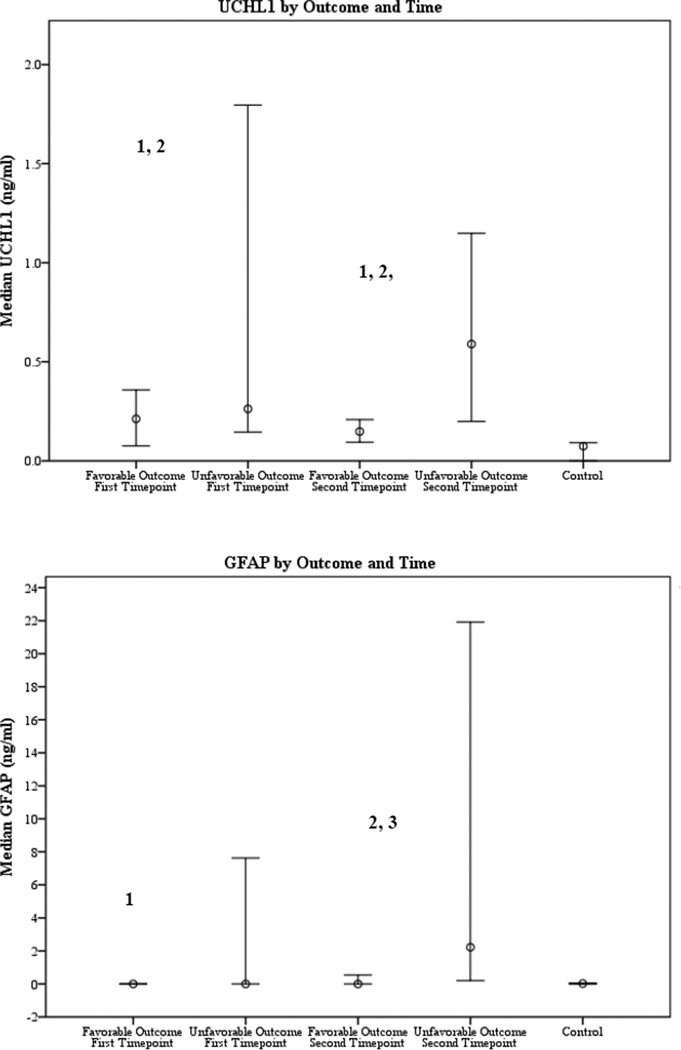
The initial assessment (time point 1) occurred at a median (IQR) of 10.5 (5.5-17.0)h and the second assessment (time point 2) at 59.0 (54.5-65.0)h post-cardiac arrest. Serum UCH-L1 was higher among children following cardiac arrest than among controls at both time points (p<0.05). Serum GFAP in subjects with unfavorable outcome was higher at time point 2 than in controls (p<0.05). Serum UCH-L1 at time point 1 (AUC 0.782) and both UCH-L1 and GFAP at time point 2 had good classification accuracy for outcome (AUC 0.822 and 0.796), p<0.05 for all.

CONCLUSION

Preliminary data suggest that serum UCH-L1 and GFAP may be of use to prognosticate outcome after pediatric cardiac arrest at clinically-relevant time points and should be validated prospectively.

摘要

引言

脑损伤是小儿心脏骤停后发病和死亡的主要原因。脑损伤的血清生物标志物可能有助于预后评估。本研究的目的是评估血清泛素羧基末端水解酶-L1(UCH-L1)和胶质纤维酸性蛋白(GFAP)对小儿心脏骤停预后进行分类的特性。

方法

单中心前瞻性研究。在心脏骤停后的儿童(n=19)初始72小时内的2个时间点测量血清生物标志物,在健康儿童(对照组,n=43)中测量一次。我们记录了人口统计学资料以及心脏骤停和复苏的详细情况。我们确定了血清生物标志物浓度与6个月时小儿脑功能表现分类(PCPC)之间的关联(良好(PCPC 1-3)或不良(PCPC 4-6))。

结果

首次评估(时间点1)发生在心脏骤停后中位数(IQR)为10.5(5.5-17.0)小时,第二次评估(时间点2)发生在59.0(54.5-65.0)小时。在两个时间点,心脏骤停后的儿童血清UCH-L1均高于对照组(p<0.05)。预后不良的受试者在时间点2的血清GFAP高于对照组(p<0.05)。时间点1的血清UCH-L1(AUC 0.782)以及时间点2的UCH-L1和GFAP对预后均具有良好的分类准确性(AUC 0.822和0.796),所有p均<0.05。

结论

初步数据表明,血清UCH-L1和GFAP可能有助于在临床相关时间点预测小儿心脏骤停后的预后,应进行前瞻性验证。
https://cdn.ncbi.nlm.nih.gov/pmc/blobs/0d20/4792689/1043766e6ec5/nihms758232f1.jpg

相似文献

1
Exploratory study of serum ubiquitin carboxyl-terminal esterase L1 and glial fibrillary acidic protein for outcome prognostication after pediatric cardiac arrest.小儿心脏骤停后血清泛素羧基末端酯酶L1和胶质纤维酸性蛋白用于预后评估的探索性研究
Resuscitation. 2016 Apr;101:65-70. doi: 10.1016/j.resuscitation.2016.01.024. Epub 2016 Feb 6.
2
Serum GFAP and UCH-L1 for the prediction of neurological outcome in comatose cardiac arrest patients.血清胶质纤维酸性蛋白和泛素羧基末端水解酶L1用于预测昏迷性心脏骤停患者的神经学预后。
Resuscitation. 2020 Sep;154:61-68. doi: 10.1016/j.resuscitation.2020.05.016. Epub 2020 May 21.
3
Glial Fibrillary Acidic Protein and Ubiquitin C-Terminal Hydrolase-L1 as Outcome Predictors in Traumatic Brain Injury.胶质纤维酸性蛋白和泛素羧基末端水解酶-L1作为创伤性脑损伤的预后预测指标
World Neurosurg. 2016 Mar;87:8-20. doi: 10.1016/j.wneu.2015.10.066. Epub 2015 Nov 10.
4
Temporal response profiles of serum ubiquitin C-terminal hydrolase-L1 and the 145-kDa alpha II-spectrin breakdown product after severe traumatic brain injury in children.儿童严重创伤性脑损伤后血清泛素 C 末端水解酶-L1 和 145 kDa αII-血影蛋白降解产物的时间反应曲线
J Neurosurg Pediatr. 2018 Oct;22(4):369-374. doi: 10.3171/2018.4.PEDS17593. Epub 2018 Jun 29.
5
Serum Concentrations of Ubiquitin C-Terminal Hydrolase-L1 and Glial Fibrillary Acidic Protein after Pediatric Traumatic Brain Injury.儿童创伤性脑损伤后血清泛素羧基末端水解酶-L1 和神经胶质纤维酸性蛋白浓度的变化
Sci Rep. 2016 Jun 20;6:28203. doi: 10.1038/srep28203.
6
The Levels of Glial Fibrillary Acidic Protein and Ubiquitin C-Terminal Hydrolase-L1 During the First Week After a Traumatic Brain Injury: Correlations With Clinical and Imaging Findings.创伤性脑损伤后第一周内胶质纤维酸性蛋白和泛素 C 末端水解酶-L1 的水平:与临床和影像学结果的相关性
Neurosurgery. 2016 Sep;79(3):456-64. doi: 10.1227/NEU.0000000000001226.
7
Acute biomarkers of traumatic brain injury: relationship between plasma levels of ubiquitin C-terminal hydrolase-L1 and glial fibrillary acidic protein.创伤性脑损伤的急性生物标志物:泛素 C 端水解酶-L1 与神经胶质纤维酸性蛋白的血浆水平之间的关系。
J Neurotrauma. 2014 Jan 1;31(1):19-25. doi: 10.1089/neu.2013.3040. Epub 2013 Oct 9.
8
Association of Blood-Based Brain Injury Biomarker Concentrations With Outcomes After Pediatric Cardiac Arrest.血液脑损伤生物标志物浓度与小儿心搏骤停后结局的关系。
JAMA Netw Open. 2022 Sep 1;5(9):e2230518. doi: 10.1001/jamanetworkopen.2022.30518.
9
Association of Very Early Serum Levels of S100B, Glial Fibrillary Acidic Protein, Ubiquitin C-Terminal Hydrolase-L1, and Spectrin Breakdown Product with Outcome in ProTECT III.S100B、胶质纤维酸性蛋白、泛素羧基末端水解酶-L1 和血影蛋白断裂产物的非常早期血清水平与 PROTECT III 结局的关系。
J Neurotrauma. 2019 Oct 15;36(20):2863-2871. doi: 10.1089/neu.2018.5809. Epub 2019 Jul 9.
10
Utility of Serum Biomarkers in the Diagnosis and Stratification of Mild Traumatic Brain Injury.血清生物标志物在轻度创伤性脑损伤诊断和分层中的应用
Acad Emerg Med. 2017 Jun;24(6):710-720. doi: 10.1111/acem.13174. Epub 2017 May 18.

引用本文的文献

1
Ischemic Stroke and the Biological Hallmarks of Aging.缺血性中风与衰老的生物学特征
Aging Dis. 2024 Sep 30;16(5):2908-2936. doi: 10.14336/AD.2024.1059.
2
The utility of brain biomarkers in predicting survival and neurological outcomes in pediatric patients after cardiac arrest: A systematic review and meta-analysis.脑生物标志物在预测小儿心脏骤停患者生存及神经功能结局中的应用:一项系统评价与荟萃分析
Cardiol J. 2025;32(2):130-141. doi: 10.5603/cj.103883. Epub 2025 Mar 10.
3
Higher levels of brain injury biomarker tau are associated with unfavorable outcomes in patients supported with ECMO following cardiac arrest.

本文引用的文献

1
Biomarkers of traumatic injury are transported from brain to blood via the glymphatic system.创伤性损伤的生物标志物通过类淋巴系统从大脑运输到血液中。
J Neurosci. 2015 Jan 14;35(2):518-26. doi: 10.1523/JNEUROSCI.3742-14.2015.
2
Post-cardiac arrest serum levels of glial fibrillary acidic protein for predicting neurological outcome.心脏骤停后血清胶质纤维酸性蛋白水平对神经功能预后的预测作用
Resuscitation. 2014 Dec;85(12):1654-61. doi: 10.1016/j.resuscitation.2014.09.007. Epub 2014 Sep 28.
3
Biomarkers for severity of neonatal hypoxic-ischemic encephalopathy and outcomes in newborns receiving hypothermia therapy.
在心脏骤停后接受体外膜肺氧合(ECMO)支持的患者中,较高水平的脑损伤生物标志物tau与不良预后相关。
Resusc Plus. 2024 Mar 22;18:100609. doi: 10.1016/j.resplu.2024.100609. eCollection 2024 Jun.
4
2023 International Consensus on Cardiopulmonary Resuscitation and Emergency Cardiovascular Care Science With Treatment Recommendations: Summary From the Basic Life Support; Advanced Life Support; Pediatric Life Support; Neonatal Life Support; Education, Implementation, and Teams; and First Aid Task Forces.2023 年国际心肺复苏和紧急心血管护理科学共识及治疗推荐:基础生命支持、高级生命支持、儿科生命支持、新生儿生命支持、教育、实施和团队以及急救任务组的总结。
Circulation. 2023 Dec 12;148(24):e187-e280. doi: 10.1161/CIR.0000000000001179. Epub 2023 Nov 9.
5
Neuromonitoring after Pediatric Cardiac Arrest: Cerebral Physiology and Injury Stratification.小儿心脏骤停后的神经监测:脑生理与损伤分层。
Neurocrit Care. 2024 Feb;40(1):99-115. doi: 10.1007/s12028-023-01685-6. Epub 2023 Apr 1.
6
Association of Blood-Based Brain Injury Biomarker Concentrations With Outcomes After Pediatric Cardiac Arrest.血液脑损伤生物标志物浓度与小儿心搏骤停后结局的关系。
JAMA Netw Open. 2022 Sep 1;5(9):e2230518. doi: 10.1001/jamanetworkopen.2022.30518.
7
Use of Magnetic Resonance Imaging in Neuroprognostication After Pediatric Cardiac Arrest: Survey of Current Practices.磁共振成像在儿科心搏骤停后神经预后中的应用:当前实践调查。
Pediatr Neurol. 2022 Sep;134:45-51. doi: 10.1016/j.pediatrneurol.2022.06.011. Epub 2022 Jun 20.
8
Biomarkers associated with mortality in pediatric patients with cardiac arrest and acute respiratory distress syndrome.与心脏骤停和急性呼吸窘迫综合征儿科患者死亡率相关的生物标志物。
Resuscitation. 2022 Jan;170:184-193. doi: 10.1016/j.resuscitation.2021.11.036. Epub 2021 Dec 3.
9
Diffuse Axonal Injury Grade on Early MRI is Associated with Worse Outcome in Children with Moderate-Severe Traumatic Brain Injury.早期 MRI 上弥漫性轴索损伤分级与中重度创伤性脑损伤患儿的预后不良相关。
Neurocrit Care. 2022 Apr;36(2):492-503. doi: 10.1007/s12028-021-01336-8. Epub 2021 Aug 30.
10
Changes in Plasma Glial Fibrillary Acidic Protein in Children Receiving Sevoflurane Anesthesia: A Preliminary Randomized Trial.接受七氟醚麻醉的儿童血浆胶质纤维酸性蛋白的变化:一项初步随机试验
J Clin Med. 2021 Feb 9;10(4):662. doi: 10.3390/jcm10040662.
新生儿缺氧缺血性脑病严重程度和接受低温治疗的新生儿结局的生物标志物。
J Pediatr. 2014 Mar;164(3):468-74.e1. doi: 10.1016/j.jpeds.2013.10.067. Epub 2013 Dec 12.
4
Serum biomarkers of brain injury to classify outcome after pediatric cardiac arrest*.儿童心脏骤停后用于分类结局的脑损伤血清生物标志物*。
Crit Care Med. 2014 Mar;42(3):664-74. doi: 10.1097/01.ccm.0000435668.53188.80.
5
The potential for bio-mediators and biomarkers in pediatric traumatic brain injury and neurocritical care.生物介质和生物标志物在儿科创伤性脑损伤和神经危重症中的潜力。
Front Neurol. 2013 Apr 26;4:40. doi: 10.3389/fneur.2013.00040. eCollection 2013.
6
Brain-wide pathway for waste clearance captured by contrast-enhanced MRI.对比增强 MRI 捕获到全脑清除废物的通路。
J Clin Invest. 2013 Mar;123(3):1299-309. doi: 10.1172/JCI67677. Epub 2013 Feb 22.
7
Brain injury biomarkers may improve the predictive power of the IMPACT outcome calculator.脑损伤生物标志物可能会提高 IMPACT 结局计算器的预测能力。
J Neurotrauma. 2012 Jun 10;29(9):1770-8. doi: 10.1089/neu.2011.2127. Epub 2012 Apr 30.
8
Elevated levels of serum glial fibrillary acidic protein breakdown products in mild and moderate traumatic brain injury are associated with intracranial lesions and neurosurgical intervention.血清神经胶质纤维酸性蛋白降解产物水平升高与轻度和中度创伤性脑损伤的颅内病变和神经外科干预有关。
Ann Emerg Med. 2012 Jun;59(6):471-83. doi: 10.1016/j.annemergmed.2011.08.021. Epub 2011 Nov 8.
9
Serum concentrations of ubiquitin C-terminal hydrolase-L1 and αII-spectrin breakdown product 145 kDa correlate with outcome after pediatric TBI.血清泛素 C 端水解酶-L1 和 αII-血影蛋白裂解产物 145 kDa 浓度与儿童创伤性脑损伤后的结局相关。
J Neurotrauma. 2012 Jan 1;29(1):162-7. doi: 10.1089/neu.2011.1989.
10
Clinical utility of serum levels of ubiquitin C-terminal hydrolase as a biomarker for severe traumatic brain injury.血清泛素 C 端水解酶水平对严重创伤性脑损伤的临床应用价值。
Neurosurgery. 2012 Mar;70(3):666-75. doi: 10.1227/NEU.0b013e318236a809.