Safar Center for Resuscitation Research, Department of Critical Care Medicine, University of Pittsburgh School of Medicine Pittsburgh, PA, USA.
Front Neurol. 2013 Apr 26;4:40. doi: 10.3389/fneur.2013.00040. eCollection 2013.
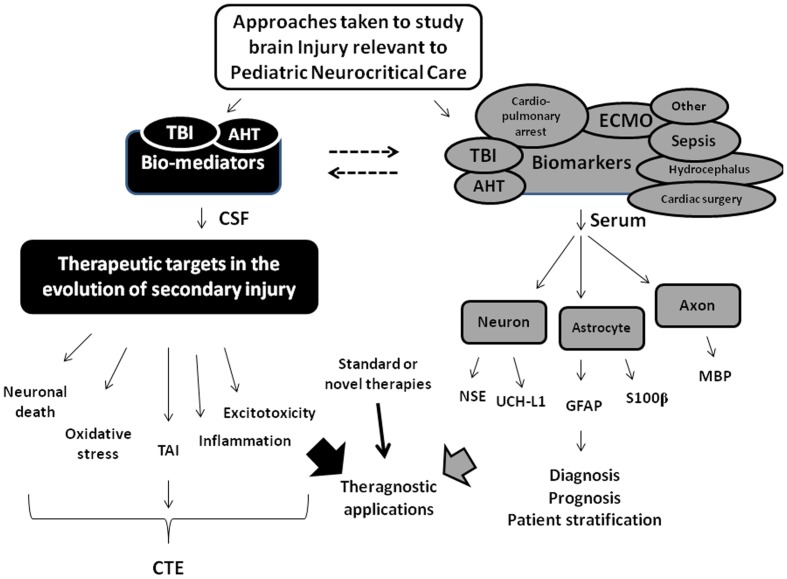
The use of biomarkers of brain injury in pediatric neurocritical care has been explored for at least 15 years. Two general lines of research on biomarkers in pediatric brain injury have been pursued: (1) studies of "bio-mediators" in cerebrospinal fluid (CSF) of children after traumatic brain injury (TBI) to explore the components of the secondary injury cascades in an attempt to identify potential therapeutic targets and (2) studies of the release of structural proteins into the CSF, serum, or urine in order to diagnose, monitor, and/or prognosticate in patients with TBI or other pediatric neurocritical care conditions. Unique age-related differences in brain biology, disease processes, and clinical applications mandate the development and testing of brain injury bio-mediators and biomarkers specifically in pediatric neurocritical care applications. Finally, although much of the early work on biomarkers of brain injury in pediatrics has focused on TBI, new applications are emerging across a wide range of conditions specifically for pediatric neurocritical care including abusive head trauma, cardiopulmonary arrest, septic shock, extracorporeal membrane oxygenation, hydrocephalus, and cardiac surgery. The potential scope of the utility of biomarkers in pediatric neurocritical care is thus also discussed.
在儿科神经危重症护理中,使用脑损伤生物标志物的研究已经进行了至少 15 年。儿科脑损伤生物标志物的研究主要有两条思路:(1)研究创伤性脑损伤(TBI)后儿童脑脊液(CSF)中的“生物介质”,以探索继发性损伤级联反应的组成部分,试图确定潜在的治疗靶点;(2)研究结构蛋白在脑脊液、血清或尿液中的释放,以诊断、监测和/或预测 TBI 或其他儿科神经危重症患者的病情。大脑生物学、疾病过程和临床应用方面的独特年龄相关差异,要求针对儿科神经危重症应用专门开发和测试脑损伤生物介质和生物标志物。最后,尽管儿科脑损伤生物标志物的早期研究大多集中在 TBI 上,但新的应用正在涌现,涵盖范围广泛的儿科神经危重症疾病,包括虐待性头部创伤、心肺骤停、感染性休克、体外膜氧合、脑积水和心脏手术。因此,本文还讨论了生物标志物在儿科神经危重症护理中的潜在应用范围。