Maguire Aideen, French Declan, O'Reilly Dermot
Centre for Public Health, Queen's University, Belfast, UK.
School of Management, Queen's University, Belfast, UK.
J Epidemiol Community Health. 2016 Sep;70(9):845-54. doi: 10.1136/jech-2015-206888. Epub 2016 Feb 8.
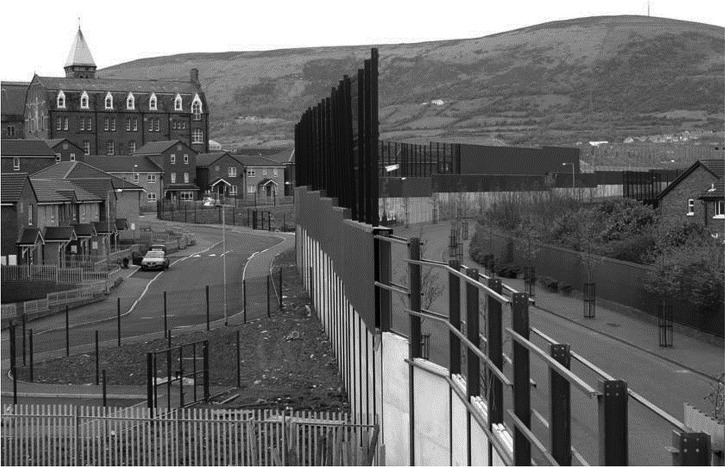
Neighbourhood segregation has been described as a fundamental determinant of physical health, but literature on its effect on mental health is less clear. While most previous research has relied on conceptualised measures of segregation, Northern Ireland is unique as it contains physical manifestations of segregation in the form of segregation barriers (or 'peacelines') which can be used to accurately identify residential segregation.
We used population-wide health record data on over 1.3 million individuals, to analyse the effect of residential segregation, measured by both the formal Dissimilarity Index and by proximity to a segregation barrier, on the likelihood of poor mental health.
Using multilevel logistic regression models, we found residential segregation measured by the Dissimilarity Index poses no additional risk to the likelihood of poor mental health after adjustment for area-level deprivation. However, residence in an area segregated by a 'peaceline' increases the likelihood of antidepressant medication by 19% (OR=1.19, 95% CI 1.14 to 1.23) and anxiolytic medication by 39% (OR=1.39, 95% CI 1.32 to 1.48), even after adjustment for gender, age, conurbation, deprivation and crime.
Living in an area segregated by a 'peaceline' is detrimental to mental health suggesting segregated areas characterised by a heightened sense of 'other' pose a greater risk to mental health. The difference in results based on segregation measure highlights the importance of choice of measure when studying segregation.
社区隔离被认为是身体健康的一个基本决定因素,但关于其对心理健康影响的文献尚不清楚。虽然此前大多数研究依赖于概念化的隔离测量方法,但北爱尔兰很独特,因为它存在以隔离屏障(或“和平线”)形式出现的隔离实体表现,可用于准确识别居住隔离情况。
我们使用了超过130万人的全人群健康记录数据,分析居住隔离(通过正式的差异指数和与隔离屏障的接近程度来衡量)对心理健康状况不佳可能性的影响。
使用多水平逻辑回归模型,我们发现,在对地区层面的贫困状况进行调整后,用差异指数衡量的居住隔离对心理健康状况不佳的可能性没有额外风险。然而,居住在被“和平线”隔离的地区,即使在对性别、年龄、城市区域、贫困状况和犯罪情况进行调整后,抗抑郁药物使用的可能性仍增加19%(比值比=1.19,95%置信区间1.14至1.23),使用抗焦虑药物的可能性增加39%(比值比=1.39,95%置信区间1.32至1.48)。
生活在被“和平线”隔离的地区对心理健康有害,这表明以强烈的“他者”感为特征的隔离地区对心理健康构成更大风险。基于隔离测量方法的结果差异凸显了在研究隔离时测量方法选择的重要性。