Jalal Baland
Behavioural and Clinical Neuroscience Institute, Department of Psychiatry, University of Cambridge Cambridge, UK.
Front Psychol. 2016 Jan 29;7:28. doi: 10.3389/fpsyg.2016.00028. eCollection 2016.
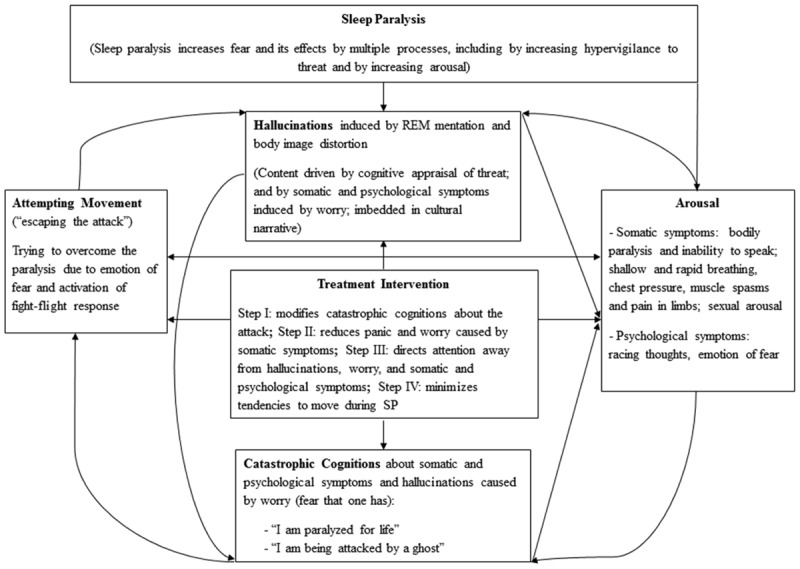
Sleep paralysis (SP) is a common state of involuntary immobility occurring at sleep onset or offset. It can include terrifying hypnogogic or hypnopompic hallucinations of menacing bedroom intruders. Unsurprisingly, the experience is associated with great fear and horror worldwide. To date, there exist no direct treatment intervention for SP. In this article, I propose for the first time a type of focused inward-attention meditation combined with muscle relaxation as a direct intervention to be applied during the attack, to ameliorate and possibly eliminate it (what could be called, meditation-relaxation or MR therapy for SP). The intervention includes four steps: (1) reappraisal of the meaning of the attack; (2) psychological and emotional distancing; (3) inward focused-attention meditation; (4) muscle relaxation. The intervention promotes attentional shift away from unpleasant external and internal stimuli (i.e., terrifying hallucinations and bodily paralysis sensations) unto an emotionally pleasant internal object (e.g., a positive memory). It may facilitate a relaxed meditative state characterized by a shift from sympathetic to parasympathetic dominance, associated with greater levels of alpha activity (which may lead to drowsiness and potentially sleep). The procedure may also reduce the initial panic and arousal that occur when realizing one is paralyzed. In addition, I present a novel Panic-Hallucination (PH) Model of Sleep Paralysis; describing how through escalating cycles of fear and panic-like autonomic arousal, a positive feedback loop is created that worsens the attack (e.g., leading to longer and more fearful episodes), drives content of hallucinations, and causes future episodes of SP. Case examples are presented to illustrate the feasibility of MR therapy for SP.
睡眠瘫痪症(SP)是一种在入睡或醒来时出现的常见的非自主不能动弹状态。它可能包括令人恐惧的睡前或睡后幻觉,如威胁性的卧室闯入者。不出所料,这种体验在全球范围内都与巨大的恐惧和惊骇相关。迄今为止,尚无针对睡眠瘫痪症的直接治疗干预措施。在本文中,我首次提出一种专注于内向注意力的冥想与肌肉放松相结合的方法,作为在发作期间应用的直接干预措施,以改善并可能消除这种症状(可称之为针对睡眠瘫痪症的冥想 - 放松或MR疗法)。该干预措施包括四个步骤:(1)重新评估发作的意义;(2)心理和情感上的疏离;(3)内向专注注意力的冥想;(4)肌肉放松。这种干预措施促使注意力从令人不快的外部和内部刺激(即可怕的幻觉和身体麻痹感)转移到一个情感上愉悦的内部对象(例如积极的记忆)上。它可能有助于促进一种放松的冥想状态,其特征是从交感神经主导转变为副交感神经主导,与更高水平的α波活动相关(这可能导致困倦并潜在地进入睡眠状态)。该过程还可能减少意识到自己瘫痪时最初出现的恐慌和唤醒。此外,我提出了一种新颖的睡眠瘫痪症恐慌 - 幻觉(PH)模型;描述了如何通过恐惧和类似恐慌的自主唤醒的升级循环,创建一个正反馈回路,使发作恶化(例如导致更长、更可怕的发作),驱动幻觉内容,并引发未来的睡眠瘫痪症发作。文中给出了案例示例以说明MR疗法治疗睡眠瘫痪症的可行性。