Romero Ana Carolina, Bergamaschi Cassia Toledo, de Souza Douglas Nesadal, Nogueira Fernando Neves
Departamento de Biomateriais e Biologia Oral, Faculdade de Odontologia, Universidade de São Paulo, São Paulo, Brasil.
Departamento de Fisiologia, Escola Paulista de Medicina - UNIFESP, São Paulo, Brasil.
PLoS One. 2016 Feb 9;11(2):e0148742. doi: 10.1371/journal.pone.0148742. eCollection 2016.
This study aimed to analyze changes in saliva composition and salivary secretion process of rats with chronic kidney disease induced by 5/6 nephrectomy to set the foundation for salivary studies related to CKD.
CKD was induced in Wistar rats via 5/6 nephrectomy. Blood and saliva samples were collected from Control, Sham and CKD groups at 8 and 12 weeks after the surgery. Salivation was stimulated via intraperitoneal injections of pilocarpine (1.0 mg/Kg body weight) or isoproterenol (5.0 mg/Kg body weight). Saliva was collected and immediately stored at -80°C until analysis. The salivary flow rate, total protein, amylase and peroxidase activities, and urea concentrations were measured. The blood urea nitrogen (BUN) and serum creatinine concentrations were also evaluated.
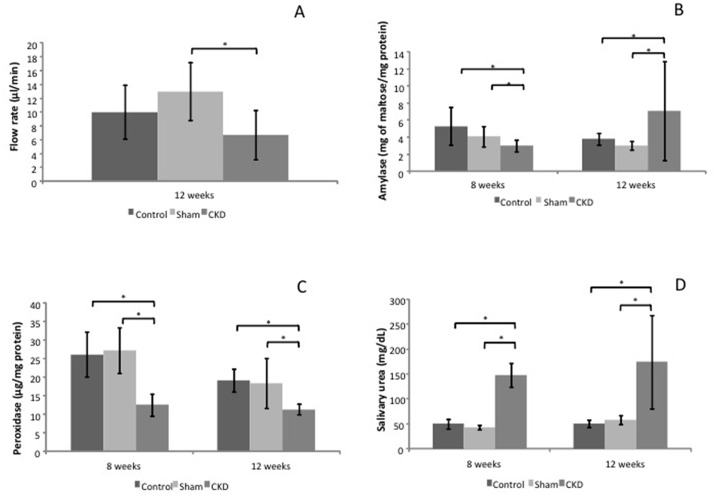
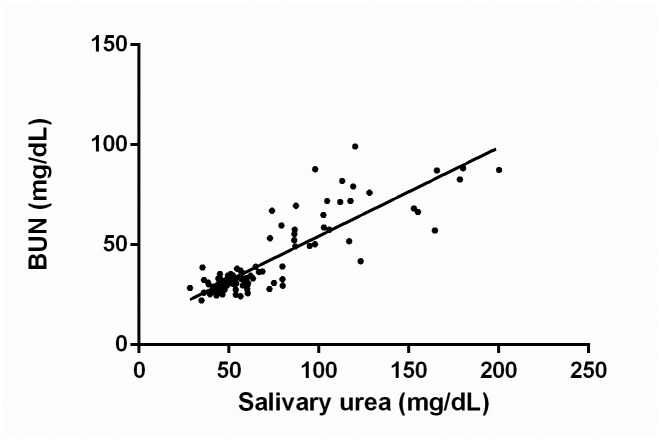
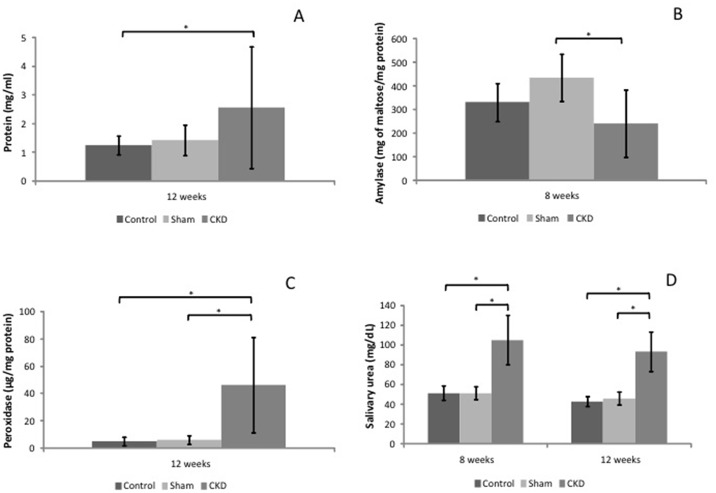
Increases in BUN and serum creatinine concentrations were observed in the CKD groups. Amylase activity was significantly reduced in response to both stimuli in the CKD groups at 8 weeks and increased in the CKD groups at 12 weeks in response to isoproterenol stimulus. The peroxidase activities of the CKD groups were significantly reduced in response to isoproterenol stimulation and were increased at 12 weeks in response to pilocarpine stimulation. Salivary urea was significantly increased in the CKD groups at 8 weeks in response to the isoproterenol stimuli and at 12 weeks in response to both salivary agonists.
The pattern of alterations observed in this experimental model is similar to those observed in patients and clearly demonstrates the viability of 5/6 nephrectomy as an experimental model in future studies to understand the alterations in salivary compositions and in salivary glands that are elicited by CKD.
本研究旨在分析5/6肾切除诱导的慢性肾脏病大鼠唾液成分和唾液分泌过程的变化,为与慢性肾脏病相关的唾液研究奠定基础。
通过5/6肾切除在Wistar大鼠中诱导慢性肾脏病。在手术后8周和12周从对照组、假手术组和慢性肾脏病组采集血液和唾液样本。通过腹腔注射毛果芸香碱(1.0毫克/千克体重)或异丙肾上腺素(5.0毫克/千克体重)刺激唾液分泌。收集唾液并立即储存在-80°C直至分析。测量唾液流速、总蛋白、淀粉酶和过氧化物酶活性以及尿素浓度。还评估了血尿素氮(BUN)和血清肌酐浓度。
慢性肾脏病组中观察到BUN和血清肌酐浓度升高。在8周时,慢性肾脏病组对两种刺激的淀粉酶活性均显著降低,而在12周时,慢性肾脏病组对异丙肾上腺素刺激的淀粉酶活性升高。慢性肾脏病组对异丙肾上腺素刺激的过氧化物酶活性显著降低,而在12周时对毛果芸香碱刺激的过氧化物酶活性升高。在8周时,慢性肾脏病组对异丙肾上腺素刺激的唾液尿素显著增加,在12周时对两种唾液激动剂的刺激均增加。
在该实验模型中观察到的改变模式与在患者中观察到的相似,并且清楚地证明了5/6肾切除作为未来研究中理解慢性肾脏病引起的唾液成分和唾液腺改变的实验模型的可行性。