Gschwind Yves J, Eichberg Sabine, Ejupi Andreas, de Rosario Helios, Kroll Michael, Marston Hannah R, Drobics Mario, Annegarn Janneke, Wieching Rainer, Lord Stephen R, Aal Konstantin, Vaziri Daryoush, Woodbury Ashley, Fink Dennis, Delbaere Kim
Neuroscience Research Australia, University of New South Wales, Barker Street, Randwick, Sydney, New South Wales 2031 Australia.
Institute of Movement and Sport Gerontology, German Sport University Cologne, Am Sportpark Muengersdorf 6, 50933 Cologne, Germany.
Eur Rev Aging Phys Act. 2015 Nov 27;12:10. doi: 10.1186/s11556-015-0155-6. eCollection 2015.
Falls and fall-related injuries are a serious public health issue. Exercise programs can effectively reduce fall risk in older people. The iStoppFalls project developed an Information and Communication Technology-based system to deliver an unsupervised exercise program in older people's homes. The primary aims of the iStoppFalls randomized controlled trial were to assess the feasibility (exercise adherence, acceptability and safety) of the intervention program and its effectiveness on common fall risk factors.
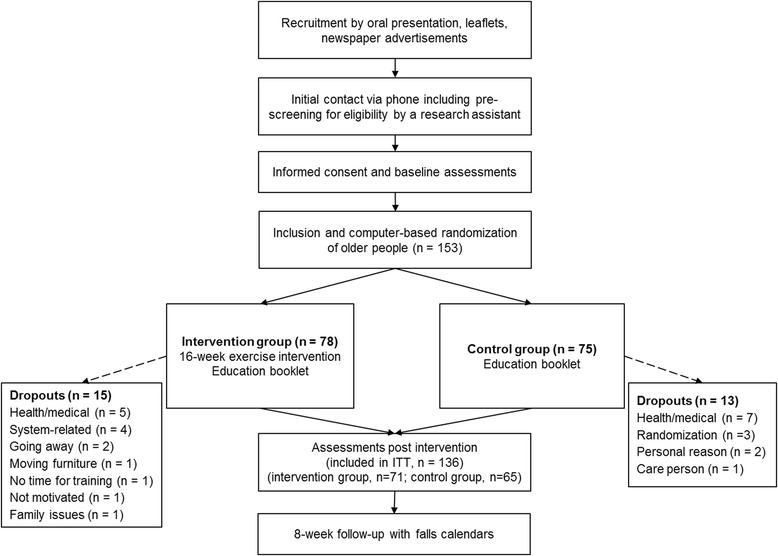
A total of 153 community-dwelling people aged 65+ years took part in this international, multicentre, randomized controlled trial. Intervention group participants conducted the exercise program for 16 weeks, with a recommended duration of 120 min/week for balance exergames and 60 min/week for strength exercises. All intervention and control participants received educational material including advice on a healthy lifestyle and fall prevention. Assessments included physical and cognitive tests, and questionnaires for health, fear of falling, number of falls, quality of life and psychosocial outcomes.
The median total exercise duration was 11.7 h (IQR = 22.0) over the 16-week intervention period. There were no adverse events. Physiological fall risk (Physiological Profile Assessment, PPA) reduced significantly more in the intervention group compared to the control group (F1,127 = 4.54, p = 0.035). There was a significant three-way interaction for fall risk assessed by the PPA between the high-adherence (>90 min/week; n = 18, 25.4 %), low-adherence (<90 min/week; n = 53, 74.6 %) and control group (F2,125 = 3.12, n = 75, p = 0.044). Post hoc analysis revealed a significantly larger effect in favour of the high-adherence group compared to the control group for fall risk (p = 0.031), postural sway (p = 0.046), stepping reaction time (p = 0.041), executive functioning (p = 0.044), and quality of life (p for trend = 0.052).
The iStoppFalls exercise program reduced physiological fall risk in the study sample. Additional subgroup analyses revealed that intervention participants with better adherence also improved in postural sway, stepping reaction, and executive function.
Australian New Zealand Clinical Trials Registry Trial ID: ACTRN12614000096651 International Standard Randomised Controlled Trial Number: ISRCTN15932647.
跌倒及与跌倒相关的损伤是一个严重的公共卫生问题。运动项目可有效降低老年人的跌倒风险。iStoppFalls项目开发了一种基于信息通信技术的系统,以便在老年人家里提供无监督的运动项目。iStoppFalls随机对照试验的主要目的是评估干预项目的可行性(运动依从性、可接受性和安全性)及其对常见跌倒风险因素的有效性。
共有153名65岁及以上的社区居住者参与了这项国际多中心随机对照试验。干预组参与者进行为期16周的运动项目,建议平衡运动游戏每周持续120分钟,力量训练每周持续60分钟。所有干预组和对照组参与者均收到了包括健康生活方式和预防跌倒建议在内的教育材料。评估包括身体和认知测试,以及关于健康、跌倒恐惧、跌倒次数、生活质量和心理社会结果的问卷调查。
在16周的干预期内,运动总时长的中位数为11.7小时(四分位距=22.0)。未发生不良事件。与对照组相比,干预组的生理跌倒风险(生理特征评估,PPA)显著降低更多(F1,127 = 4.54,p = 0.035)。由PPA评估的跌倒风险在高依从性组(>90分钟/周;n = 18,25.4%)、低依从性组(<90分钟/周;n = 53,74.6%)和对照组之间存在显著的三因素交互作用(F2,125 = 3.12,n = 75,p = 0.044)。事后分析显示,与对照组相比,高依从性组在跌倒风险(p = 0.031)、姿势摇摆(p = 0.046)、跨步反应时间(p = 0.041)、执行功能(p = 0.044)和生活质量(趋势p = 0.052)方面有显著更大的改善。
iStoppFalls运动项目降低了研究样本中的生理跌倒风险。额外的亚组分析显示,依从性较好的干预参与者在姿势摇摆、跨步反应和执行功能方面也有改善。
澳大利亚新西兰临床试验注册中心 试验编号:ACTRN12614000096651 国际标准随机对照试验编号:ISRCTN15932647