Gschwind Yves J, Schoene Daniel, Lord Stephen R, Ejupi Andreas, Valenzuela Trinidad, Aal Konstantin, Woodbury Ashley, Delbaere Kim
NeuRA, UNSW, Randwick, Australia.
Assistive Healthcare Information Technology Group, Austrian Institute of Technology, Vienna, Austria.
Eur Rev Aging Phys Act. 2015 Nov 30;12:11. doi: 10.1186/s11556-015-0156-5. eCollection 2015.
There is good evidence that balance challenging exercises can reduce falls in older people. However, older people often find it difficult to incorporate such programs in their daily life. Videogame technology has been proposed to promote enjoyable, balance-challenging exercise. As part of a larger analysis, we compared feasibility and efficacy of two exergame interventions: step-mat-training (SMT) and Microsoft-Kinect® (KIN) exergames.
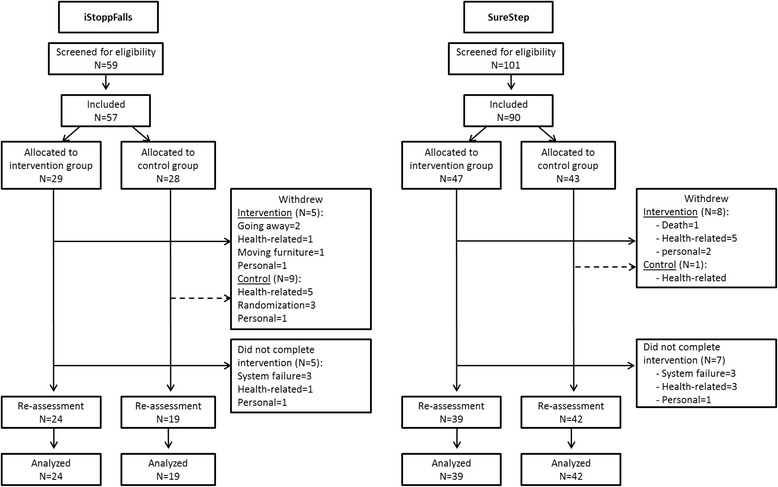
148 community-dwelling people, aged 65+ years participated in two exergame studies in Sydney, Australia (KIN: n = 57, SMT: n = 91). Both interventions were delivered as unsupervised exercise programs in participants' homes for 16 weeks. Assessment measures included overall physiological fall risk, muscle strength, finger-press reaction time, proprioception, vision, balance and executive functioning.
For participants allocated to the intervention arms, the median time played each week was 17 min (IQR 32) for KIN and 48 min (IQR 94) for SMT. Compared to the control group, SMT participants improved their fall risk score (p = 0.036), proprioception (p = 0.015), reaction time (p = 0.003), sit-to-stand performance (p = 0.011) and executive functioning (p = 0.001), while KIN participants improved their muscle strength (p = 0.032) and vision (p = 0.010), and showed a trend towards improved fall risk scores (p = 0.057).
The findings suggest that it is feasible for older people to conduct an unsupervised exercise program at home using exergames. Both interventions reduced fall risk and SMT additionally improved specific cognitive functions. However, further refinement of the systems is required to improve adherence and maximise the benefits of exergames to deliver fall prevention programs in older people's homes.
ACTRN12613000671763 (Step Mat Training RCT) ACTRN12614000096651 (MS Kinect RCT).
有充分证据表明,具有挑战性的平衡练习可减少老年人跌倒。然而,老年人往往觉得难以将此类项目纳入日常生活。有人提议使用电子游戏技术来促进有趣且具有挑战性的平衡练习。作为一项更大规模分析的一部分,我们比较了两种运动游戏干预措施的可行性和效果:踏步垫训练(SMT)和微软Kinect®(KIN)运动游戏。
148名年龄在65岁及以上的社区居民参与了澳大利亚悉尼的两项运动游戏研究(KIN组:n = 57,SMT组:n = 91)。两种干预措施均作为无监督的锻炼项目在参与者家中进行,为期16周。评估指标包括总体生理跌倒风险、肌肉力量、手指按压反应时间、本体感觉、视力、平衡和执行功能。
对于分配到干预组的参与者,KIN组每周的中位游戏时间为17分钟(四分位间距32),SMT组为48分钟(四分位间距94)。与对照组相比,SMT组参与者的跌倒风险评分(p = 0.036)、本体感觉(p = 0.015)、反应时间(p = 0.003)、从坐到站的能力(p = 0.011)和执行功能(p = 0.001)有所改善,而KIN组参与者的肌肉力量(p = 0.032)和视力(p = 0.010)有所改善,且跌倒风险评分有改善趋势(p = 0.057)。
研究结果表明,老年人在家中使用运动游戏进行无监督锻炼项目是可行的。两种干预措施均降低了跌倒风险,SMT还额外改善了特定认知功能。然而,需要进一步完善系统,以提高依从性并最大限度地发挥运动游戏的益处,从而在老年人家庭中实施预防跌倒项目。
ACTRN12613000671763(踏步垫训练随机对照试验)ACTRN12614000096651(微软Kinect随机对照试验)