Anígilájé Emmanuel Ademola, Ageda Bem Ruben, Nweke Nnamdi Okechukwu
Department of Paediatrics, Federal Medical Centre, Makurdi, Nigeria.
Department of Obstetrics and Gynaecology, Federal Medical Centre, Makurdi, Nigeria.
Patient Prefer Adherence. 2016 Jan 27;10:57-72. doi: 10.2147/PPA.S87228. eCollection 2016.
Perinatal transmission of human immunodeficiency virus (HIV) continues in Nigeria because of the poor use of prevention of mother-to-child transmission of HIV (PMTCT) services. This study reports on the barriers preventing mothers of vertically infected HIV-seropositive infants to use the PMTCT services at the Federal Medical Centre, Makurdi, Nigeria.
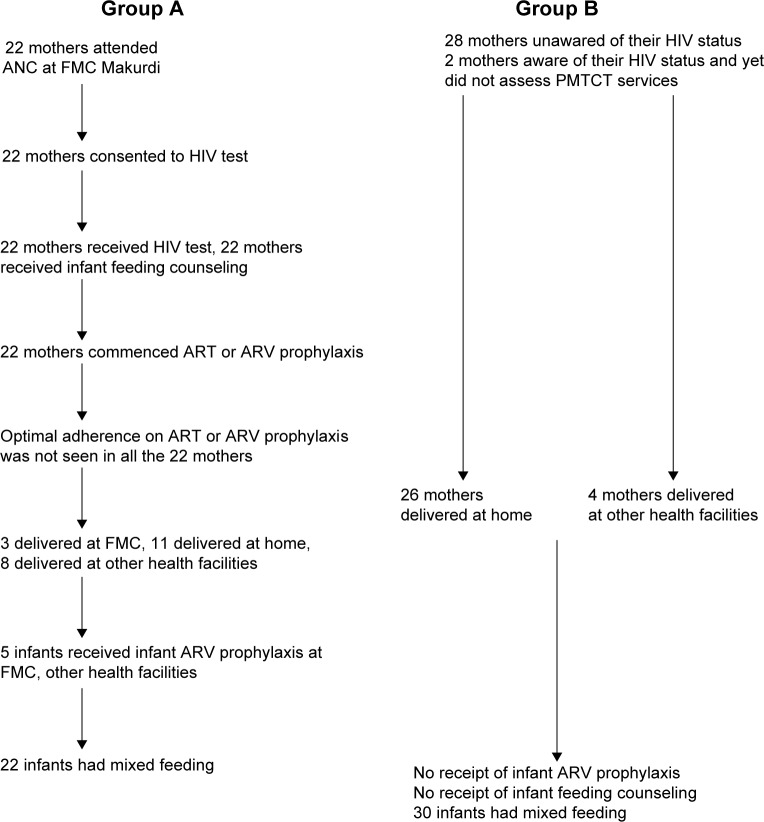
This is a descriptive study conducted between January and April, 2014. A quantitative survey was applied to detect barriers along the PMTCT services cascade among 52 mothers of vertically infected HIV-seropositive infants. This includes 22 women who attended antenatal care at the Federal Medical Centre (designated as Group A mothers) and 30 women who did not receive any form of PMTCT service (Group B mothers). The study was supplemented with a focused group discussion involving 12 discussants from the two groups.
In the quantitative assessment: among the Group A mothers, falling asleep was the most common reason (n=22, 100%) for missing therapeutic/prophylactic antiretroviral medicine; financial constraint (n=22, 100%) was the most common reason for antenatal care visit defaults; and a lot of the mothers (n=11, 50.0%) did not give nevirapine to their newborns because they delivered at home. Among Group B mothers, unawareness of HIV-seropositive status was the most common reason (n=28, 93.3%) given for not accessing PMTCT services. In the qualitative study: noninvolvement of male partners, stigma and discrimination experienced by HIV-seropositive mothers, financial constraints in couples, involvement of traditional birth attendants in antenatal care and delivery of HIV-infected women, unawareness of HIV-seropositive status by pregnant women, poor health system, and the lack of funding for PMTCT services at private and rural health facilities were the major barriers preventing the use of PMTCT services.
In order to reduce the missed opportunities for PMTCT interventions in Makurdi and by extension the Benue State it represents in Nigeria, strong political and financial commitments are needed to overcome the identified barriers.
由于预防母婴传播艾滋病毒(PMTCT)服务利用不足,尼日利亚仍存在艾滋病毒(HIV)的围产期传播。本研究报告了阻碍尼日利亚马库尔迪联邦医疗中心垂直感染艾滋病毒血清阳性婴儿的母亲使用PMTCT服务的障碍。
这是一项于2014年1月至4月间开展的描述性研究。采用定量调查来检测52名垂直感染艾滋病毒血清阳性婴儿的母亲在PMTCT服务流程中的障碍。这包括22名在联邦医疗中心接受产前护理的女性(指定为A组母亲)和30名未接受任何形式PMTCT服务的女性(B组母亲)。该研究还辅以一次焦点小组讨论,参与者包括来自两组的12名讨论者。
在定量评估中:在A组母亲中,入睡是错过治疗性/预防性抗逆转录病毒药物的最常见原因(n = 22,100%);经济拮据(n = 22,100%)是产前检查缺诊的最常见原因;许多母亲(n = 11,50.0%)没有给新生儿服用奈韦拉平,原因是她们在家分娩。在B组母亲中,不知道自己艾滋病毒血清阳性是未使用PMTCT服务的最常见原因(n = 28,93.3%)。在定性研究中:男性伴侣未参与、艾滋病毒血清阳性母亲遭受的耻辱和歧视、夫妻经济拮据、传统助产士参与艾滋病毒感染妇女的产前护理和分娩、孕妇不知道自己艾滋病毒血清阳性、卫生系统薄弱以及私立和农村卫生机构缺乏PMTCT服务资金是阻碍使用PMTCT服务的主要障碍。
为了减少马库尔迪以及它所代表的尼日利亚贝努埃州PMTCT干预措施的错失机会,需要强有力的政治和财政承诺来克服已确定的障碍。