Kirsch Peter
Department of Clinical Psychology, Central Institute of Mental Health, Medical Faculty Mannheim, University of Heidelberg, Germany.
Dialogues Clin Neurosci. 2015 Dec;17(4):463-76. doi: 10.31887/DCNS.2015.17.4/pkirsch.
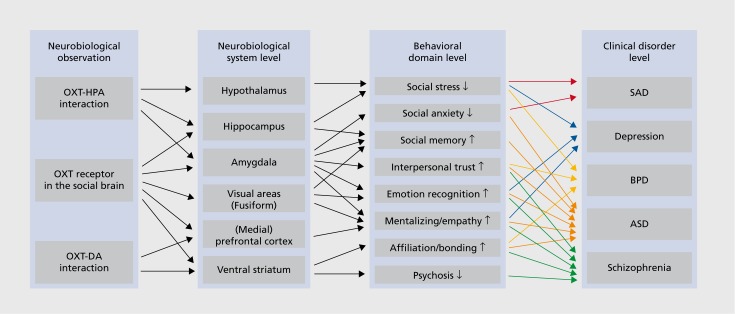
The neuropeptide oxytocin (OXT), highly conserved during evolution, is an important modulator of social and emotional processes across many species. During the last decade, a large body of literature has revealed its effects on different aspects of social behavior, including social stress and anxiety, social memory, affiliation and bonding, emotion recognition, mentalizing, empathy, and interpersonal trust. In addition, as impairments in these social domains can be observed in a number of neuropsychiatric disorders, such as autism, social anxiety disorder, depression, schizophrenia, and borderline personality disorder, the role of OXT in mental disorders and their treatment has been intensively studied. The present paper gives a short overview of these lines of research and shows how OXT has become a promising target for novel treatment approaches for mental disorders characterized by social impairments.
神经肽催产素(OXT)在进化过程中高度保守,是许多物种社会和情感过程的重要调节因子。在过去十年中,大量文献揭示了它对社会行为不同方面的影响,包括社会压力和焦虑、社会记忆、依恋和联结、情绪识别、心理化、共情以及人际信任。此外,由于在一些神经精神疾病(如自闭症、社交焦虑症、抑郁症、精神分裂症和边缘型人格障碍)中可以观察到这些社会领域的损害,催产素在精神疾病及其治疗中的作用已得到深入研究。本文简要概述了这些研究方向,并展示了催产素如何成为针对以社会功能损害为特征的精神疾病新型治疗方法的一个有前景的靶点。