Zarychta Karolina, Mullan Barbara, Luszczynska Aleksandra
SWPS University of Social Sciences and Humanities Wroclaw, Poland.
Curtin University, Bentley WA, Australia.
Front Psychol. 2016 Feb 4;7:83. doi: 10.3389/fpsyg.2016.00083. eCollection 2016.
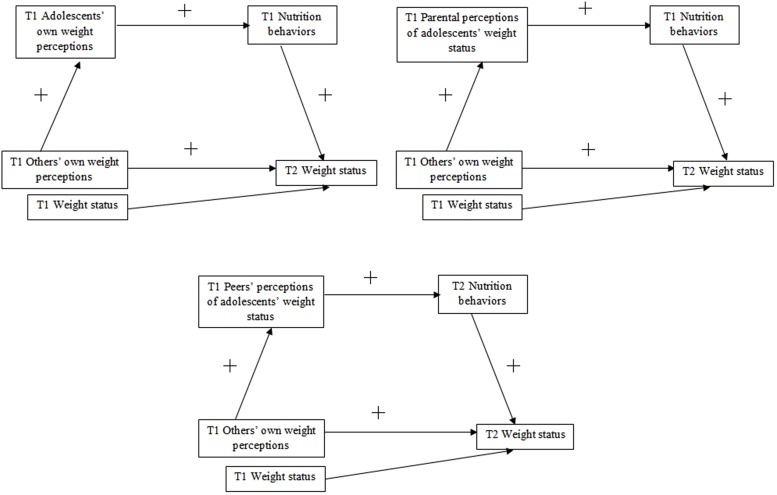
An investigation of the interplay between various types of adolescents' perceptions of weight status in predicting adolescents' nutrition behavior and their body mass was conducted. In particular, it was hypothesized that the relationship between parental and peers' perceptions of their own weight status (reported by adolescents) and objectively measured weight status of adolescents would be mediated by three types of adolescents' weight status perceptions (adolescents' own weight perceptions, parental perceptions of adolescents' weight status perceived by participants, and peers' perceptions of adolescents' weight status perceived by participants) and by adolescents' nutrition behaviors.
Data were collected twice, with a 13-month follow-up. Participants (N = 1096) were aged 14-20, with BMI ranging from 16.20 to 41.21. Multiple mediation analysis with two sequential mediators was applied.
At the baseline adolescents completed the questionnaire assessing their nutrition behaviors and weight status perceptions. Weight and height were measured objectively at baseline and follow-up.
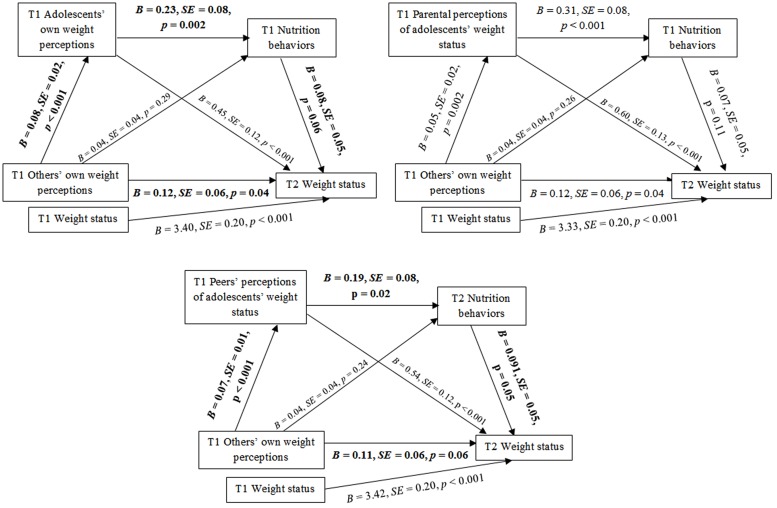
Two types of weight perceptions (adolescents' own weight status perceptions, peers' perceptions of adolescents' weight status reported by participants), and adolescents' nutrition behaviors mediated the relationship between the others' own weight perceptions and adolescents' weight status. No indirect effects of others' own weight perceptions on adolescents' weight status through parental perceptions were found.
Adolescents' nutrition behaviors and body weight status depend on what they think about their own weight status and what they think of their peers' perceptions, but do not depend on what adolescents think of their parents' perceptions.
对各类青少年体重状况认知之间的相互作用在预测青少年营养行为及其体重方面进行调查。具体而言,研究假设青少年报告的父母和同伴对自身体重状况的认知与青少年客观测量的体重状况之间的关系将由三种青少年体重状况认知(青少年对自己体重的认知、参与者感知到的父母对青少年体重状况的认知以及参与者感知到的同伴对青少年体重状况的认知)和青少年的营养行为来介导。
数据收集了两次,随访间隔为13个月。参与者(N = 1096)年龄在14至20岁之间,体重指数(BMI)范围为16.20至41.21。应用了具有两个连续中介变量的多重中介分析。
在基线时,青少年完成评估其营养行为和体重状况认知的问卷。在基线和随访时客观测量体重和身高。
两种体重认知(青少年对自己体重状况的认知、参与者报告的同伴对青少年体重状况的认知)以及青少年的营养行为介导了他人对自身体重的认知与青少年体重状况之间的关系。未发现他人对自身体重的认知通过父母的认知对青少年体重状况产生间接影响。
青少年的营养行为和体重状况取决于他们对自己体重状况的看法以及他们对同伴看法的认知,但不取决于青少年对父母看法的认知。