Holme Francesca, Thompson Beti, Holte Sarah, Vigoren Eric M, Espinoza Noah, Ulrich Angela, Griffith William, Faustman Elaine M
Department of Global Health, University of Washington, Seattle, WA, USA.
Public Health Sciences Division, Fred Hutchinson Cancer Research Center, Seattle, WA, USA.
Environ Res. 2016 May;147:133-40. doi: 10.1016/j.envres.2016.02.003. Epub 2016 Feb 11.
Studies suggest that some of the greatest exposure to OPs in children occurs in agricultural communities and various pathways of exposure including the take-home pathway, proximity to orchards, and diet have been explored. However, the importance of the dietary pathway of exposure for children in agricultural communities is not well understood.
Our goal was to ascertain whether there were associations between measures of OP exposure and apple juice, fruit, and vegetable consumption across growing seasons by children of farmworkers and non-farmworkers in a rural agricultural setting.
Study participants were children of farmworker (N=100) or non-farmworker (N=100) households from a longitudinal cohort study. Dietary intake of fruits and vegetables was assessed using a "5-A-Day" abbreviated food frequency questionnaire, and exposure to OPs was characterized using three urinary di-methyl and three di-ethyl metabolite measurements per child for each of three growing seasons. We used generalized estimating equations to examine data.
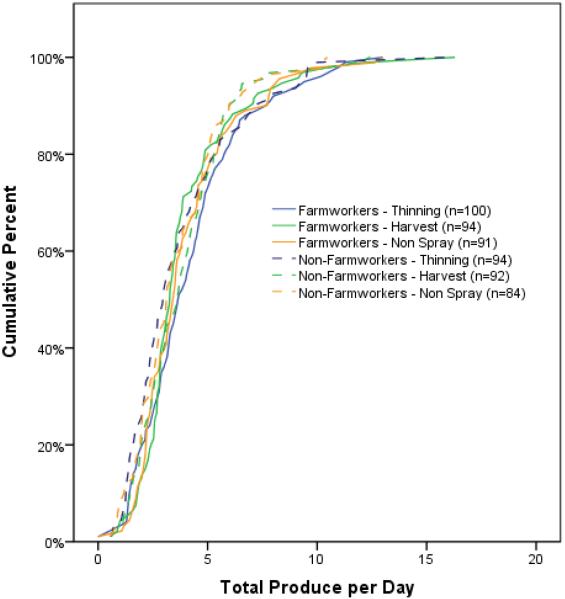
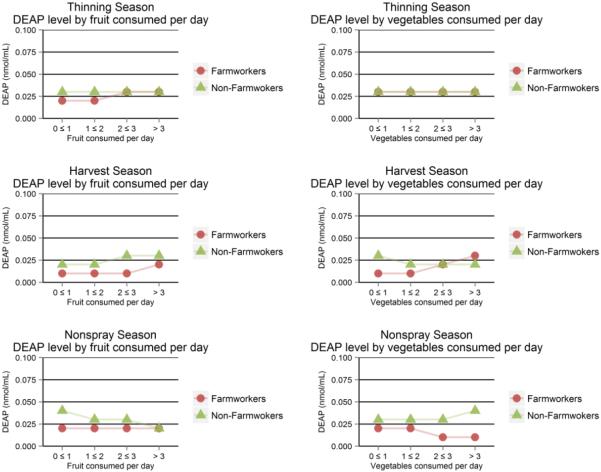
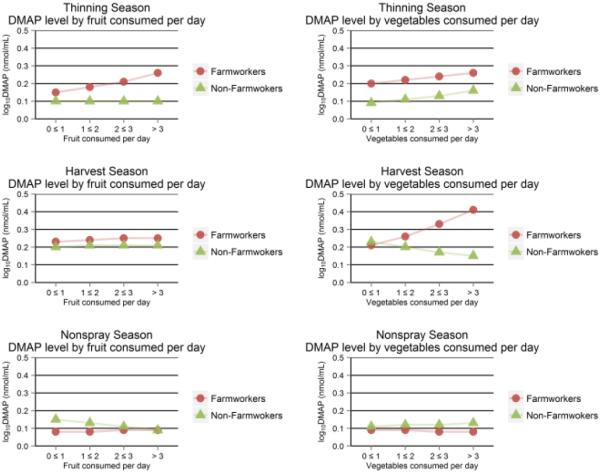
Consumption frequency of fruits and vegetables was similar between children of farmworkers and non-farmworkers and across seasons. There were a few significant trends between dimethyl metabolites (DMAP) and fruit, vegetable or apple juice consumption; however, no clear pattern held across seasons or occupation. One difference was found in vegetable consumption during the harvest season, where the farmworker families showed a significant relationship between vegetable consumption and dimethyl metabolite levels (p=0.002). We also found a significant difference in this relationship between farmworkers and non-farmworkers (p=0.001). No significant trends between fruit and vegetable consumption and diethyl (DEAP) metabolites were found.
Our study shows the importance of considering season and parents' occupation in understanding OP exposure routes among children in an agricultural community. The impact of these factors on dietary OP exposure requires a more thorough analysis of the availability and consumption of produce from different sources including farms using pesticides where parents worked.
研究表明,儿童接触有机磷农药的最大暴露源存在于农业社区,人们已经探索了包括带回家途径、靠近果园以及饮食等各种暴露途径。然而,农业社区儿童饮食暴露途径的重要性尚未得到充分理解。
我们的目标是确定在农村农业环境中,农场工人和非农场工人家庭的儿童在不同生长季节的有机磷农药暴露量与苹果汁、水果和蔬菜消费量之间是否存在关联。
研究参与者来自一项纵向队列研究中的农场工人家庭(N = 100)或非农场工人家庭(N = 100)的儿童。使用“每日五蔬果”简化食物频率问卷评估水果和蔬菜的饮食摄入量,并通过在三个生长季节中对每个儿童测量三种尿中二甲基和三种二乙基代谢物来表征有机磷农药暴露情况。我们使用广义估计方程来分析数据。
农场工人家庭和非农场工人家庭的儿童以及不同季节之间,水果和蔬菜的消费频率相似。二甲基代谢物(DMAP)与水果、蔬菜或苹果汁消费之间存在一些显著趋势;然而,跨季节或职业并没有明显的模式。在收获季节的蔬菜消费中发现了一个差异,农场工人家庭的蔬菜消费与二甲基代谢物水平之间存在显著关系(p = 0.002)。我们还发现农场工人和非农场工人在这种关系上存在显著差异(p = 0.001)。未发现水果和蔬菜消费与二乙基(DEAP)代谢物之间的显著趋势。
我们的研究表明,在理解农业社区儿童的有机磷农药暴露途径时,考虑季节和父母职业非常重要。这些因素对饮食中有机磷农药暴露的影响需要更全面地分析来自不同来源(包括父母工作的使用农药的农场)农产品的可获得性和消费量。