Guignard Maïté S, Nichols Richard A, Knell Robert J, Macdonald Andy, Romila Catalina-Andreea, Trimmer Mark, Leitch Ilia J, Leitch Andrew R
School of Biological and Chemical Sciences, Queen Mary University of London, Mile End Road, London, E1 4NS, UK.
Jodrell Laboratory, Royal Botanic Gardens, Kew, Richmond, Surrey, TW9 3DS, UK.
New Phytol. 2016 Jun;210(4):1195-206. doi: 10.1111/nph.13881. Epub 2016 Feb 15.
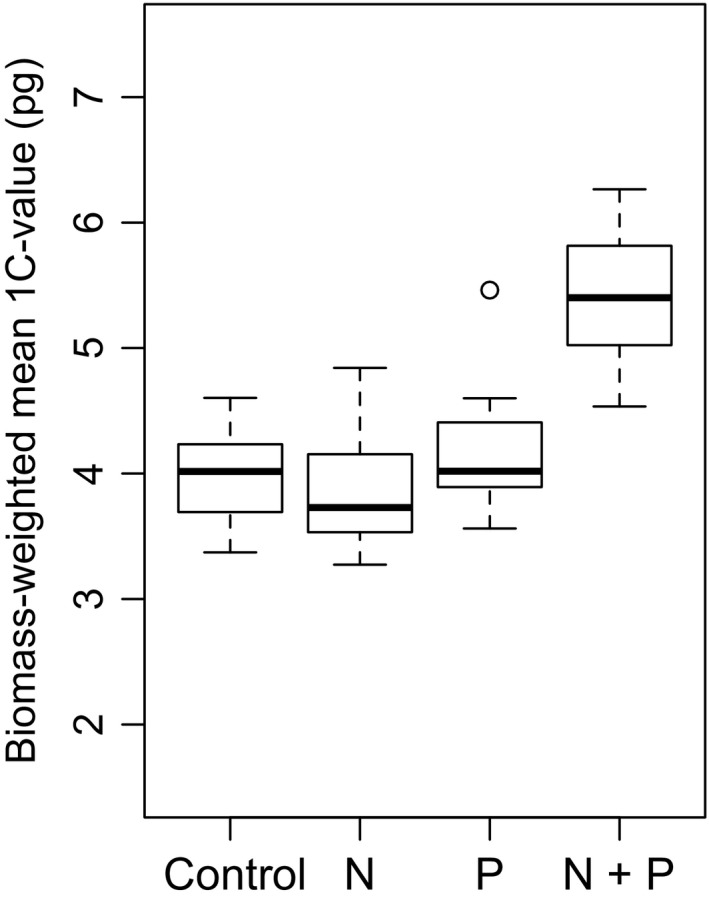
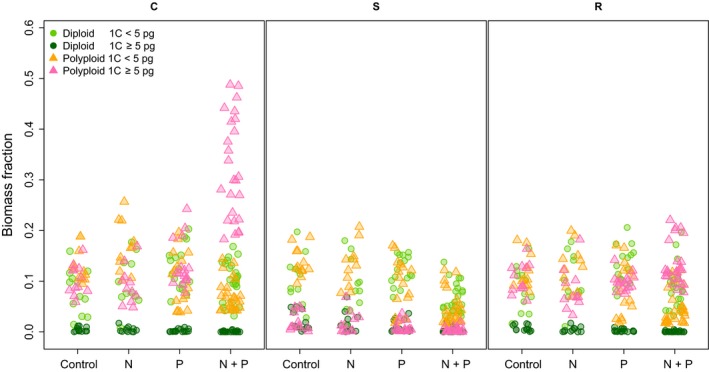
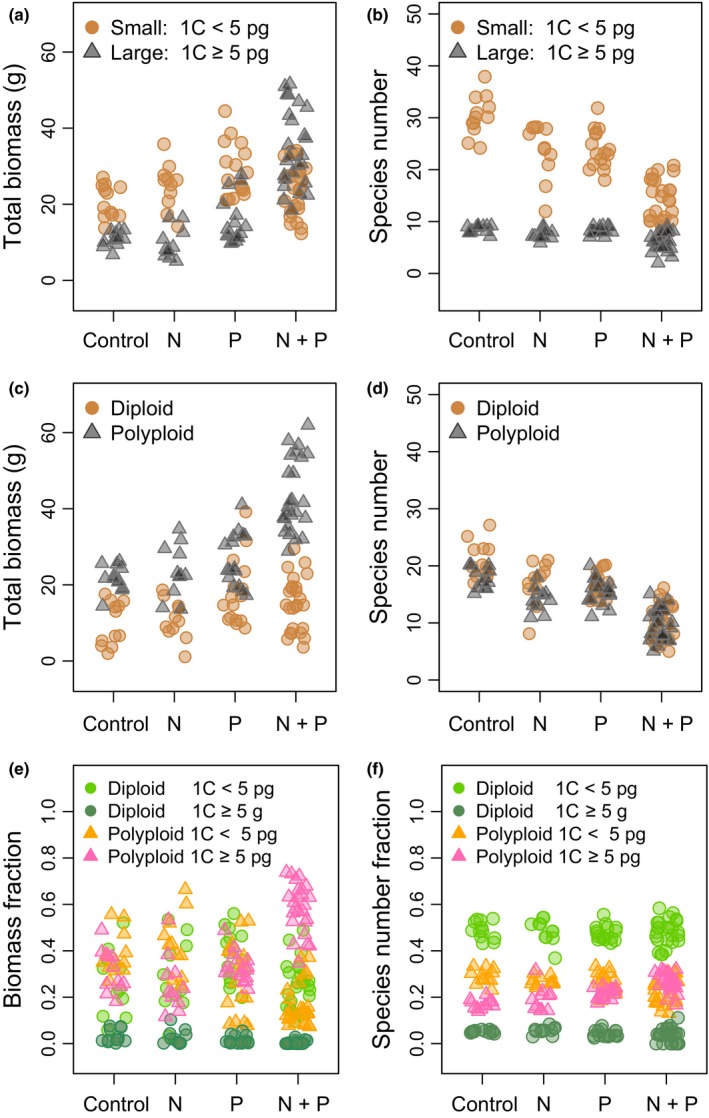
Angiosperm genome sizes (GS) range c. 2400-fold, and as nucleic acids are amongst the most phosphorus- (P) and nitrogen (N)-demanding cellular biomolecules, we test the hypothesis that a key influence on plant biomass and species composition is the interaction between N and P availability and plant GS. We analysed the impact of different nutrient regimes on above-ground biomass of angiosperm species with different GS, ploidy level and Grime's C-S-R (competitive, stress-tolerant, ruderal) plant strategies growing at the Park Grass Experiment (Rothamsted, UK), established in 1856. The biomass-weighted mean GS of species growing on plots with the addition of both N and P fertilizer were significantly higher than that of plants growing on control plots and plots with either N or P. The plants on these N + P plots are dominated by polyploids with large GS and a competitive plant strategy. The results are consistent with our hypothesis that large genomes are costly to build and maintain under N and P limitation. Hence GS and ploidy are significant traits affecting biomass growth under different nutrient regimes, influencing plant community composition and ecosystem dynamics. We propose that GS is a critical factor needed in models that bridge the knowledge gap between biodiversity and ecosystem functioning.
被子植物的基因组大小(GS)范围约为2400倍,由于核酸是对磷(P)和氮(N)需求最高的细胞生物分子之一,我们检验了这样一个假设,即对植物生物量和物种组成的一个关键影响因素是氮和磷的有效性与植物基因组大小之间的相互作用。我们分析了不同养分状况对具有不同基因组大小、倍性水平以及格莱姆C-S-R(竞争型、耐胁迫型、杂草型)植物策略的被子植物地上生物量的影响,这些植物生长在1856年设立的英国洛桑试验站的草地试验场。在同时添加氮和磷肥料的地块上生长的物种,其生物量加权平均基因组大小显著高于在对照地块以及只添加氮或只添加磷的地块上生长的植物。这些氮 + 磷地块上的植物以具有大基因组大小的多倍体和竞争型植物策略为主。结果与我们的假设一致,即在氮和磷限制条件下,构建和维持大基因组成本高昂。因此,基因组大小和倍性是影响不同养分状况下生物量增长的重要性状,影响着植物群落组成和生态系统动态。我们提出,基因组大小是弥合生物多样性与生态系统功能之间知识差距的模型中所需的一个关键因素。