Huhn Andrew S, Harris Jonathan, Cleveland H Harrington, Lydon David M, Stankoski Dean, Cleveland Michael J, Deneke Erin, Bunce Scott C
Department of Psychiatry, Pennsylvania State University College of Medicine, Hershey, PA, United States.
Department of Human Development and Family Studies, Pennsylvania State University, State College, PA, United States.
Brain Res Bull. 2016 May;123:94-101. doi: 10.1016/j.brainresbull.2016.01.012. Epub 2016 Feb 11.
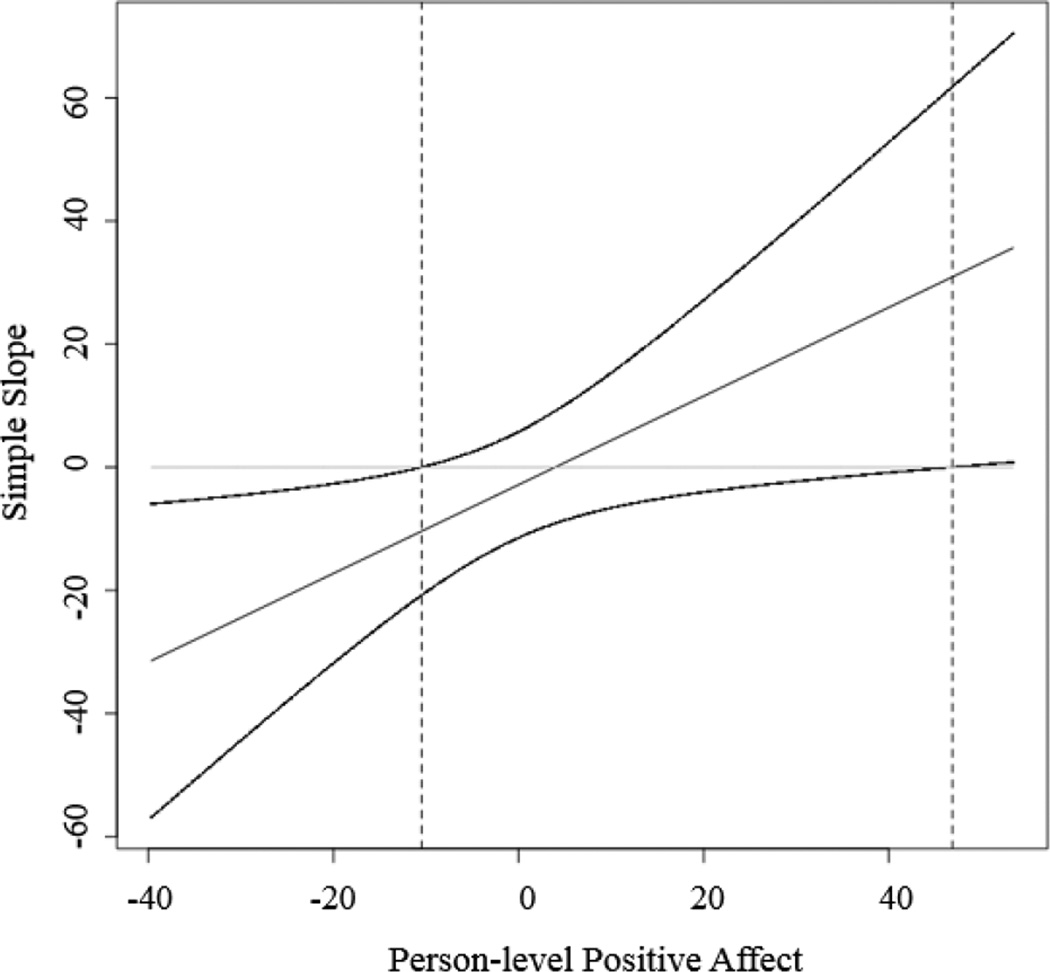
Low positive affect (PA) is likely to contribute to risk of relapse; however, it has received relatively little attention in clinical research. This study examined the associations among positive affect, negative affect (NA), and craving in medically withdrawn patients using ecological momentary assessment (EMA). Participants (n=73) provided reports of their PA, NA, and craving 4 times a day for an average of 10.47 (SD=3.80) days. Person- and day-level associations between PA, NA, and craving were examined using multilevel models. A significant interaction emerged between person- and day-level PA such that PA on the day level was negatively associated with craving for individuals experiencing low mean PA throughout the study. No significant interaction emerged between person- and day-level NA. The main effects for both person- and day-level NA were significant. Individuals experiencing high NA throughout the study experienced higher craving overall and on days when NA was higher than usual, craving was also higher. Results suggest that high person- and day-level NA may directly contribute to the risk for relapse via increased craving, whereas low day- level PA may contribute to risk for relapse among individuals exhibiting low person-level PA via increased craving on days with lower than average levels of PA for those individuals. Given that there is a paucity of research relating low PA to craving, continued investigation into how and when low PA creates risk for relapse is warranted.
低积极情绪(PA)可能会导致复发风险;然而,它在临床研究中受到的关注相对较少。本研究使用生态瞬时评估(EMA)来检验医学戒断患者的积极情绪、消极情绪(NA)和渴望之间的关联。参与者(n = 73)每天报告4次他们的积极情绪、消极情绪和渴望,平均持续10.47(标准差 = 3.80)天。使用多层次模型检验了积极情绪、消极情绪和渴望之间的个体层面和每日层面的关联。在个体层面和每日层面的积极情绪之间出现了显著的交互作用,即对于在整个研究中平均积极情绪较低的个体,每日层面的积极情绪与渴望呈负相关。个体层面和每日层面的消极情绪之间未出现显著的交互作用。个体层面和每日层面消极情绪的主效应均显著。在整个研究中经历高消极情绪的个体总体上渴望程度更高,并且在消极情绪高于平常的日子里,渴望程度也更高。结果表明,个体层面和每日层面的高消极情绪可能通过增加渴望直接导致复发风险,而每日层面的低积极情绪可能通过那些个体在积极情绪低于平均水平的日子里增加渴望,导致个体层面积极情绪较低的个体复发风险增加。鉴于将低积极情绪与渴望联系起来的研究较少,有必要继续研究低积极情绪如何以及何时会产生复发风险。