Mekonnen Awol, Yitayew Berhanu, Tesema Alemnesh, Taddese Solomon
College of Medicine, Institute of Medicine and Health Science, Debre Birhan University, P.O. Box 445, Debre Berhan, Ethiopia.
College of Natural Science, Department of Biology, Debre Birhan University, P.O. Box 445, Debre Berhan, Ethiopia.
Int J Microbiol. 2016;2016:9545693. doi: 10.1155/2016/9545693. Epub 2016 Jan 4.
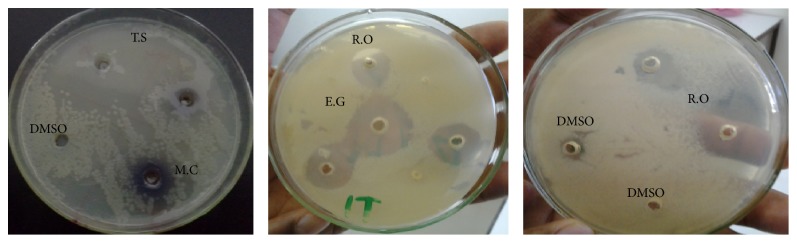
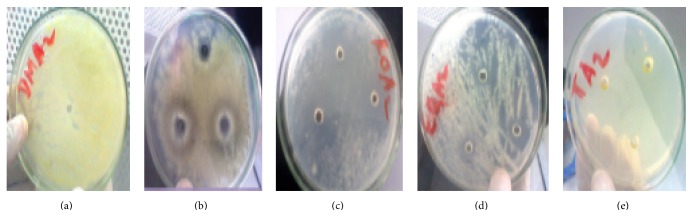
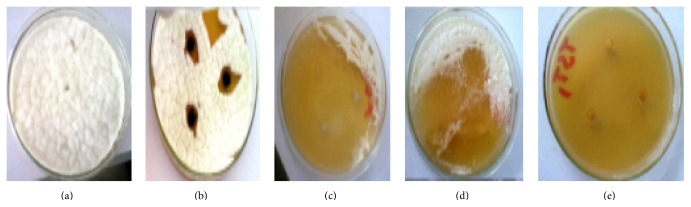
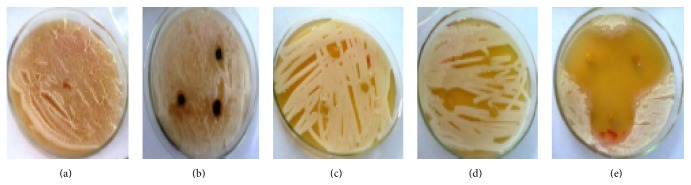
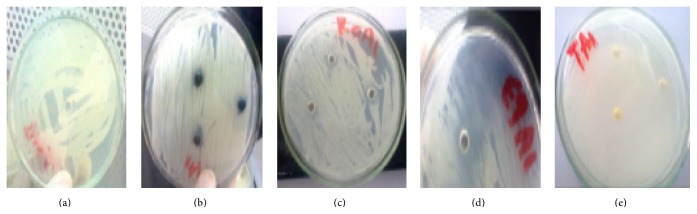
In this study, the in vitro antimicrobial activities of four plant essential oils (T. schimperi, E. globulus, R. officinalis, and M. Chamomilla) were evaluated against bacteria and fungi. The studies were carried out using agar diffusion method for screening the most effective essential oils and agar dilution to determine minimum inhibitory concentration of the essential oils. Results of this study revealed that essential oils of T. schimperi, E. globulus, and R. officinalis were active against bacteria and some fungi. The antimicrobial effect of M. chamomilla was found to be weaker and did not show any antimicrobial activity. The minimum inhibitory concentration values of T. schimperi were <15.75 mg/mL for most of the bacteria and fungi used in this study. The minimum inhibitory concentration values of the other essential oils were in the range of 15.75-36.33 mg/mL against tested bacteria. This study highlighted the antimicrobial activity of the essential oil of E. globulus, M. chamomilla, T. Schimperi, and R. officinalis. The results indicated that T. schimperi have shown strong antimicrobial activity which could be potential candidates for preparation of antimicrobial drug preparation.
在本研究中,评估了四种植物精油(施氏千里光、蓝桉、药用玫瑰和洋甘菊)对细菌和真菌的体外抗菌活性。研究采用琼脂扩散法筛选最有效的精油,并采用琼脂稀释法测定精油的最低抑菌浓度。本研究结果表明,施氏千里光、蓝桉和药用玫瑰的精油对细菌和一些真菌具有活性。发现洋甘菊的抗菌作用较弱,未表现出任何抗菌活性。施氏千里光对本研究中使用的大多数细菌和真菌的最低抑菌浓度值<15.75mg/mL。其他精油对受试细菌的最低抑菌浓度值在15.75-36.33mg/mL范围内。本研究突出了蓝桉、洋甘菊、施氏千里光和药用玫瑰精油的抗菌活性。结果表明,施氏千里光具有很强的抗菌活性,可能是制备抗菌药物制剂的潜在候选物。