Benoot Charlotte, Hannes Karin, Bilsen Johan
Mental Health and Wellbeing Research Group (MENT), Vrije Universiteit Brussel, Laarbeeklaan 103, Brussels, 1050, Belgium.
Centre for Sociological Research, Catholic University of Leuven, Parkstraat 45, Leuven, 3000, Belgium.
BMC Med Res Methodol. 2016 Feb 18;16:21. doi: 10.1186/s12874-016-0114-6.
An increasing number of qualitative evidence syntheses papers are found in health care literature. Many of these syntheses use a strictly exhaustive search strategy to collect articles, mirroring the standard template developed by major review organizations such as the Cochrane and Campbell Collaboration. The hegemonic idea behind it is that non-comprehensive samples in systematic reviews may introduce selection bias. However, exhaustive sampling in a qualitative evidence synthesis has been questioned, and a more purposeful way of sampling papers has been proposed as an alternative, although there is a lack of transparency on how these purposeful sampling strategies might be applied to a qualitative evidence synthesis. We discuss in our paper why and how we used purposeful sampling in a qualitative evidence synthesis about 'sexual adjustment to a cancer trajectory', by giving a worked example.
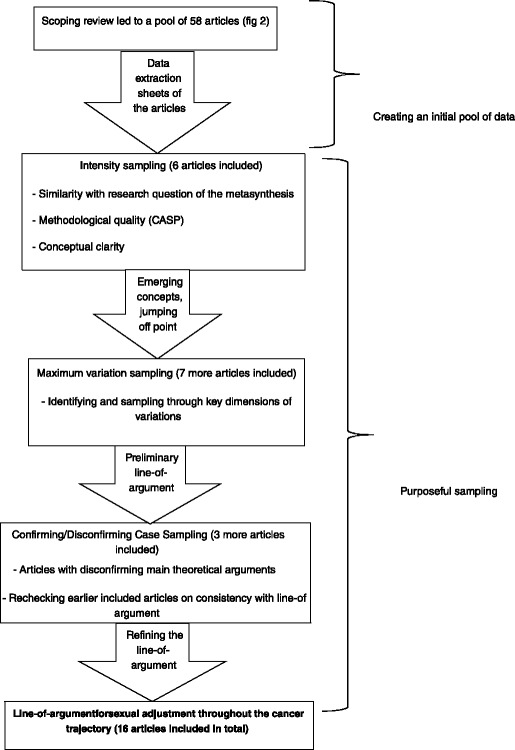
We have chosen a mixed purposeful sampling, combining three different strategies that we considered the most consistent with our research purpose: intensity sampling, maximum variation sampling and confirming/disconfirming case sampling.
The concept of purposeful sampling on the meta-level could not readily been borrowed from the logic applied in basic research projects. It also demands a considerable amount of flexibility, and is labour-intensive, which goes against the argument of many authors that using purposeful sampling provides a pragmatic solution or a short cut for researchers, compared with exhaustive sampling. Opportunities of purposeful sampling were the possible inclusion of new perspectives to the line-of-argument and the enhancement of the theoretical diversity of the papers being included, which could make the results more conceptually aligned with the synthesis purpose.
This paper helps researchers to make decisions related to purposeful sampling in a more systematic and transparent way. Future research could confirm or disconfirm the hypothesis of conceptual enhancement by comparing the findings of a purposefully sampled qualitative evidence synthesis with those drawing on an exhaustive sample of the literature.
在医疗保健文献中,定性证据综合论文的数量日益增多。其中许多综合研究采用严格的详尽搜索策略来收集文章,这与Cochrane和坎贝尔协作网等主要综述组织制定的标准模板一致。其背后的主导思想是,系统评价中的非全面样本可能会引入选择偏倚。然而,定性证据综合中的详尽抽样受到了质疑,有人提出了一种更具针对性的论文抽样方法作为替代,尽管对于如何将这些针对性抽样策略应用于定性证据综合缺乏透明度。我们在论文中通过一个实例讨论了在关于“癌症病程中的性适应”的定性证据综合中为何以及如何使用针对性抽样。
我们选择了混合针对性抽样,结合了三种我们认为与研究目的最相符的不同策略:强度抽样、最大变异抽样和证实/证伪案例抽样。
元层面的针对性抽样概念无法轻易从基础研究项目中应用的逻辑借鉴而来。它还需要相当大的灵活性,且劳动强度大,这与许多作者的观点相悖,他们认为与详尽抽样相比,使用针对性抽样为研究人员提供了一种务实的解决方案或捷径。针对性抽样的好处在于可能为论证思路纳入新观点,并增强所纳入论文的理论多样性,这可以使结果在概念上更符合综合目的。
本文有助于研究人员更系统、透明地做出与针对性抽样相关的决策。未来的研究可以通过比较针对性抽样的定性证据综合结果与基于文献详尽样本得出的结果,来证实或证伪概念增强的假设。