Hoyne Gerard, Rudnicka Caroline, Sang Qing-Xiang, Roycik Mark, Howarth Sarah, Leedman Peter, Schlaich Markus, Candy Patrick, Matthews Vance
School of Health Sciences and Institute of Health Science Research, The University of Notre Dame Australia, Fremantle Campus, Australia.
Royal Perth Hospital, Perth, Australia.
BMC Cancer. 2016 Feb 24;16:151. doi: 10.1186/s12885-016-2178-4.
Prostate cancer is the second most frequently diagnosed cancer in men worldwide. Current treatments include surgery, androgen ablation and radiation. Introduction of more targeted therapies in prostate cancer, based on a detailed knowledge of the signalling pathways, aims to reduce side effects, leading to better clinical outcomes for the patient. ADAM19 (A Disintegrin And Metalloproteinase 19) is a transmembrane and soluble protein which can regulate cell phenotype through cell adhesion and proteolysis. ADAM19 has been positively associated with numerous diseases, but has not been shown to be a tumor suppressor in the pathogenesis of any human cancers. Our group sought to investigate the role of ADAM19 in human prostate cancer.
ADAM19 mRNA and protein levels were assessed in well characterised human prostate cancer cohorts. ADAM19 expression was assessed in normal prostate epithelial cells (RWPE-1) and prostate cancer cells (LNCaP, PC3) using western blotting and immunocytochemistry. Proliferation assays were conducted in LNCaP cells in which ADAM19 was over-expressed. In vitro scratch assays were performed in PC3 cells over-expressing ADAM19.
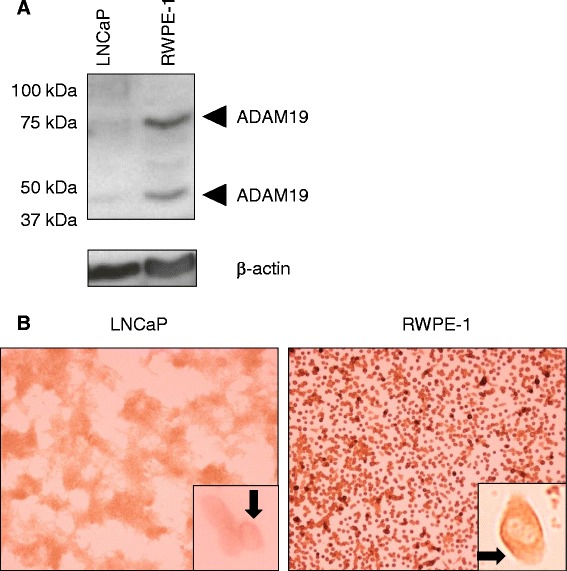
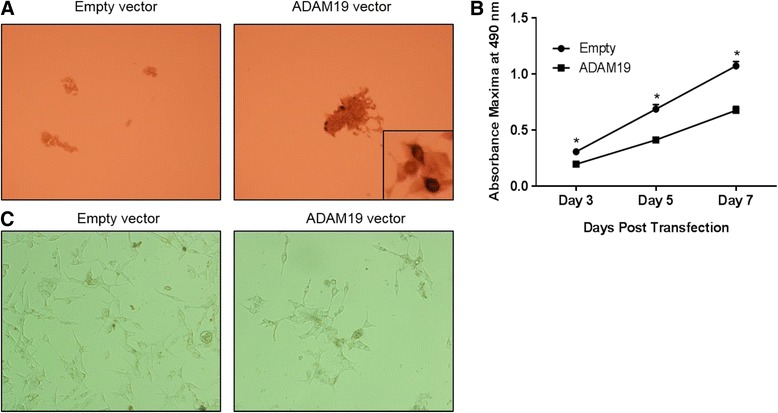
Immunohistochemical studies highlighted that ADAM19 protein levels were elevated in normal prostate tissue compared to prostate cancer biopsies. Results from the clinical cohorts demonstrated that high levels of ADAM19 in microarrays are positively associated with lower stage (p = 0.02591) and reduced relapse (p = 0.00277) of human prostate cancer. In vitro, ADAM19 expression was higher in RWPE-1 cells compared to LNCaP cells. In addition, human ADAM19 over-expression reduced LNCaP cell proliferation and PC3 cell migration.
Taken together, our immunohistochemical and microarray results and cellular studies have shown for the first time that ADAM19 is a protective factor for human prostate cancer. Further, this study suggests that upregulation of ADAM19 expression could be of therapeutic potential in human prostate cancer.
前列腺癌是全球男性中第二常见的确诊癌症。目前的治疗方法包括手术、雄激素去除和放疗。基于对信号通路的详细了解,在前列腺癌中引入更具针对性的疗法旨在减少副作用,从而为患者带来更好的临床结果。ADAM19(解整合素和金属蛋白酶19)是一种跨膜和可溶性蛋白,可通过细胞黏附和蛋白水解调节细胞表型。ADAM19与多种疾病呈正相关,但在任何人类癌症的发病机制中均未显示为肿瘤抑制因子。我们的研究小组旨在探讨ADAM19在人类前列腺癌中的作用。
在特征明确的人类前列腺癌队列中评估ADAM19的mRNA和蛋白水平。使用蛋白质印迹法和免疫细胞化学法在正常前列腺上皮细胞(RWPE-1)和前列腺癌细胞(LNCaP、PC3)中评估ADAM19的表达。在过表达ADAM19的LNCaP细胞中进行增殖测定。在过表达ADAM19的PC3细胞中进行体外划痕试验。
免疫组织化学研究表明,与前列腺癌活检组织相比,正常前列腺组织中ADAM19蛋白水平升高。临床队列的结果表明,微阵列中高水平的ADAM19与人类前列腺癌的低分期(p = 0.02591)和复发减少(p = 0.00277)呈正相关。在体外,RWPE-1细胞中ADAM19的表达高于LNCaP细胞。此外,人类ADAM19的过表达降低了LNCaP细胞的增殖和PC3细胞的迁移。
综合来看,我们的免疫组织化学和微阵列结果以及细胞研究首次表明,ADAM19是人类前列腺癌的保护因子。此外,这项研究表明ADAM19表达的上调在人类前列腺癌中可能具有治疗潜力。