Liu Wenyan, Tagawa Miho, Xin Huolin L, Wang Tong, Emamy Hamed, Li Huilin, Yager Kevin G, Starr Francis W, Tkachenko Alexei V, Gang Oleg
Center for Functional Nanomaterials, Brookhaven National Laboratory, Upton, NY 11973, USA.
Department of Materials Science and Engineering, Nagoya University, Furo-cho, Chikusa-ku, Nagoya 464-8603, Japan.
Science. 2016 Feb 5;351(6273):582-6. doi: 10.1126/science.aad2080.
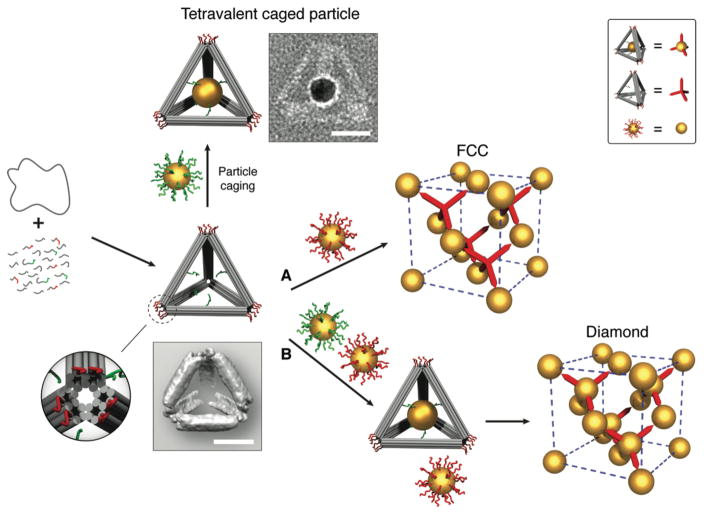
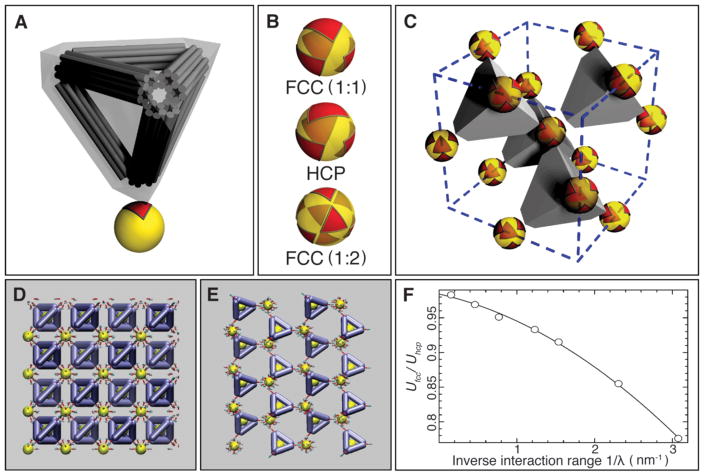
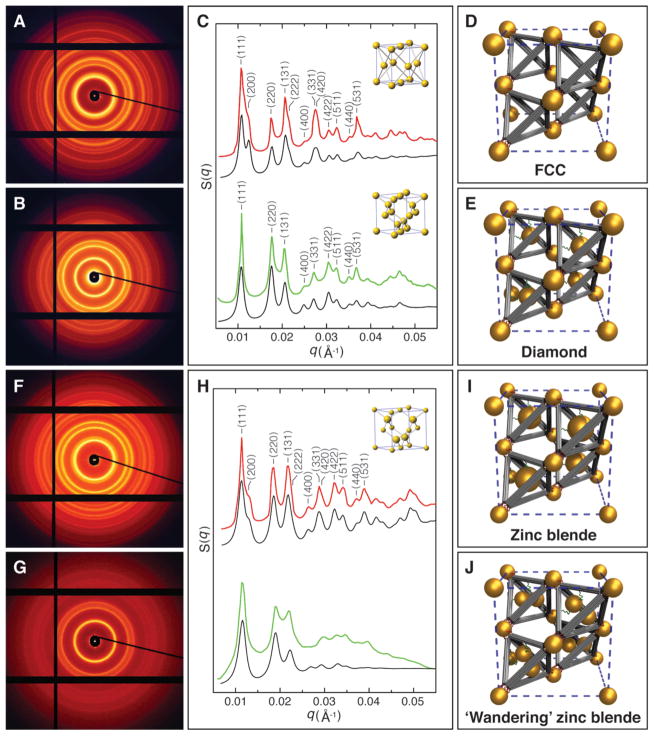
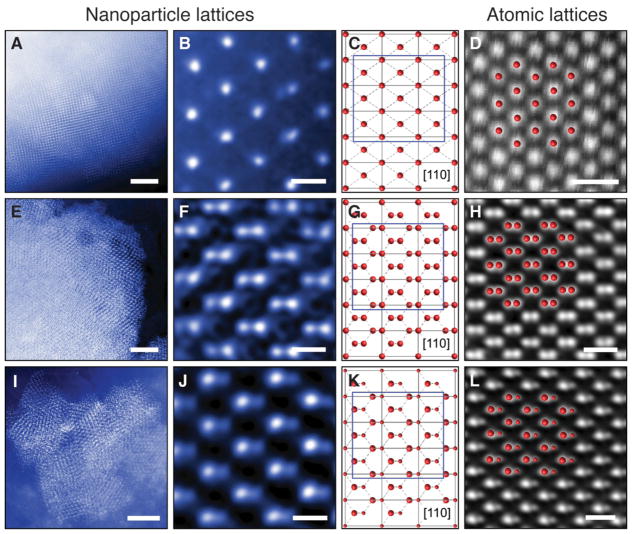
Diamond lattices formed by atomic or colloidal elements exhibit remarkable functional properties. However, building such structures via self-assembly has proven to be challenging because of the low packing fraction, sensitivity to bond orientation, and local heterogeneity. We report a strategy for creating a diamond superlattice of nano-objects via self-assembly and demonstrate its experimental realization by assembling two variant diamond lattices, one with and one without atomic analogs. Our approach relies on the association between anisotropic particles with well-defined tetravalent binding topology and isotropic particles. The constrained packing of triangular binding footprints of truncated tetrahedra on a sphere defines a unique three-dimensional lattice. Hence, the diamond self-assembly problem is solved via its mapping onto two-dimensional triangular packing on the surface of isotropic spherical particles.
由原子或胶体元素形成的金刚石晶格具有显著的功能特性。然而,由于填充率低、对键取向敏感以及局部不均匀性,通过自组装构建此类结构已被证明具有挑战性。我们报告了一种通过自组装创建纳米物体金刚石超晶格的策略,并通过组装两种变体金刚石晶格(一种有原子类似物,一种没有)展示了其实验实现。我们的方法依赖于具有明确四价结合拓扑结构的各向异性粒子与各向同性粒子之间的关联。截顶四面体在球体上的三角形结合足迹的受限堆积定义了一种独特的三维晶格。因此,通过将金刚石自组装问题映射到各向同性球形粒子表面的二维三角形堆积上得以解决。