Fleta-Soriano Eva, Munné-Bosch Sergi
Department of Plant Biology, Faculty of Biology, University of Barcelona Barcelona, Spain.
Front Plant Sci. 2016 Feb 15;7:143. doi: 10.3389/fpls.2016.00143. eCollection 2016.
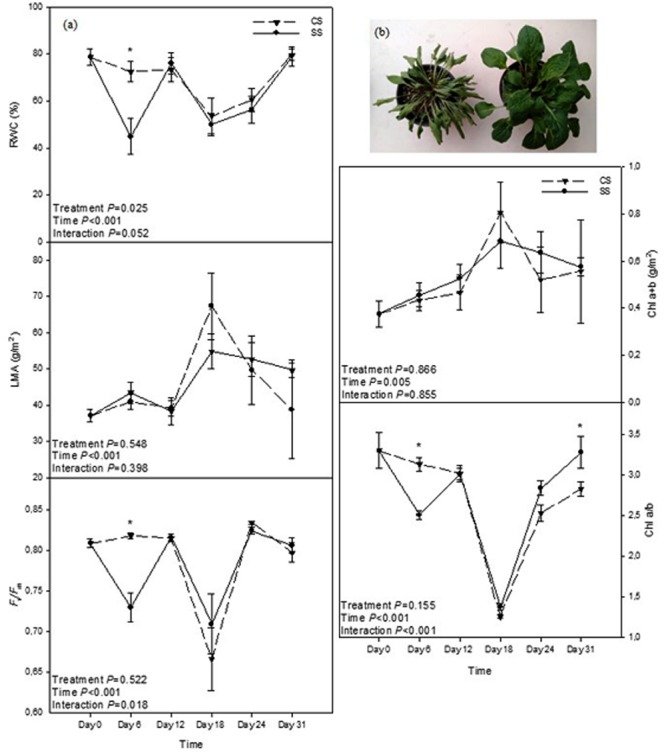
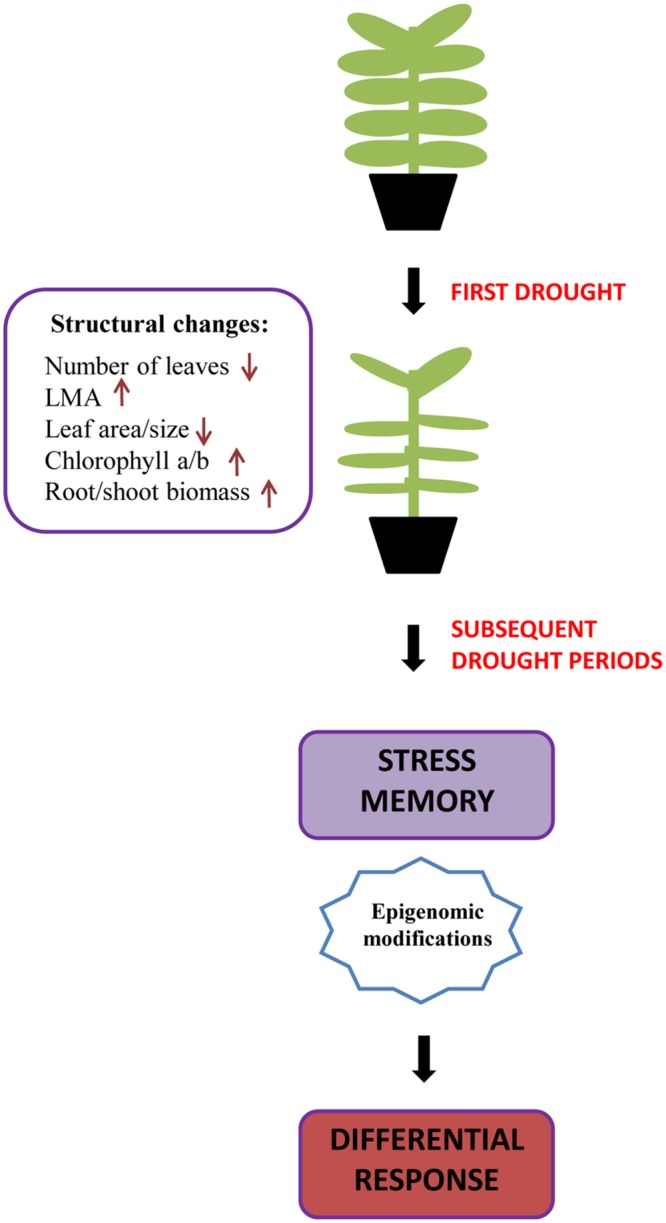
Plants grow and develop by adjusting their physiology to changes in their environment. Changes in the abiotic environment occur over years, seasons, and days, but also over minutes and even seconds. In this ever-changing environment, plants may adjust their structure and function rapidly to optimize growth and reproduction. Plant responses to reiterated drought (i.e., repeated cycles of drought) differ from those to single incidences of drought; in fact, in nature, plants are usually exposed to repeated cycles of drought that differ in duration and intensity. Nowadays, there is increased interest in better understanding mechanisms of plant response to reiterated drought due, at least in part, to the discovery of epigenomic changes that trigger drought stress memory in plants. Beyond epigenomic changes, there are, however, other aspects that should be considered in the study of plant responses to reiterated drought: from changes in other "omics" approaches (transcriptomics, proteomics, and metabolomics), to changes in plant structure; all of which may help us to better understand plant stress memory and its underlying mechanisms. Here, we present an example in which reiterated drought affects the pigment composition of leaves in the ornamental plant Silene dioica and discuss the importance of structural changes (in this case in the photosynthetic apparatus) for the plant response to reiterated drought; they represent a stress imprint that can affect plant response to subsequent stress episodes. Emphasis is placed on the importance of considering structural changes, in addition to physiological adjustments at the "omics" level, to understand stress memory in plants better.
植物通过调整自身生理机能以适应环境变化来实现生长和发育。非生物环境的变化历经数年、季节、昼夜,甚至在数分钟乃至数秒内也会发生。在这种不断变化的环境中,植物可能会迅速调整其结构和功能,以优化生长和繁殖。植物对反复干旱(即干旱的重复循环)的反应不同于对单次干旱事件的反应;事实上,在自然界中,植物通常会经历持续时间和强度各异的反复干旱循环。如今,人们对更好地理解植物对反复干旱的反应机制兴趣日增,这至少部分归因于表观基因组变化的发现,这些变化触发了植物的干旱胁迫记忆。然而,除了表观基因组变化之外,在研究植物对反复干旱的反应时,还应考虑其他方面:从其他“组学”方法(转录组学、蛋白质组学和代谢组学)的变化,到植物结构的变化;所有这些都可能有助于我们更好地理解植物胁迫记忆及其潜在机制。在此,我们给出一个例子,即反复干旱如何影响观赏植物二色补血草叶片的色素组成,并讨论结构变化(在本例中为光合器官的结构变化)对植物对反复干旱反应的重要性;它们代表了一种胁迫印记,能够影响植物对后续胁迫事件的反应。重点强调了除了“组学”水平的生理调节外,考虑结构变化对于更好地理解植物胁迫记忆的重要性。