Schadeweg Virginia, Boles Eckhard
Institute of Molecular Biosciences, Goethe-University Frankfurt, Max-von-Laue Str.9, 60438 Frankfurt Am Main, Germany.
Biotechnol Biofuels. 2016 Feb 24;9:44. doi: 10.1186/s13068-016-0456-7. eCollection 2016.
Butanol isomers are regarded as more suitable fuel substitutes than bioethanol. n-Butanol is naturally produced by some Clostridia species, but due to inherent problems with clostridial fermentations, industrially more relevant organisms have been genetically engineered for n-butanol production. Although the yeast Saccharomyces cerevisiae holds significant advantages in terms of scalable industrial fermentation, n-butanol yields and titers obtained so far are only low.
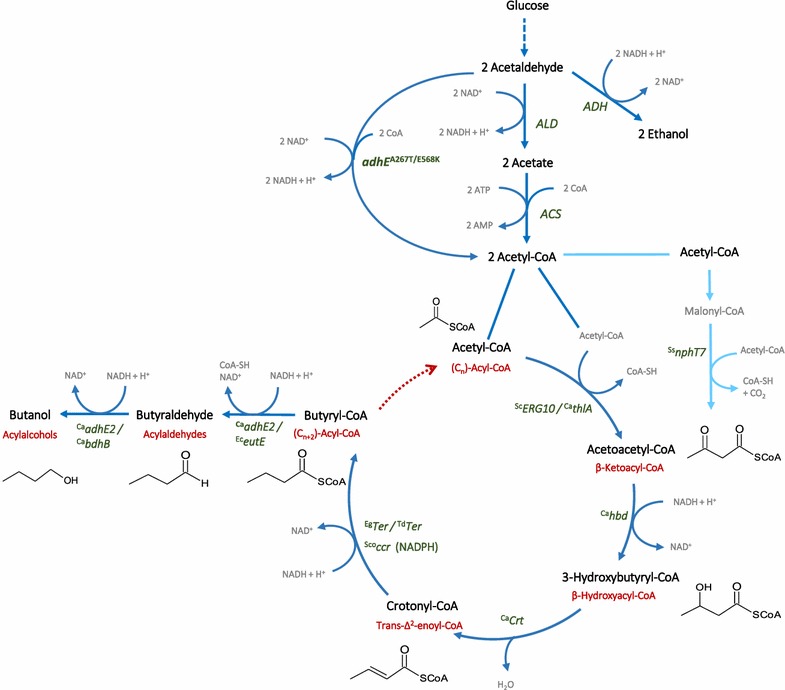
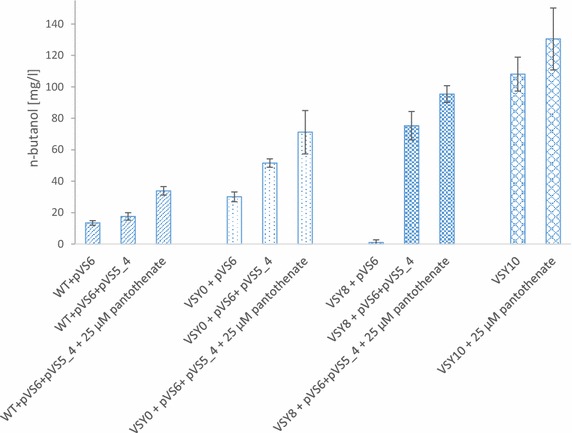
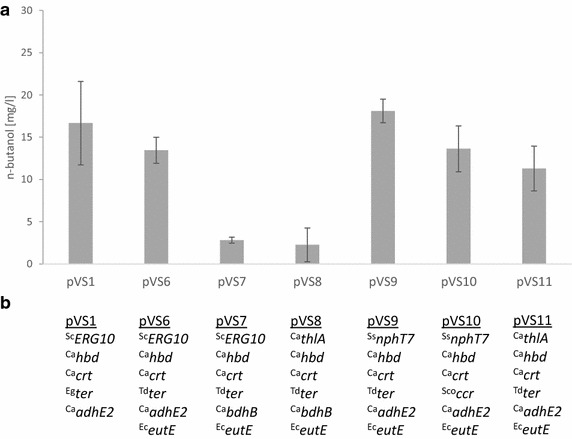
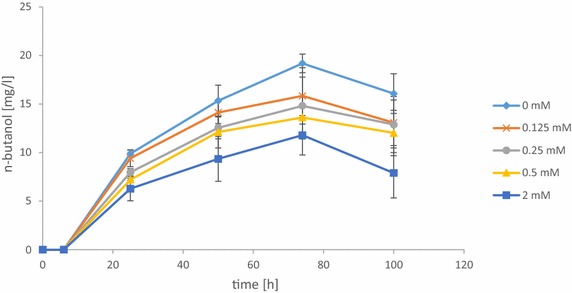
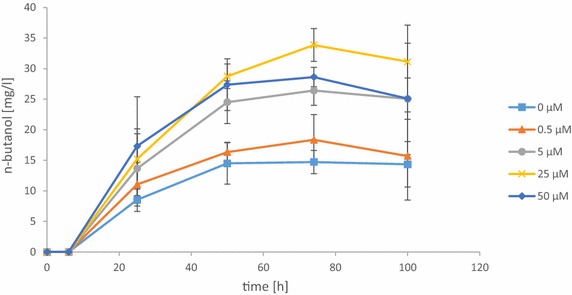
Here we report a thorough analysis and significant improvements of n-butanol production from glucose with yeast via the acetoacetyl-CoA-derived pathway. First, we established an improved n-butanol pathway by testing various isoenzymes of different pathway reactions. This resulted in n-butanol titers around 15 mg/L in synthetic medium after 74 h. As the initial substrate of the n-butanol pathway is acetyl-coenzyme A (acetyl-CoA) and most intermediates are bound to coenzyme A (CoA), we increased CoA synthesis by overexpression of the pantothenate kinase coaA gene from Escherichia coli. Supplementation with pantothenate increased n-butanol production up to 34 mg/L. Additional reduction of ethanol formation by deletion of alcohol dehydrogenase genes ADH1-5 led to n-butanol titers of 71 mg/L. Further expression of a mutant form of an ATP independent acetylating acetaldehyde dehydrogenase, adhE(A267T/E568K), converting acetaldehyde into acetyl-CoA, resulted in 95 mg/L n-butanol. In the final strain, the n-butanol pathway genes, coaA and adhE (A267T/E568K), were stably integrated into the yeast genome, thereby deleting another alcohol dehydrogenase gene, ADH6, and GPD2-encoding glycerol-3-phosphate dehydrogenase. This led to a further decrease in ethanol and glycerol by-product formation and elevated redox power in the form of NADH. With the addition of pantothenate, this strain produced n-butanol up to a titer of 130 ± 20 mg/L and a yield of 0.012 g/g glucose. These are the highest values reported so far for S. cerevisiae in synthetic medium via an acetoacetyl-CoA-derived n-butanol pathway.
By gradually increasing substrate supply and redox power in the form of CoA, acetyl-CoA, and NADH, and decreasing ethanol and glycerol formation, we could stepwise increase n-butanol production in S. cerevisiae. However, still further bottlenecks in the n-butanol pathway must be deciphered and improved for industrially relevant n-butanol production levels.
与生物乙醇相比,丁醇异构体被认为是更合适的燃料替代品。正丁醇由某些梭菌属自然产生,但由于梭菌发酵存在固有问题,已对工业上更具相关性的生物体进行基因工程改造以用于生产正丁醇。尽管酿酒酵母在可扩展的工业发酵方面具有显著优势,但迄今为止获得的正丁醇产量和滴度仍然很低。
在此,我们报告了通过乙酰乙酰辅酶A衍生途径利用酵母从葡萄糖生产正丁醇的全面分析及显著改进。首先,我们通过测试不同途径反应的各种同工酶建立了一条改进的正丁醇途径。这使得在合成培养基中培养74小时后正丁醇滴度达到约15毫克/升。由于正丁醇途径的初始底物是乙酰辅酶A(乙酰 - CoA)且大多数中间体与辅酶A(CoA)结合,我们通过过表达来自大肠杆菌的泛酸激酶coaA基因来增加CoA的合成。添加泛酸使正丁醇产量提高至34毫克/升。通过缺失乙醇脱氢酶基因ADH1 - 5进一步减少乙醇生成,使正丁醇滴度达到71毫克/升。进一步表达一种不依赖ATP的乙酰化乙醛脱氢酶的突变形式adhE(A267T/E568K),将乙醛转化为乙酰 - CoA,使正丁醇产量达到95毫克/升。在最终菌株中,正丁醇途径基因coaA和adhE (A267T/E568K)被稳定整合到酵母基因组中,从而缺失另一个乙醇脱氢酶基因ADH6和编码甘油 - 3 - 磷酸脱氢酶的GPD2。这导致乙醇和甘油副产物形成进一步减少,并以NADH的形式提高了氧化还原能力。添加泛酸后,该菌株产生的正丁醇滴度高达130±20毫克/升,产量为0.012克/克葡萄糖。这些是迄今为止通过乙酰乙酰辅酶A衍生的正丁醇途径在合成培养基中酿酒酵母所报道的最高值。
通过逐步增加以CoA、乙酰 - CoA和NADH形式存在的底物供应和氧化还原能力,并减少乙醇和甘油的形成,我们能够逐步提高酿酒酵母中正丁醇的产量。然而,对于工业相关的正丁醇生产水平,正丁醇途径中仍有更多瓶颈需要破解和改进。