Kruizinga R, Helmich E, Schilderman J B A M, Scherer-Rath M, van Laarhoven H W M
Department of Medical Oncology, Academic Medical Center, University of Amsterdam, Meibergdreef 9, F4-261, 1105 AZ, Amsterdam, The Netherlands.
Center for Evidence-Based Education, Academic Medical Center, University of Amsterdam, Meibergdreef 15, J1A, 1105 AZ, Amsterdam, The Netherlands.
Support Care Cancer. 2016 Jul;24(7):3111-8. doi: 10.1007/s00520-016-3115-4. Epub 2016 Feb 26.
Good palliative care requires excellent interprofessional collaboration; however, working in interprofessional teams may be challenging and difficult.
The aim of the study is to understand the lived experience of spiritual counselors working with a new structured method in offering spiritual care to palliative patients in relation to a multidisciplinary health care team.
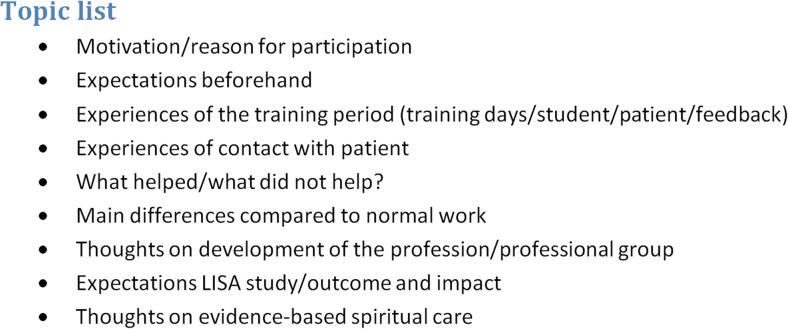
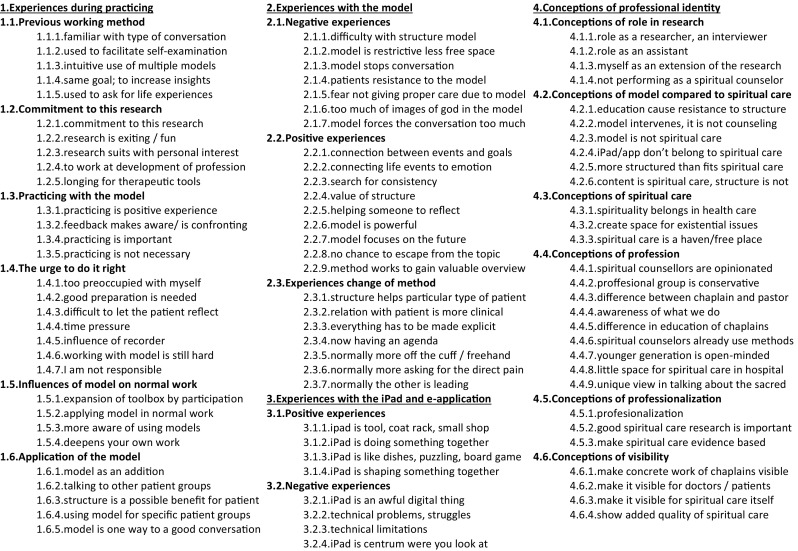
Interpretive phenomenological analysis of in-depth interviews, was done using template analysis to structure the data. We included nine spiritual counselors who are trained in using the new structured method to provide spiritual care for advanced cancer patients.
Although the spiritual counselors were experiencing struggles with structure and iPad, they were immediately willing to work with the new structured method as they expected the visibility and professionalization of their profession to improve. In this process, they experienced a need to adapt to a certain role while working with the new method and described how the identities of the profession were challenged.
There is a need to concretize, professionalize, and substantiate the work of spiritual counselors in a health care setting, to enhance visibility for patients and improve interprofessional collaboration with other health care workers. However, introducing new methods to spiritual counselors is not easy, as this may challenge or jeopardize their current professional identities. Therefore, we recommend to engage spiritual counselors early in processes of change to ensure that the core of who they are as professionals remains reflected in their work.
优质的姑息治疗需要出色的跨专业协作;然而,在跨专业团队中工作可能具有挑战性且困难重重。
本研究旨在了解灵性咨询师运用一种新的结构化方法,与多学科医疗团队协作,为姑息治疗患者提供灵性关怀的实际体验。
采用模板分析法对深度访谈进行解释现象学分析,以此构建数据。我们纳入了九名接受过培训、运用新结构化方法为晚期癌症患者提供灵性关怀的灵性咨询师。
尽管灵性咨询师在适应结构和iPad方面面临困难,但他们立即愿意使用这种新的结构化方法,因为他们期望自身职业的能见度和专业化程度能够提高。在此过程中,他们在使用新方法时体验到需要适应特定角色,并描述了该职业身份如何受到挑战。
有必要在医疗环境中使灵性咨询师的工作具体化、专业化并充实其内容,以提高患者对其的认知度,并改善与其他医护人员的跨专业协作。然而,向灵性咨询师引入新方法并非易事,因为这可能会挑战或危及他们当前的职业身份。因此,我们建议在变革过程中尽早让灵性咨询师参与进来,以确保他们作为专业人员的核心特质在工作中得以体现。