Beraldo Rebeca Antunes, Meliscki Gabriela Cristina, Silva Bruna Ramos, Navarro Anderson Marliere, Bollela Valdes Roberto, Schmidt André, Foss-Freitas Maria Cristina
Department of Internal Medicine, Ribeirão Preto Medical School, University of São Paulo, Ribeirão Preto, São Paulo, Brazil.
PLoS One. 2016 Feb 26;11(2):e0149905. doi: 10.1371/journal.pone.0149905. eCollection 2016.
Highly active antiretroviral therapy (HAART) can cause side effects in HIV patients, as the metabolic syndrome. Early identification of risk for development of cardiovascular diseases using available reliable and practical methods is fundamental. On this basis, the aim of this study was to compare the effectiveness of anthropometric indicators to identify metabolic syndrome in HIV patients on HAART.
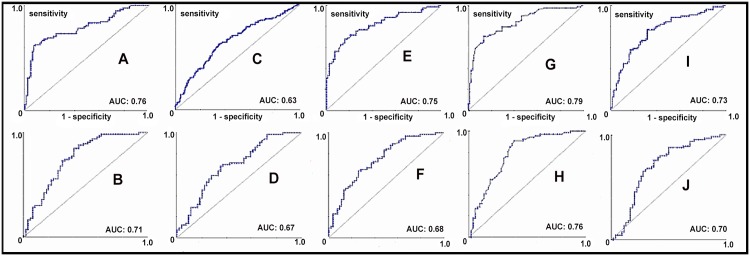
It is a cross-sectional study. A number of 280 stable HIV patients were studied. It measured weight, height, waist circumference (WC), hip circumference (HP), thigh circumference (TC) and calculated body mass index (BMI), body adiposity index (BAI), waist to hip ratio (WHR) and waist to thigh ratio (WTR). There was also a performance of biochemical tests of lipid profile and fasting glucose. Systemic blood pressure was measured. The criteria proposed by the National Cholesterol Education Program III (NCEP-ATP III) to metabolic syndrome classification was used. Individuals were divided in groups with or without metabolic alterations and their anthropometric indicators were compared. Receiver operating characteristic (ROC) curves were designed for each anthropometric indicator using the metabolic syndrome classification to identify sensitivity and specificity.
WC was a good tool to identify each metabolic disorder separately: total cholesterol (only females, p<0.05), triglycerides (only males, p<0.001), HDL cholesterol (p<0.05), LDL cholesterol (p<005) and fasting glycemic (p<005). WC also showed the best performance to identify metabolic syndrome in both genders (areas under the curve (AUCs): 0.79 and 0.76 for male and female, respectively), while BAI proved to be an inadequate indicator (AUCs: 0.63 and 0.67 for males and females), respectively, in this population.
The central adiposity measure (WC) had the best performance to identify metabolic syndrome, and it is a convenient, cheap and reliable tool that can be used in clinical practice routinely to prevent cardiovascular complications in HIV patients.
高效抗逆转录病毒疗法(HAART)会给艾滋病患者带来副作用,比如代谢综合征。运用现有可靠且实用的方法尽早识别心血管疾病的发病风险至关重要。在此基础上,本研究旨在比较人体测量指标在识别接受HAART治疗的艾滋病患者代谢综合征方面的有效性。
这是一项横断面研究。对280名病情稳定的艾滋病患者进行了研究。测量了体重、身高、腰围(WC)、臀围(HP)、大腿围(TC),并计算了体重指数(BMI)、体脂指数(BAI)、腰臀比(WHR)和腰大腿比(WTR)。还进行了血脂谱和空腹血糖的生化检测。测量了全身血压。采用美国国家胆固醇教育计划第三次报告(NCEP-ATP III)提出的代谢综合征分类标准。将个体分为有或没有代谢改变的组,并比较他们的人体测量指标。使用代谢综合征分类为每个人体测量指标设计受试者工作特征(ROC)曲线,以确定敏感性和特异性。
腰围是分别识别每种代谢紊乱的良好工具:总胆固醇(仅女性,p<0.05)、甘油三酯(仅男性,p<0.001)、高密度脂蛋白胆固醇(p<0.05)、低密度脂蛋白胆固醇(p<0.05)和空腹血糖(p<0.05)。腰围在识别男女代谢综合征方面也表现最佳(曲线下面积(AUC):男性和女性分别为0.79和0.76),而在该人群中,体脂指数被证明是一个不充分的指标(男性和女性的AUC分别为0.63和0.67)。
中心性肥胖测量指标(腰围)在识别代谢综合征方面表现最佳,它是一种方便、廉价且可靠的工具,可在临床实践中常规用于预防艾滋病患者的心血管并发症。