• 文献检索
  • 文档翻译
  • 深度研究
  • 学术资讯
  • Suppr Zotero 插件Zotero 插件
  • 邀请有礼
  • 套餐&价格
  • 历史记录
应用&插件
Suppr Zotero 插件Zotero 插件浏览器插件Mac 客户端Windows 客户端微信小程序
定价
高级版会员购买积分包购买API积分包
服务
文献检索文档翻译深度研究API 文档MCP 服务
关于我们
关于 Suppr公司介绍联系我们用户协议隐私条款
关注我们

Suppr 超能文献

核心技术专利:CN118964589B侵权必究
粤ICP备2023148730 号-1Suppr @ 2026

文献检索

告别复杂PubMed语法,用中文像聊天一样搜索,搜遍4000万医学文献。AI智能推荐,让科研检索更轻松。

立即免费搜索

文件翻译

保留排版,准确专业,支持PDF/Word/PPT等文件格式,支持 12+语言互译。

免费翻译文档

深度研究

AI帮你快速写综述,25分钟生成高质量综述,智能提取关键信息,辅助科研写作。

立即免费体验

肿瘤微环境衍生的外泌体多效性地调节癌细胞代谢。

Tumor microenvironment derived exosomes pleiotropically modulate cancer cell metabolism.

作者信息

Zhao Hongyun, Yang Lifeng, Baddour Joelle, Achreja Abhinav, Bernard Vincent, Moss Tyler, Marini Juan C, Tudawe Thavisha, Seviour Elena G, San Lucas F Anthony, Alvarez Hector, Gupta Sonal, Maiti Sourindra N, Cooper Laurence, Peehl Donna, Ram Prahlad T, Maitra Anirban, Nagrath Deepak

机构信息

Laboratory for Systems Biology of Human Diseases, Rice University, Houston, United States.

Department of Chemical and Biomolecular Engineering, Rice University, Houston, United States.

出版信息

Elife. 2016 Feb 27;5:e10250. doi: 10.7554/eLife.10250.

DOI:10.7554/eLife.10250
PMID:26920219
原文链接:https://pmc.ncbi.nlm.nih.gov/articles/PMC4841778/
Abstract

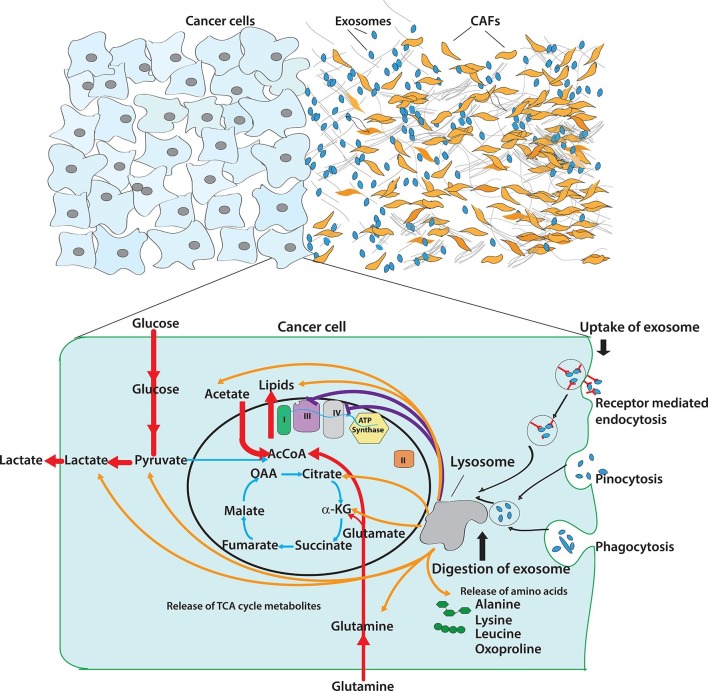
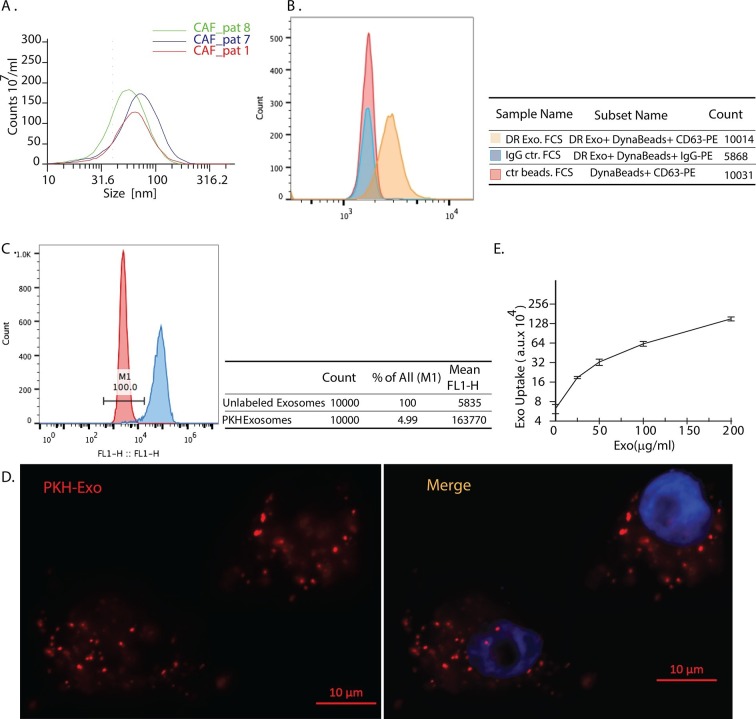
Cancer-associated fibroblasts (CAFs) are a major cellular component of tumor microenvironment in most solid cancers. Altered cellular metabolism is a hallmark of cancer, and much of the published literature has focused on neoplastic cell-autonomous processes for these adaptations. We demonstrate that exosomes secreted by patient-derived CAFs can strikingly reprogram the metabolic machinery following their uptake by cancer cells. We find that CAF-derived exosomes (CDEs) inhibit mitochondrial oxidative phosphorylation, thereby increasing glycolysis and glutamine-dependent reductive carboxylation in cancer cells. Through 13C-labeled isotope labeling experiments we elucidate that exosomes supply amino acids to nutrient-deprived cancer cells in a mechanism similar to macropinocytosis, albeit without the previously described dependence on oncogenic-Kras signaling. Using intra-exosomal metabolomics, we provide compelling evidence that CDEs contain intact metabolites, including amino acids, lipids, and TCA-cycle intermediates that are avidly utilized by cancer cells for central carbon metabolism and promoting tumor growth under nutrient deprivation or nutrient stressed conditions.

摘要

癌症相关成纤维细胞(CAFs)是大多数实体癌肿瘤微环境中的主要细胞成分。细胞代谢改变是癌症的一个标志,并且大部分已发表的文献都聚焦于肿瘤细胞自主过程的这些适应性变化。我们证明,患者来源的CAFs分泌的外泌体在被癌细胞摄取后能显著地重新编程代谢机制。我们发现,CAF来源的外泌体(CDEs)抑制线粒体氧化磷酸化,从而增加癌细胞中的糖酵解和谷氨酰胺依赖性还原羧化作用。通过13C标记的同位素标记实验,我们阐明外泌体以类似于巨胞饮作用的机制向营养缺乏的癌细胞提供氨基酸,尽管不依赖于先前描述的致癌Kras信号传导。使用外泌体内代谢组学,我们提供了令人信服的证据,表明CDEs含有完整的代谢物,包括氨基酸、脂质和三羧酸循环中间体这些被癌细胞用于中心碳代谢并在营养缺乏或营养应激条件下促进肿瘤生长的物质。
https://cdn.ncbi.nlm.nih.gov/pmc/blobs/1e77/4841778/3fee4b9cdc04/elife-10250-resp-fig1.jpg
https://cdn.ncbi.nlm.nih.gov/pmc/blobs/1e77/4841778/9ec8d9d3b361/elife-10250-fig1.jpg
https://cdn.ncbi.nlm.nih.gov/pmc/blobs/1e77/4841778/bfd02192e841/elife-10250-fig2.jpg
https://cdn.ncbi.nlm.nih.gov/pmc/blobs/1e77/4841778/1cd805d63130/elife-10250-fig2-figsupp1.jpg
https://cdn.ncbi.nlm.nih.gov/pmc/blobs/1e77/4841778/a7a334676912/elife-10250-fig2-figsupp2.jpg
https://cdn.ncbi.nlm.nih.gov/pmc/blobs/1e77/4841778/bba9cd6da727/elife-10250-fig3.jpg
https://cdn.ncbi.nlm.nih.gov/pmc/blobs/1e77/4841778/21b4af65d1e9/elife-10250-fig3-figsupp1.jpg
https://cdn.ncbi.nlm.nih.gov/pmc/blobs/1e77/4841778/61f7efc99cca/elife-10250-fig4.jpg
https://cdn.ncbi.nlm.nih.gov/pmc/blobs/1e77/4841778/e4be2a64608d/elife-10250-fig4-figsupp1.jpg
https://cdn.ncbi.nlm.nih.gov/pmc/blobs/1e77/4841778/7fb5c6fc57d4/elife-10250-fig5.jpg
https://cdn.ncbi.nlm.nih.gov/pmc/blobs/1e77/4841778/5720cd2319da/elife-10250-fig6.jpg
https://cdn.ncbi.nlm.nih.gov/pmc/blobs/1e77/4841778/6ef32d9fe388/elife-10250-fig6-figsupp1.jpg
https://cdn.ncbi.nlm.nih.gov/pmc/blobs/1e77/4841778/3ed529871cd3/elife-10250-fig7.jpg
https://cdn.ncbi.nlm.nih.gov/pmc/blobs/1e77/4841778/93558aa1a485/elife-10250-fig7-figsupp1.jpg
https://cdn.ncbi.nlm.nih.gov/pmc/blobs/1e77/4841778/427cc2590dac/elife-10250-fig7-figsupp2.jpg
https://cdn.ncbi.nlm.nih.gov/pmc/blobs/1e77/4841778/f79ef4d69f03/elife-10250-fig7-figsupp3.jpg
https://cdn.ncbi.nlm.nih.gov/pmc/blobs/1e77/4841778/1bb8cd3a6230/elife-10250-fig7-figsupp4.jpg
https://cdn.ncbi.nlm.nih.gov/pmc/blobs/1e77/4841778/b3f46ecf3ba6/elife-10250-fig8.jpg
https://cdn.ncbi.nlm.nih.gov/pmc/blobs/1e77/4841778/3fee4b9cdc04/elife-10250-resp-fig1.jpg
https://cdn.ncbi.nlm.nih.gov/pmc/blobs/1e77/4841778/9ec8d9d3b361/elife-10250-fig1.jpg
https://cdn.ncbi.nlm.nih.gov/pmc/blobs/1e77/4841778/bfd02192e841/elife-10250-fig2.jpg
https://cdn.ncbi.nlm.nih.gov/pmc/blobs/1e77/4841778/1cd805d63130/elife-10250-fig2-figsupp1.jpg
https://cdn.ncbi.nlm.nih.gov/pmc/blobs/1e77/4841778/a7a334676912/elife-10250-fig2-figsupp2.jpg
https://cdn.ncbi.nlm.nih.gov/pmc/blobs/1e77/4841778/bba9cd6da727/elife-10250-fig3.jpg
https://cdn.ncbi.nlm.nih.gov/pmc/blobs/1e77/4841778/21b4af65d1e9/elife-10250-fig3-figsupp1.jpg
https://cdn.ncbi.nlm.nih.gov/pmc/blobs/1e77/4841778/61f7efc99cca/elife-10250-fig4.jpg
https://cdn.ncbi.nlm.nih.gov/pmc/blobs/1e77/4841778/e4be2a64608d/elife-10250-fig4-figsupp1.jpg
https://cdn.ncbi.nlm.nih.gov/pmc/blobs/1e77/4841778/7fb5c6fc57d4/elife-10250-fig5.jpg
https://cdn.ncbi.nlm.nih.gov/pmc/blobs/1e77/4841778/5720cd2319da/elife-10250-fig6.jpg
https://cdn.ncbi.nlm.nih.gov/pmc/blobs/1e77/4841778/6ef32d9fe388/elife-10250-fig6-figsupp1.jpg
https://cdn.ncbi.nlm.nih.gov/pmc/blobs/1e77/4841778/3ed529871cd3/elife-10250-fig7.jpg
https://cdn.ncbi.nlm.nih.gov/pmc/blobs/1e77/4841778/93558aa1a485/elife-10250-fig7-figsupp1.jpg
https://cdn.ncbi.nlm.nih.gov/pmc/blobs/1e77/4841778/427cc2590dac/elife-10250-fig7-figsupp2.jpg
https://cdn.ncbi.nlm.nih.gov/pmc/blobs/1e77/4841778/f79ef4d69f03/elife-10250-fig7-figsupp3.jpg
https://cdn.ncbi.nlm.nih.gov/pmc/blobs/1e77/4841778/1bb8cd3a6230/elife-10250-fig7-figsupp4.jpg
https://cdn.ncbi.nlm.nih.gov/pmc/blobs/1e77/4841778/b3f46ecf3ba6/elife-10250-fig8.jpg
https://cdn.ncbi.nlm.nih.gov/pmc/blobs/1e77/4841778/3fee4b9cdc04/elife-10250-resp-fig1.jpg

相似文献

1
Tumor microenvironment derived exosomes pleiotropically modulate cancer cell metabolism.肿瘤微环境衍生的外泌体多效性地调节癌细胞代谢。
Elife. 2016 Feb 27;5:e10250. doi: 10.7554/eLife.10250.
2
Exo-MFA - A 13C metabolic flux analysis framework to dissect tumor microenvironment-secreted exosome contributions towards cancer cell metabolism.外泌体代谢通量分析框架解析肿瘤微环境分泌的外泌体对癌细胞代谢的贡献
Metab Eng. 2017 Sep;43(Pt B):156-172. doi: 10.1016/j.ymben.2017.01.001. Epub 2017 Jan 11.
3
Exosomes Derived from Human Primary and Metastatic Colorectal Cancer Cells Contribute to Functional Heterogeneity of Activated Fibroblasts by Reprogramming Their Proteome.人原发和转移性结直肠癌细胞来源的外泌体通过重编程其蛋白质组来促进激活的成纤维细胞的功能异质性。
Proteomics. 2019 Apr;19(8):e1800148. doi: 10.1002/pmic.201800148. Epub 2019 Jan 31.
4
Cancer-derived exosomes trigger endothelial to mesenchymal transition followed by the induction of cancer-associated fibroblasts.肿瘤来源的外泌体引发内皮细胞向间充质转化,随后诱导肿瘤相关成纤维细胞。
Acta Biomater. 2018 Aug;76:146-153. doi: 10.1016/j.actbio.2018.07.001. Epub 2018 Jul 4.
5
The Engaged Role of Tumor Microenvironment in Cancer Metabolism: Focusing on Cancer-Associated Fibroblast and Exosome Mediators.肿瘤微环境在癌症代谢中的活跃角色:聚焦于癌症相关成纤维细胞和外泌体介导物。
Anticancer Agents Med Chem. 2021;21(2):254-266. doi: 10.2174/1871520620666200910123428.
6
Tumor microenvironment and metabolic synergy in breast cancers: critical importance of mitochondrial fuels and function.肿瘤微环境与乳腺癌的代谢协同作用:线粒体燃料和功能的关键重要性。
Semin Oncol. 2014 Apr;41(2):195-216. doi: 10.1053/j.seminoncol.2014.03.002. Epub 2014 Mar 5.
7
Cancer-associated fibroblasts and its derived exosomes: a new perspective for reshaping the tumor microenvironment.癌相关成纤维细胞及其衍生的外泌体:重塑肿瘤微环境的新视角。
Mol Med. 2023 May 22;29(1):66. doi: 10.1186/s10020-023-00665-y.
8
Metabolic reprogramming of stromal fibroblasts by melanoma exosome microRNA favours a pre-metastatic microenvironment.黑色素瘤外泌体 microRNA 对基质成纤维细胞的代谢重编程有利于形成一个有利于转移的微环境。
Sci Rep. 2018 Aug 27;8(1):12905. doi: 10.1038/s41598-018-31323-7.
9
NADH-linked metabolic plasticity of MCF-7 breast cancer cells surviving in a nutrient-deprived microenvironment.在营养缺乏的微环境中存活的MCF-7乳腺癌细胞的NADH相关代谢可塑性。
J Cell Biochem. 2015 May;116(5):822-35. doi: 10.1002/jcb.25038.
10
Metabolic and Signaling Functions of Cancer Cell-Derived Extracellular Vesicles.肿瘤细胞衍生的细胞外囊泡的代谢和信号功能。
Int Rev Cell Mol Biol. 2016;326:175-99. doi: 10.1016/bs.ircmb.2016.04.004. Epub 2016 Jun 2.

引用本文的文献

1
The Role of Tumor Microenvironment in Triple-Negative Breast Cancer and Its Therapeutic Targeting.肿瘤微环境在三阴性乳腺癌中的作用及其治疗靶向
Cells. 2025 Aug 30;14(17):1353. doi: 10.3390/cells14171353.
2
Diagnostic and prognostic significance of circulating extracellular vesicles in gastrointestinal cancers.循环细胞外囊泡在胃肠道癌症中的诊断和预后意义
Clin Transl Oncol. 2025 Sep 12. doi: 10.1007/s12094-025-04055-0.
3
Human-induced pluripotent stem cell-based hepatic modeling of lipid metabolism-associated TM6SF2-E167K variant.

本文引用的文献

1
Tumour exosome integrins determine organotropic metastasis.肿瘤外泌体整合素决定器官特异性转移。
Nature. 2015 Nov 19;527(7578):329-35. doi: 10.1038/nature15756. Epub 2015 Oct 28.
2
Pancreatic cancer exosomes initiate pre-metastatic niche formation in the liver.胰腺癌外泌体启动肝脏中前转移生态位的形成。
Nat Cell Biol. 2015 Jun;17(6):816-26. doi: 10.1038/ncb3169. Epub 2015 May 18.
3
Fibroblast-Derived Exosomes Contribute to Chemoresistance through Priming Cancer Stem Cells in Colorectal Cancer.成纤维细胞衍生的外泌体通过启动结直肠癌中的癌症干细胞促进化疗耐药性。
基于人诱导多能干细胞的脂质代谢相关TM6SF2-E167K变体的肝脏建模
Hepatology. 2025 Sep 1;82(3):638-654. doi: 10.1097/HEP.0000000000001065. Epub 2024 Aug 27.
4
Extracellular Vesicles As a Source of Biomarkers for Cancer Diagnosis.细胞外囊泡作为癌症诊断生物标志物的来源
Acta Naturae. 2025 Apr-Jun;17(2):28-40. doi: 10.32607/actanaturae.27591.
5
Fibroblasts activated by miRs-185-5p, miR-652-5p, and miR-1246 shape the tumor microenvironment in triple-negative breast cancer via PATZ1 downregulation.由miR-185-5p、miR-652-5p和miR-1246激活的成纤维细胞通过下调PATZ1塑造三阴性乳腺癌的肿瘤微环境。
Cell Mol Life Sci. 2025 Jul 25;82(1):287. doi: 10.1007/s00018-025-05781-y.
6
What's on the menu?: metabolic constraints in the pancreatic tumor microenvironment.菜单上有什么?:胰腺肿瘤微环境中的代谢限制
J Clin Invest. 2025 Jul 15;135(14). doi: 10.1172/JCI191940.
7
Exosomal long non-coding RNAs in human malignancies: biological functions and clinical applications.人类恶性肿瘤中的外泌体长链非编码RNA:生物学功能与临床应用
Med Oncol. 2025 Jun 24;42(8):279. doi: 10.1007/s12032-025-02845-8.
8
Extracellular vesicles as missiles for enhanced anti-tumor efficacy of oncolytic viruses: from disseminating oncolysis and anti-tumor immunity to targeted delivery.细胞外囊泡作为增强溶瘤病毒抗肿瘤疗效的“导弹”:从传播溶瘤作用和抗肿瘤免疫到靶向递送
Cell Commun Signal. 2025 Jun 11;23(1):276. doi: 10.1186/s12964-025-02283-z.
9
Bronchial smooth muscle extracellular vesicles interfere with bronchial epithelium metabolism and function in asthma.支气管平滑肌细胞外囊泡干扰哮喘患者支气管上皮的代谢和功能。
iScience. 2025 Apr 29;28(6):112546. doi: 10.1016/j.isci.2025.112546. eCollection 2025 Jun 20.
10
Extracellular vesicle proteomics uncovers energy metabolism, complement system, and endoplasmic reticulum stress response dysregulation postexercise in males with myalgic encephalomyelitis/chronic fatigue syndrome.细胞外囊泡蛋白质组学揭示了肌痛性脑脊髓炎/慢性疲劳综合征男性运动后能量代谢、补体系统和内质网应激反应失调。
Clin Transl Med. 2025 May;15(5):e70346. doi: 10.1002/ctm2.70346.
PLoS One. 2015 May 4;10(5):e0125625. doi: 10.1371/journal.pone.0125625. eCollection 2015.
4
Quantitative analysis of acetyl-CoA production in hypoxic cancer cells reveals substantial contribution from acetate.缺氧肿瘤细胞中乙酰辅酶 A 生成的定量分析显示乙酸盐有很大贡献。
Cancer Metab. 2014 Dec 11;2:23. doi: 10.1186/2049-3002-2-23. eCollection 2014.
5
Nitric oxide mediates metabolic coupling of omentum-derived adipose stroma to ovarian and endometrial cancer cells.一氧化氮介导网膜来源的脂肪基质与卵巢和子宫内膜癌细胞的代谢偶联。
Cancer Res. 2015 Jan 15;75(2):456-71. doi: 10.1158/0008-5472.CAN-14-1337. Epub 2014 Nov 25.
6
Extracellular vesicles including exosomes are mediators of signal transduction: are they protective or pathogenic?包括外泌体在内的细胞外囊泡是信号转导的介质:它们是保护性的还是致病性的?
Proteomics. 2015 Jan;15(2-3):260-71. doi: 10.1002/pmic.201400234. Epub 2014 Dec 18.
7
Metabolic shifts toward glutamine regulate tumor growth, invasion and bioenergetics in ovarian cancer.代谢向谷氨酰胺的转变调节卵巢癌的肿瘤生长、侵袭和生物能量学。
Mol Syst Biol. 2014 May 5;10(5):728. doi: 10.1002/msb.20134892.
8
Exosomes: decreased sensitivity of lung cancer A549 cells to cisplatin.外泌体:肺癌A549细胞对顺铂的敏感性降低。
PLoS One. 2014 Feb 21;9(2):e89534. doi: 10.1371/journal.pone.0089534. eCollection 2014.
9
starBase v2.0: decoding miRNA-ceRNA, miRNA-ncRNA and protein-RNA interaction networks from large-scale CLIP-Seq data.starBase v2.0:从大规模 CLIP-Seq 数据中解码 miRNA-ceRNA、miRNA-ncRNA 和蛋白质-RNA 相互作用网络。
Nucleic Acids Res. 2014 Jan;42(Database issue):D92-7. doi: 10.1093/nar/gkt1248. Epub 2013 Dec 1.
10
Cancer cell exosomes depend on cell-surface heparan sulfate proteoglycans for their internalization and functional activity.癌细胞外泌体依赖细胞表面的硫酸乙酰肝素蛋白聚糖来实现内化及其功能活性。
Proc Natl Acad Sci U S A. 2013 Oct 22;110(43):17380-5. doi: 10.1073/pnas.1304266110. Epub 2013 Oct 7.