Kang Min, Xiao Jingjian, Wang Jun, Zhou Pingting, Wei Tingting, Zhao Tingting, Wang Rensheng
Department of Radiation Oncology, The First Affiliated Hospital of Guangxi Medical University, Nanning, 530021, Guangxi, P.R. China.
Cancer Med. 2016 Jun;5(6):1163-73. doi: 10.1002/cam4.660. Epub 2016 Feb 29.
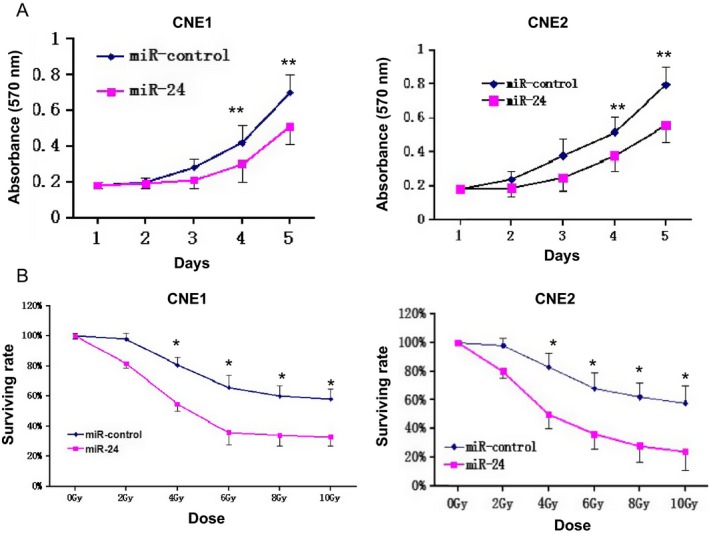
Radioresistance remains a major problem in the treatment of patients suffering from nasopharyngeal carcinoma (NPC). A better understanding of the mechanisms of radioresistance may generate new strategies to improve NPC patients' responses to therapy. This study was designed to investigate the effect of microRNA on the radiosensitivity of NPC cells. A microRNA microarray indicated that miR-24 was downregulated in NPC cell lines and tissues. Furthermore, cell proliferation was suppressed and radiosensitivity increased when miR-24 was ectopically expressed in NPC cells. Specificity protein 1 (SP1) was additionally verified as a direct functional target of miR-24, which was found to be involved in cell viability as well as the radiosensitivity of NPC cells. In conclusion, the results of this study suggest that the miR-24/SP1 pathway contributed to the reduction in radioresistance in human NPC and that it may thus represent a therapeutic target.
放射抗性仍然是鼻咽癌(NPC)患者治疗中的一个主要问题。更好地了解放射抗性机制可能会产生改善NPC患者治疗反应的新策略。本研究旨在探讨微小RNA对NPC细胞放射敏感性的影响。微小RNA微阵列表明,miR-24在NPC细胞系和组织中表达下调。此外,当miR-24在NPC细胞中异位表达时,细胞增殖受到抑制,放射敏感性增加。特异性蛋白1(SP1)被进一步证实为miR-24的直接功能靶点,发现其与NPC细胞的细胞活力以及放射敏感性有关。总之,本研究结果表明,miR-24/SP1通路有助于降低人NPC的放射抗性,因此可能代表一个治疗靶点。