Lee Ji Hyun, Son Sag Wook, Cho Sang Hyun
Department of Dermatology, The Catholic University of Korea, Seoul, Korea.
Department of Dermatology, Korea University College of Medicine, Seoul, Korea.
Allergy Asthma Immunol Res. 2016 May;8(3):181-90. doi: 10.4168/aair.2016.8.3.181.
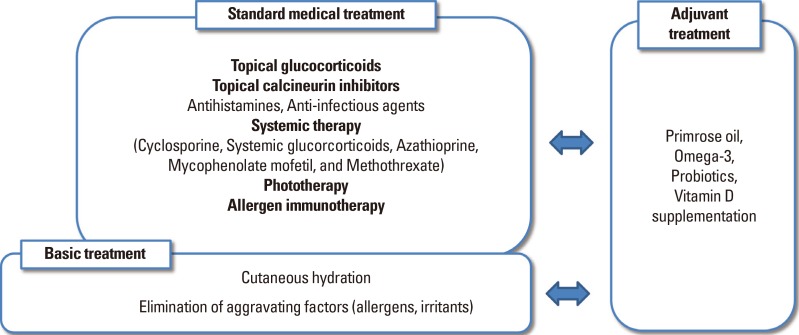
Atopic eczema (AE) is a chronic, inflammatory skin disorder which usually develops in early childhood. In spite of intensive investigations, the causes of AE remain unclear, but are likely to be multifactorial in nature. Environmental factors or genetic-environmental interactions seem to play a key role in disease progression. Among various measures of AE managment, cutaneous hydration, which improves barrier function and relieve itchiness, may be helpful to reduce the need for topical steroid use and therefore should be used as a basic treatment. Avoiding aggravating factors is also a basic treatment of AE. Standard medical treatment with a pharmacologic approach may be necessary if basic treatment fails to control symptoms satisfactorily. Recently, more attention is given to a proactive therapeutic by regular intermittent application of low potency steroids or topical calcineurin inhibitors to prevent new flares. Furthermore, various targeted biologics are being introduced for AE control and are proposed as promising therapies. This paper provides a summary of the recent literature on the manangement of AE and a treatment guideline.
特应性皮炎(AE)是一种慢性炎症性皮肤病,通常在儿童早期发病。尽管进行了深入研究,但AE的病因仍不清楚,可能具有多因素性质。环境因素或基因 - 环境相互作用似乎在疾病进展中起关键作用。在AE管理的各种措施中,皮肤保湿可改善屏障功能并缓解瘙痒,有助于减少局部使用类固醇的需求,因此应作为基本治疗方法。避免加重因素也是AE的基本治疗方法。如果基本治疗不能令人满意地控制症状,可能需要采用药理学方法进行标准药物治疗。最近,人们更加关注通过定期间歇应用低效类固醇或局部钙调神经磷酸酶抑制剂进行积极治疗,以预防新的发作。此外,各种靶向生物制剂正在被引入用于控制AE,并被认为是有前景的治疗方法。本文总结了近期关于AE管理的文献并提供了治疗指南。