Derst Christian, Dircksen Heinrich, Meusemann Karen, Zhou Xin, Liu Shanlin, Predel Reinhard
Institute for Zoology, Functional Peptidomics Group, University of Cologne, D-50674, Cologne, Germany.
Department of Zoology, Stockholm University, S-10691, Stockholm, Sweden.
BMC Evol Biol. 2016 Feb 29;16:51. doi: 10.1186/s12862-016-0621-4.
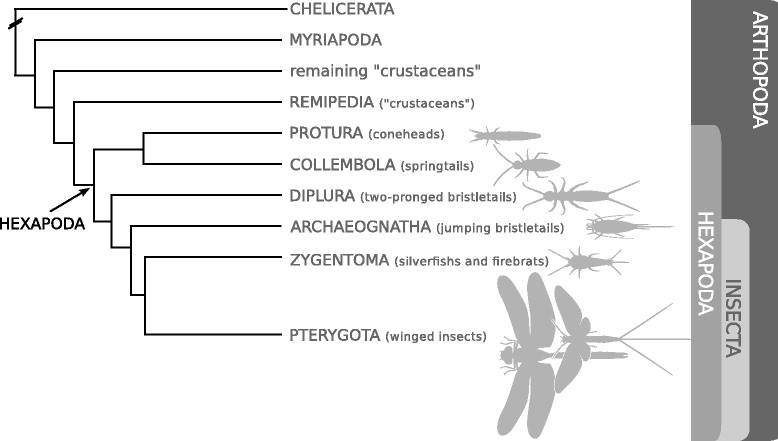
Neuropeptides are key players in information transfer and act as important regulators of development, growth, metabolism, and reproduction within multi-cellular animal organisms (Metazoa). These short protein-like substances show a high degree of structural variability and are recognized as the most diverse group of messenger molecules. We used transcriptome sequences from the 1KITE (1K Insect Transcriptome Evolution) project to search for neuropeptide coding sequences in 24 species from the non-pterygote hexapod lineages Protura (coneheads), Collembola (springtails), Diplura (two-pronged bristletails), Archaeognatha (jumping bristletails), and Zygentoma (silverfish and firebrats), which are often referred to as "basal" hexapods. Phylogenetically, Protura, Collembola, Diplura, and Archaeognatha are currently placed between Remipedia and Pterygota (winged insects); Zygentoma is the sistergroup of Pterygota. The Remipedia are assumed to be among the closest relatives of all hexapods and belong to the crustaceans.
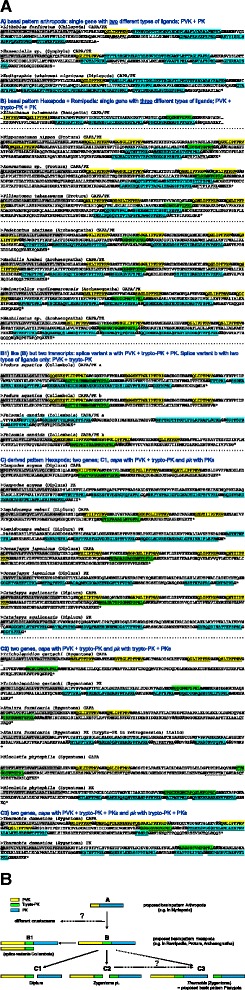
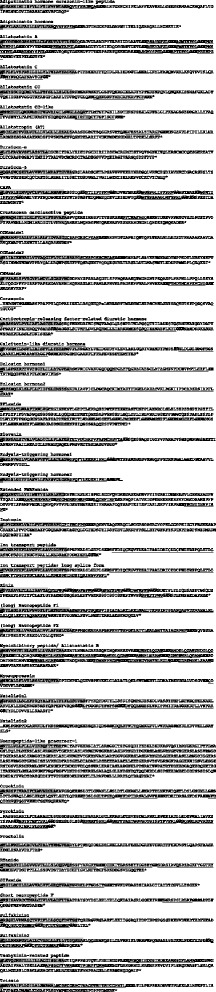
We identified neuropeptide precursor sequences within whole-body transcriptome data from these five hexapod groups and complemented this dataset with homologous sequences from three crustaceans (including Daphnia pulex), three myriapods, and the fruit fly Drosophila melanogaster. Our results indicate that the reported loss of several neuropeptide genes in a number of winged insects, particularly holometabolous insects, is a trend that has occurred within Pterygota. The neuropeptide precursor sequences of the non-pterygote hexapods show numerous amino acid substitutions, gene duplications, variants following alternative splicing, and numbers of paracopies. Nevertheless, most of these features fall within the range of variation known from pterygote insects. However, the capa/pyrokinin genes of non-pterygote hexapods provide an interesting example of rapid evolution, including duplication of a neuropeptide gene encoding different ligands.
Our findings delineate a basic pattern of neuropeptide sequences that existed before lineage-specific developments occurred during the evolution of pterygote insects.
神经肽是信息传递的关键参与者,在多细胞动物(后生动物)的发育、生长、代谢和繁殖过程中充当重要的调节因子。这些短的蛋白质样物质表现出高度的结构变异性,被认为是最多样化的信使分子群体。我们利用1KITE(1000种昆虫转录组进化)项目的转录组序列,在无翅六足动物谱系原尾目(锥头虫)、弹尾目(跳虫)、双尾目(双尾虫)、石蛃目(跳蛃)和缨尾目(衣鱼和火蠊)的24个物种中搜索神经肽编码序列,这些物种常被称为“基础”六足动物。在系统发育上,原尾目、弹尾目、双尾目和石蛃目目前位于盲虾目和有翅昆虫(翼虫)之间;缨尾目是有翅昆虫的姐妹群。盲虾目被认为是所有六足动物最亲近的亲属之一,属于甲壳类动物。
我们在这五个六足动物类群的全身转录组数据中鉴定出神经肽前体序列,并用来自三种甲壳类动物(包括大型溞)、三种多足类动物和果蝇的同源序列补充了该数据集。我们的结果表明,在一些有翅昆虫,特别是全变态昆虫中报道的几种神经肽基因的丢失是有翅昆虫中出现的一种趋势。无翅六足动物的神经肽前体序列显示出大量的氨基酸替换、基因重复、可变剪接后的变体以及旁系同源物数量。然而,这些特征大多落在有翅昆虫已知的变异范围内。然而,无翅六足动物的CAPA/促速激肽基因提供了一个快速进化的有趣例子,包括一个编码不同配体的神经肽基因的重复。
我们的研究结果描绘了在有翅昆虫进化过程中谱系特异性发育发生之前存在的神经肽序列的基本模式。