Biology Center of the Academy of Sciences of the Czech Republic, Institute of Entomology, 37005, Ceske Budejovice, Czech Republic.
Biology Center of the Academy of Sciences of the Czech Republic, Institute of Entomology, 37005, Ceske Budejovice, Czech Republic; Faculty of Science, University of South Bohemia in Ceske Budejovice, 37005, Ceske Budejovice, Czech Republic.
Insect Biochem Mol Biol. 2020 Jul;122:103376. doi: 10.1016/j.ibmb.2020.103376. Epub 2020 Apr 24.
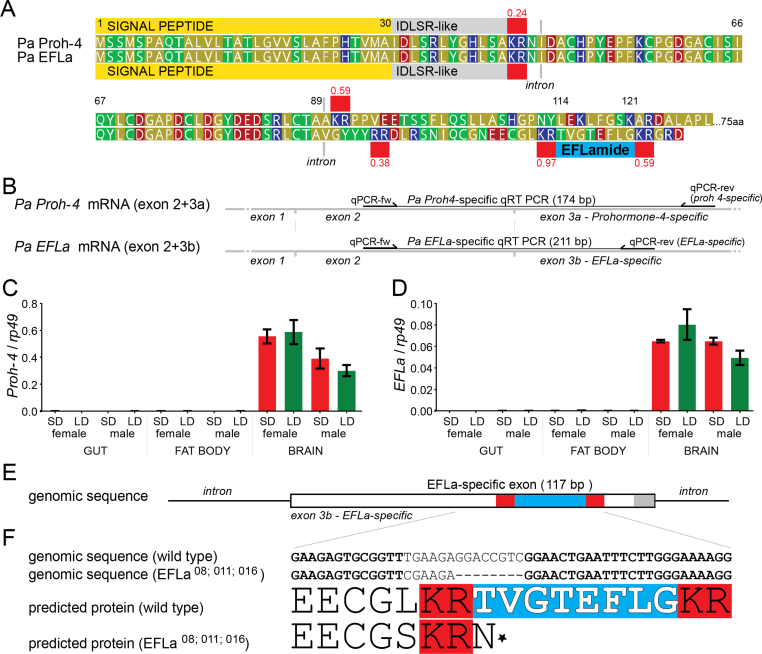
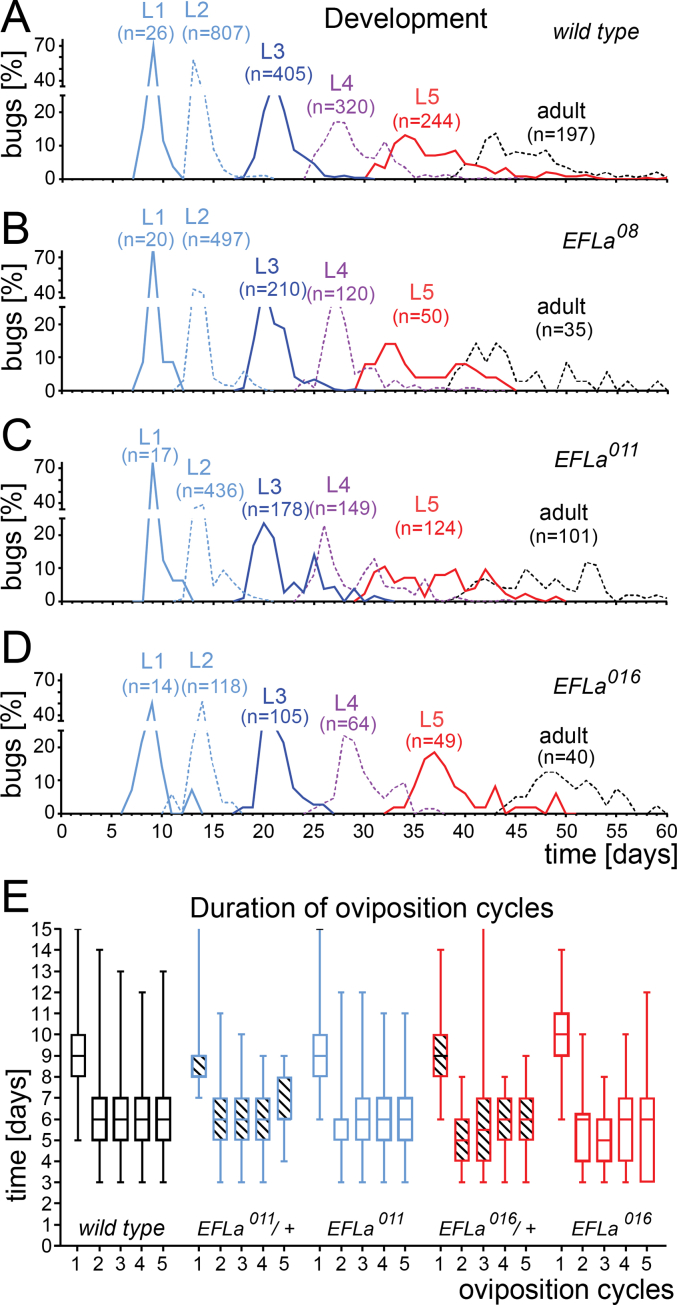
EFLamide (EFLa) is a neuropeptide known for a long time from crustaceans, chelicerates and myriapods. Recently, EFLa-encoding genes were identified in the genomes of apterygote hexapods including basal insect species. In pterygote insects, however, evidence of EFLa was limited to partial sequences in the bed bug (Cimex), migratory locust and a few phasmid species. Here we present identification of a full length EFLa-encoding transcript in the linden bug, Pyrrhocoris apterus (Heteroptera). We created complete null mutants allowing unambiguous anatomical location of this peptide in the central nervous system. Only 2-3 EFLa-expressing cells are located very close to each other near to the surface of the lateral protocerebrum with dense neuronal arborization. Homozygous null EFLa mutants are fully viable and do not have any visible defect in development, reproduction, lifespan, diapause induction or circadian rhythmicity. Phylogenetic analysis revealed that EFLa-encoding transcripts are produced by alternative splicing of a gene that also produces Prohormone-4. However, this Proh-4/EFLa connection is found only in Hemiptera and Locusta, whereas EFLa-encoding transcripts in apterygote hexapods, chelicerates and crustaceans are clearly distinct from Proh-4 genes. The exact mechanism leading to the fused Proh-4/EFLa transcript is not yet determined, and might be a result of canonical cis-splicing, cis-splicing of adjacent genes (cis-SAG), or trans-splicing.
EFLamide (EFLa) 是一种在甲壳动物、螯肢动物和多足动物中很早就被发现的神经肽。最近,在无翅六足动物的基因组中,包括基础昆虫物种,也鉴定出了编码 EFLa 的基因。然而,在有翅昆虫中,EFLa 的证据仅限于臭虫(Cimex)、迁徙蝗虫和少数竹节虫物种的部分序列。在这里,我们在榆绿毛萤叶甲( Pyrrhocoris apterus )(半翅目)中鉴定出了一个全长的 EFLa 编码转录本。我们创建了完整的 null 突变体,允许在中枢神经系统中明确确定这种肽的解剖位置。只有 2-3 个 EFLa 表达细胞彼此非常靠近,位于侧面原脑的表面附近,神经元分支密集。纯合 null EFLa 突变体完全存活,在发育、繁殖、寿命、滞育诱导或昼夜节律性方面没有任何可见缺陷。系统发育分析表明,EFLa 编码转录本是通过基因的选择性剪接产生的,该基因也产生 Prohormone-4。然而,这种 Proh-4/EFLa 连接仅存在于半翅目和蝗虫中,而无翅六足动物、螯肢动物和甲壳动物中的 EFLa 编码转录本与 Proh-4 基因明显不同。导致融合的 Proh-4/EFLa 转录本的确切机制尚不清楚,可能是由于规范的顺式剪接、相邻基因的顺式剪接(cis-SAG)或反式剪接。